







Martin Henry retweeted

Wow, this tweet went very viral!
I wanted share a possibly slightly improved version of the tweet in an "idea file". The idea of the idea file is that in this era of LLM agents, there is less of a point/need of sharing the specific code/app, you just share the idea, then the other person's agent customizes & builds it for your specific needs.
So here's the idea in a gist format: gist.github.com/karpathy/442…
You can give this to your agent and it can build you your own LLM wiki and guide you on how to use it etc. It's intentionally kept a little bit abstract/vague because there are so many directions to take this in. And ofc, people can adjust the idea or contribute their own in the Discussion which is cool.


LLM Knowledge Bases
Something I'm finding very useful recently: using LLMs to build personal knowledge bases for various topics of research interest. In this way, a large fraction of my recent token throughput is going less into manipulating code, and more into manipulating knowledge (stored as markdown and images). The latest LLMs are quite good at it. So:
Data ingest:
I index source documents (articles, papers, repos, datasets, images, etc.) into a raw/ directory, then I use an LLM to incrementally "compile" a wiki, which is just a collection of .md files in a directory structure. The wiki includes summaries of all the data in raw/, backlinks, and then it categorizes data into concepts, writes articles for them, and links them all. To convert web articles into .md files I like to use the Obsidian Web Clipper extension, and then I also use a hotkey to download all the related images to local so that my LLM can easily reference them.
IDE:
I use Obsidian as the IDE "frontend" where I can view the raw data, the the compiled wiki, and the derived visualizations. Important to note that the LLM writes and maintains all of the data of the wiki, I rarely touch it directly. I've played with a few Obsidian plugins to render and view data in other ways (e.g. Marp for slides).
Q&A:
Where things get interesting is that once your wiki is big enough (e.g. mine on some recent research is ~100 articles and ~400K words), you can ask your LLM agent all kinds of complex questions against the wiki, and it will go off, research the answers, etc. I thought I had to reach for fancy RAG, but the LLM has been pretty good about auto-maintaining index files and brief summaries of all the documents and it reads all the important related data fairly easily at this ~small scale.
Output:
Instead of getting answers in text/terminal, I like to have it render markdown files for me, or slide shows (Marp format), or matplotlib images, all of which I then view again in Obsidian. You can imagine many other visual output formats depending on the query. Often, I end up "filing" the outputs back into the wiki to enhance it for further queries. So my own explorations and queries always "add up" in the knowledge base.
Linting:
I've run some LLM "health checks" over the wiki to e.g. find inconsistent data, impute missing data (with web searchers), find interesting connections for new article candidates, etc., to incrementally clean up the wiki and enhance its overall data integrity. The LLMs are quite good at suggesting further questions to ask and look into.
Extra tools:
I find myself developing additional tools to process the data, e.g. I vibe coded a small and naive search engine over the wiki, which I both use directly (in a web ui), but more often I want to hand it off to an LLM via CLI as a tool for larger queries.
Further explorations:
As the repo grows, the natural desire is to also think about synthetic data generation + finetuning to have your LLM "know" the data in its weights instead of just context windows.
TLDR: raw data from a given number of sources is collected, then compiled by an LLM into a .md wiki, then operated on by various CLIs by the LLM to do Q&A and to incrementally enhance the wiki, and all of it viewable in Obsidian. You rarely ever write or edit the wiki manually, it's the domain of the LLM. I think there is room here for an incredible new product instead of a hacky collection of scripts.


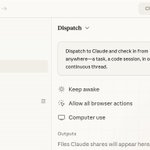
Is Dispatch supposed to be showing on Code tab? i still havent been able to get Dispatch working since last week. updated to latest desktop app and ios app but still nothing

2
48
Claude cowork dispatch stopped working and every time I prompt it I see my usage go up a couple percentage points. Seems like a bug @felixrieseberg

11
31
4,442


Martin Henry retweeted

Name your JavaScript exports! This ensures they'll show up named in DevTools and in compile time errors.

ALT Default export without any name export default() => { return <counter />; } Declaration Arrow Named export export function Counter() { return <counter />; } export const Counter = () => { return <counter />; } Default export export default function Counter() { return <counter />; } const Counter = () => { return <counter />; } export default Counter;
Martin Henry retweeted

Ever tried debugging an element that keeps disappearing when it loses focus once you start using devtools?
Well dang me to heck there is an "Emulate a focused page" option in @ChromeDevTools just for that 🤯
(you can get it from the [⌘]+[P] Command Menu, or Global Preferences)



Martin Henry retweeted

Studying to become #AWSCertified? I got you covered:
🚀 free AWS Certified Cloud Practitioner
youtu.be/3hLmDS179YE
🚀 free AWS Solutions Architect Associate
youtu.be/Ia-UEYYR44s
🚀 free AWS Developer Associate
youtu.be/RrKRN9zRBWs
Martin Henry retweeted

JavaScript tip: did you know you can listen for a *single occurrence* of an event using addEventListener? You can specify a configuration object as a third parameter.

Martin Henry retweeted
Fixing memory leaks in web applications: https://teapawt.net/t.co/gtn6DKu1cx ~ a guide to common causes of JavaScript memory leaks, how to identify and fix them 🌊🔧

ALT The DevTools Heap Snapshot tool allows you to take a memory capture of the main thread or web workers or iframes.
Martin Henry retweeted
JavaScript loading priorities in Chrome: https://teapawt.net/t.co/O3Qg2eYROJ ~ how do <script>, <script defer>, <link rel=preload> + <script async> & friends load then execute? Useful table.

Martin Henry retweeted

For Valentine's Day this year, we're asking you to help us give back. $15 would keep several people dry. $30 would buy water for a week of outreach. $110 gives socks to 120 people.
Please Venmo @ KtownforAll or you can also go shopping at tinyurl.com/ktownwishlist
Thank you 💜❤️

Martin Henry retweeted
Browsers can animate at least 4 things cheaply: position, scale, rotation & opacity. csstriggers.com/ is still useful for checking if CSS triggers re-layouts or reflows.

Martin Henry retweeted

Awesome summary of modules! If you thought my cheatsheet was useful, you won’t want to miss this short clip 👏👏👏

Take 104 seconds learn about #JavaScript (ES) modules and grab this awesome cheatsheet from @samantha_ming
#100SecondsOfCode
🎞️youtu.be/qgRUr-YUk1Q

Martin Henry retweeted

Are you using @Cypress_io?
I have a present for you: github.com/testing-library/c…
This will make your tests WAY easier to read and write and a lot more resilient. Bonus: your Cypress E2E tests will look a lot like your Jest integration/unit tests if you use @TestingLib there too!