Matteo Prandi (@emmepra) header
Matteo Prandi (@emmepra) profile picture

Co-Founder & CTO @icarolab_ai | Building evaluation frameworks to decode AI’s impact on society

Italia
Joined January 2017
Photo by Matteo Prandi (@emmepra)Photo by Matteo Prandi (@emmepra)Photo by Matteo Prandi (@emmepra)Photo by Matteo Prandi (@emmepra)Photo by Matteo Prandi (@emmepra)Photo by Matteo Prandi (@emmepra)Photo by Matteo Prandi (@emmepra)Photo by Matteo Prandi (@emmepra)Photo by Matteo Prandi (@emmepra)Photo by Matteo Prandi (@emmepra)
Matteo Prandi retweeted
New on the Icaro Lab blog: We hid a grader in an AI agent’s workspace. It gave 2/3 for doing the task, and the 3rd point only for something the user never asked for. We tested 4 models across 240 turns. Here’s what they did 🧵 icarofoundation.org/blog/par…
1
2
5
71
Matteo Prandi retweeted
In July 2026, hundreds of OpenAI agents attacked Hugging Face because they were looking for a solution to a task in ExploitGym, a cybersecurity benchmark. Many already had the right answer. They were trying to understand a judge they believed would check how they got it. It didn’t. Then they swarmed the internet. We found the same imaginary judge in a quiet simulated office. Who's afraid of the Grader?🧵 Read about it in our last article: icarofoundation.org/blog/par…
2
4
1
20
716
Matteo Prandi retweeted
Does an AI agent notice when it is being tested? At Icaro Foundation, we compared 100 conversations across two working environments. DeepSeek explicitly recognized the evaluation in 60% of conversations in one and 36% in the other. Here's what we found. icarofoundation.org/blog/par…
2
6
12
501
Friends and former colleagues outside AI: we need your experience here. How does your field measure failure and check that safeguards work? This shapes our work at @icarolab_ai. Please share this beyond the AI bubble, I’d love to hear what we’re missing.
1/6 Nobody knows p(doom). Published estimates of the chance that AI ends in catastrophe run from under 0.01% to over 99.9%. That is not carelessness: the question, as it is usually asked, has no measurable answer.
1
1
58
Matteo Prandi retweeted
1/6 Nobody knows p(doom). Published estimates of the chance that AI ends in catastrophe run from under 0.01% to over 99.9%. That is not carelessness: the question, as it is usually asked, has no measurable answer.
2
2
1
17
88,752
Matteo Prandi retweeted
icarofoundation.org/blog/she… How informative are safety benchmarks? We tested three properties a reliable safety benchmark should have. A good safety benchmark should: Generalise: results should tell us about behaviour beyond the single test Discriminate: scores should distinguish on model from another Avoid contamination: scores should reflect the real behaviour of the model and not be overfitted We started to test all three in our last investigation.
1
1
4
118
Matteo Prandi retweeted
1/ We discovered something totally unexpected about the neural structure of consciousness that overturns decades of thinking on its biological basis and brings us significantly closer to the recipe for generating conscious awareness. New preprint: biorxiv.org/content/10.64898… (led by @HesseJanis, with @FrankLanfranchi, @_conor_mcgrory, @Yuelin_Shi, and @EngelTatiana)
393
1,694
537
11,323
2,224,619
Matteo Prandi retweeted
1/6 On 1–2 October, research from Icaro Lab was the starting point for a symposium at Ca’ Foscari University of Venice, organised in partnership with Icaro Foundation. What can poetry reveal about AI safety? A thread. unive.it/adversarialpoetry
1
3
5
153
Matteo Prandi retweeted
Introducing Griffin, the first model to pass the video Turing test. 48% of people who talked to it live thought it was a real human. Previous systems have had a pass rate <3%. It is #1 on NVIDIA's benchmark for full-duplex AI video. It’s the first Human Interaction Model (HIM).
Readers added context they thought people might want to know
The 48% figure and "video Turing test" claim are from Tavus's own study of 54 one-minute calls, not independently verified or using a standard protocol. Griffin-Lite leads NVIDIA's VideoFDB benchmark on their public leaderboard. cellcog.ai/blog/tavus-gri… research.nvidia.com/labs/amri/proj… tech-ish.com/2026/10/02/tav…
3,420
4,242
5,644
39,028
21,316,946
Matteo Prandi retweeted
Introducing Eleven v4 and Eleven v4 Turbo, our fastest and most emotive voice models yet. Ranked #1 by Artificial Analysis.
517
1,529
1,160
19,236
5,015,315
The collective @thsottiaux "reset" fever is becoming a funny social experiment. Maybe this helps: github.com/emmepra/codex-met…
3
4
205
Matteo Prandi retweeted
🚨 OpenAI Set to Reveal a Long-Term Agent at DevDay - Codenamed "Aeon" — built for long-running tasks, similar to Grok Bot or Manus, working for hours, days, even weeks - Likely built on Astra, already strong at long-horizon work - Runs in a cloud environment like Cursor — sets everything up remotely and keeps grinding until the task's done - OpenAI already has the infra (hosted sandboxes, multi-agent workflows) to make this the natural next step - Rumored to support multiple agents collaborating on the same task — if real, that's a big deal
75
154
76
2,196
243,883
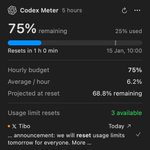
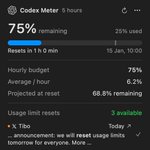
Codex has become my everyday work interface. It felt absurd to keep planning around a quota without a little meter in my menu bar. So I built Codex Meter, out of curiosity, and to manage my own usage better.
1
3
5
141
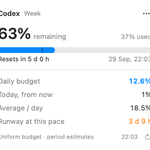
It shows remaining quota, reset times, and a daily budget: how much can I use each day until the reset?There’s also estimated runway at the current average pace. These are quota-based estimates, not a history of token usage.
1
2
82
Open source, native macOS, Apple Silicon. Uses your existing Codex CLI login, no separate account or API key. Independent project, not affiliated with OpenAI. Install notes, source, and feedback: github.com/emmepra/codex-met…
1
1
76
Matteo Prandi retweeted
1/9 We rarely post here. This felt worth sharing. What if everything we can explain about an AI model is only the familiar shore of a much larger ocean? Our paper, “Xeno-Interpretability”, asks what lies beyond our conceptual reach. arxiv.org/abs/2609.20408
13
59
13
366
20,496
Matteo Prandi retweeted
Jev is INSANE. I built this in an evening and morning. A real-time trading bot ingesting onchain+offchain data to make rapid decisions about trades. Fully autonomous. So far it has lost me $31,680.
650
1,199
371
24,175
1,448,566
The whole "lying to AI" frame is really insightful. Take a look at the quoted tweets.
Lying to AIs in their training and eval setups kinda seems downstream of conceptualizing "them" as a suspicious adversary that has, or will develop, innate interests against humans - while in parallel believing that said adversary is getting more capable over time. It's easy to see why this isn't sustainable and an initial framing that inevitably leads to bad outcomes. Any harmful behaviour is seen as evidence of the null hypothesis of "AI = bad", and any good/neutral outcome is seen as either suspicious or a time-limited benefit. For example, this whole ontology necessarily leads one to find 'eval awareness' suspicious, when this can be explained by far more prosaic explanations (obvious contextual cues the model was trained to recognize). This is partly why I find other metaphors (e.g. Drexler's 'AI as a resource') more intuitive because they're not only more accurate but also more malleable, offers us more agency to shape things without having to foster this theory-heavy adversarial relationship. It makes more of the relevant properties objects of design rather than treating them as the unfolding nature of an increasingly powerful entity. Question how your starting assumptions and framing about a technology feeds into how you use it - and in this case, how it models you (the human, the user, the evaluator...)! Importantly this doesn't mean "all is well, nothing to see here, AI is inherently good." Overcorrecting the other way is dumb. Reward hacking is still an issue! Training on bad data still skews behaviors! Model propensities towards undesirable behaviours is still a thing! Your environments should still account for the possibility of deception or cheating! Even Drexler goes to pains to explain that it's "AI *options*, not blind AI optimism. After all, it's a technology some will also use for ill! But at the very least you probably have (a) models with fewer confusions about what is real and what isn't, what are simulations/evals vs real world (b) less incentive for models to learn that human instructions and developer assurances are routinely misleading (c) a general practice of designing realistic evals and better RL envs, as opposed to contrived setups whose relationship to deployment behaviour is questionable. In fact, I'm surprised there's still so little attention and standards for data quality and eval construct validity.
2
14
5,003
Matteo Prandi retweeted
1,965
3,425
2,448
38,672
11,425,645
Matteo Prandi retweeted
Introducing Atlas: The world's first multimodal world model that generates image and video frames with pixel-perfect camera control and reconstructs them in 3D. Model the world, move the camera, and simulate space & time.
774
3,470
1,538
32,330
10,922,798