

The future of asset ownership is tokenization. Building on @MavrykNetwork
Joined January 2025
- Tweets427
- Following20
- Followers25.8K
- Likes1.1K




Equiteez retweeted

More than half of tokenized trading happens outside traditional market hours. 80% of tokenized equity trades are smaller than one share.
The market has already told us what it wants: always on, fractional, accessible.
Source: @IMFNews

"Just tokenize it" is how you get a token with a story attached.
Due diligence before issuance. Compliant structure at launch. Real secondary markets after. Distributions, reporting, and lifecycle management for years.
That's the unglamorous work most of this industry skips, and it's exactly the part we refused to skip.
Equiteez exists because tokenizing an asset was never the goal. Making it actually work was.

Equiteez retweeted
I own a basketball signed by the early-2000s Lakers. No certificate of authenticity. I’m 99% sure it’s real.
That 1% is the entire case for onchain provenance.

The @IMFNews' take on what’s slowing tokenized markets down: fragmentation.
Liquidity is split across too many networks and venues, which hurts price formation. A tokenized ecosystem's value grows with how many assets, investors, and settlement options it connects.
Isolated pools don’t scale. Equiteez is building to change that.

Equiteez retweeted
30 minutes to go.
The race to the first legal stock-token venue is on, and we have a lot of questions about that $90M.
🎙 @mv1_Davis with @micobz, Matthew Blom, and @ijhammer
xitter.cf/i/spaces/1nxeLMRQzZrJX…
Imagine this.
You own a slice of an apartment building in Lisbon. It's been paying you rental income every month for two years. Then life happens. You need cash in a week, not a quarter.
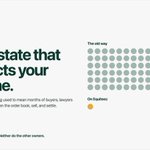
In the old world, selling 4% of a building is a slog. The other co-owners get first refusal, outside buyers rarely want a minority stake without a steep discount, and then come lawyers and closing. Months, if it happens at all.
In the tokenized version, you list your slice on the order book. When a buyer takes it, it settles onchain. The other owners don't need to sign off. You still need a buyer, but selling becomes a trade instead of a months-long process.
That's the entire pitch, honestly. Real estate that works on your timeline instead of its own.

Equiteez retweeted
Four years of posting about RWAs. The questions in our replies tell the story:
2022: What’s an RWA?
2023: Is this even legal?
2024: Where’s the liquidity?
2025: Who’s the custodian?
2026: Can I borrow against it? (yes, you can btw)
The race to the first legal stock-token venue is officially on. We know who we're listening to today.
2 PM UTC | 6 PM GST👇

Three weeks ago, nobody had filed under the SEC's tokenized-stock exemption.
Now two venues have. @Securitize is live with real votes and dividends. Tokenized stocks are the fastest-growing RWA category. And $90M left hardware wallets.
Today, 2 PM UTC | 6 PM GST:
- The race to the first legal stock-token venue
- Is RWA money rotating or getting wider?
- Self-custody after @Ledger
🎙 @mv1_Davis with @micobz (@ShiftRWA), Matthew Blom (@Tokinvest_Cap), and @ijhammer (@dltlaw_)

Your tokenized assets on Equiteez don't just earn; they can also borrow.
With @MavenFinanceDAO, you can collateralize your RWA tokens and unlock liquidity without selling, keeping your ownership, dividends, and upside intact.
Need capital? You no longer have to choose between your asset and your opportunity.
Sell nothing. Access everything.
Built on @MavrykNetwork

Equiteez retweeted

Maven 101: Oracles
Smart contracts can move millions of dollars without a middleman. But they have a blind spot: they can’t see anything outside the blockchain. A smart contract has no idea what BTC is trading at right now. Or the price of gold. Or what a commercial building is worth.
That’s where oracles come in.
An oracle is a service that sources real-world data, verifies it, and delivers it onchain so smart contracts can act on it. For a lending protocol, the most important data point is price.
Here’s why that matters:
→ Loans: how much you can borrow depends on what your collateral is worth.
→ Rates: pricing risk requires knowing the value of the assets involved.
→ Liquidations: when collateral drops below a threshold, the protocol acts. If the price is wrong, it acts at the wrong time.
Bad data has real consequences. In 2022, Mango Markets lost over $100M after a trader inflated the price of a thinly traded token and borrowed against it. The code worked exactly as written. The price feed was the weak point.
That’s why strong oracle design focuses on:
→ Aggregating data from multiple independent sources
→ Decentralized networks, so no single party controls the feed
→ Frequent updates, plus safeguards against stale or outlier prices
Real-world assets raise the bar further. BTC trades around the clock. A building might be appraised a few times a year. Bringing those assets onchain means oracles need to deliver valuations that are reliable, verifiable, and current enough to lend against.
The takeaway: a lending protocol is only as trustworthy as the data it runs on.

Tokenizing a building is one thing. Valuing it accurately enough to borrow against is the real challenge.
Great breakdown from @MavenFinanceDAO on why oracles matter so much for RWAs 👇

Maven 101: Oracles
Smart contracts can move millions of dollars without a middleman. But they have a blind spot: they can’t see anything outside the blockchain. A smart contract has no idea what BTC is trading at right now. Or the price of gold. Or what a commercial building is worth.
That’s where oracles come in.
An oracle is a service that sources real-world data, verifies it, and delivers it onchain so smart contracts can act on it. For a lending protocol, the most important data point is price.
Here’s why that matters:
→ Loans: how much you can borrow depends on what your collateral is worth.
→ Rates: pricing risk requires knowing the value of the assets involved.
→ Liquidations: when collateral drops below a threshold, the protocol acts. If the price is wrong, it acts at the wrong time.
Bad data has real consequences. In 2022, Mango Markets lost over $100M after a trader inflated the price of a thinly traded token and borrowed against it. The code worked exactly as written. The price feed was the weak point.
That’s why strong oracle design focuses on:
→ Aggregating data from multiple independent sources
→ Decentralized networks, so no single party controls the feed
→ Frequent updates, plus safeguards against stale or outlier prices
Real-world assets raise the bar further. BTC trades around the clock. A building might be appraised a few times a year. Bringing those assets onchain means oracles need to deliver valuations that are reliable, verifiable, and current enough to lend against.
The takeaway: a lending protocol is only as trustworthy as the data it runs on.
Equiteez retweeted
Goldman, Wells Fargo, Morgan Stanley, Citi, BNY, and State Street all said the same word in the same quarter.
Tokenization is the roadmap 🟠

Tokenization came up across Wall Street's Q3 earnings calls:
@GoldmanSachs: Solomon compared it to the shift to electronic trading, and Goldman already tokenizes real estate for some clients
@WellsFargo: tokenized deposits settling some cross-border payments in two minutes or less
@MorganStanley: tokenized assets move faster, and clients will need advice
@Citi: the part of its business it's most excited about
@BNYglobal and @StateStreet: building infrastructure for tokenized funds
And people still doubt tokenization?
Every venue that gets the green light makes the whole RWA market more legitimate, not just stocks.
Tune in Thursday, 2 PM UTC / 6 PM GST.
xitter.cf/i/spaces/1nxeLMRQzZrJX…
Regulators opened the door. Two venues walked through. $90M left hardware wallets.
Who wins the race to the first legal stock-token venue, and is RWA money rotating or just getting wider?
We unpack it on Thursday with @mv1_Davis, joined by
@micobz (@ShiftRWA), Matthew Blom (@Tokinvest_Cap), and @ijhammer (@dltlaw_).
🗓 Thursday, Oct 22, 2PM UTC | 6PM GST | 10AM ET

Equiteez retweeted
Mavryk ecosystem in one post:
- Layer 1 built for real-world assets.
- @equiteezdotcom: tokenize, offer, and trade.
- @MavenFinanceDAO: deposit RWAs and borrow against them.
- Non-custodial and smart-contract-based.
Tokenize. Trade. Borrow. Own.

A simple question we designed the platform around: if Equiteez disappeared tomorrow, what would our investors still hold?
Their claim on the asset. Each asset sits in its own legal entity, appraised before listing, with tokens legally tied to that entity and held in investors' own wallets.
We built Equiteez so your ownership doesn't depend on us.

Equiteez retweeted
A question nobody in finance wants to answer: if AI and robotics take over a big share of jobs, how does an ordinary person get ahead?
Some form of basic income might keep food on the table. It won’t build wealth.
We think the answer is ownership. When labor is worth less, assets are worth more. The people who come out ahead will own things that produce income: hotels, businesses, real estate, insurance pools.
Right now most people can own public stocks and maybe a home. That’s not enough for what’s coming.
Tokenization lets ownership open up to everyone, in small amounts, from anywhere. Not as a nice-to-have. As a necessity.

Tokenization came up across Wall Street's Q3 earnings calls:
@GoldmanSachs: Solomon compared it to the shift to electronic trading, and Goldman already tokenizes real estate for some clients
@WellsFargo: tokenized deposits settling some cross-border payments in two minutes or less
@MorganStanley: tokenized assets move faster, and clients will need advice
@Citi: the part of its business it's most excited about
@BNYglobal and @StateStreet: building infrastructure for tokenized funds
And people still doubt tokenization?
Equiteez retweeted
October at Mavryk: audits wrapping up, Bridge and Gas Station nearing production, and a week at Token2049 Singapore.
