

#CivicTech & Good Governance Research. #LandValueTax Stateside, #FairTax Nationwide, HSAs for All, #RegenerativeAgriculture, #BTC, #geolibertarian
Montana, USA
Joined April 2009
- Tweets1.9K
- Following2.6K
- Followers2K
- Likes16.2K





Pinned Tweet
Recent news from Michigan: (Dec 18, 2025), @RankMIVote announced they're pausing signature collection for their 2026 ranked-choice voting (RCV) constitutional amendment—short ~200k signatures with no late surge in sight and facing strong conservative opposition.
While I did support RCV for five years and now oppose the pursuit of RCV, I disagree with many of the reasons that are being touted by the likes of the Heritage Foundation. Election reform *is* necessary, but RCV is not the ideal solution.
RCV is most successful at eliminating the spoiler vote when 3rd- and 4th-place candidates have very little support to begin with. However, the more candidates that are in the race, or the more competitive the 3rd- and 4th-place candidates are, then the more likely that RCV will result in problematic results. When RCV is paired with top-four/top-five open primaries, it increases the likelihood of these problems with RCV because it sends four or five highly competitive candidates into the general election.
90% of the time, RCV doesn't run into this problem, but considering that 90% of the districts in America are largely safe and uncompetitive, that fact doesn't reassure me.
However, when RCV fails in competitive races, the backlash hurts the future of RCV and *all* types of election reform (see Alaska + present day).
Michigan, eleven states have banned RCV, and you now join the states of Montana, Idaho, Arizona, Nevada, Colorado, South Dakota, and Missouri who's voters do not support RCV. Alaska only kept their system of open primaries and ranked-choice voting by 737 votes.
Michigan, RCV has lost it's momentum. Continuing your pursuit becomes more costly every day, both in terms of money and effort.
As you regroup, I encourage you to not give up on voting reform. However, I urge you to pursue simpler, more intuitive reforms that empower voters without the pitfalls:
Least costly changes, yet powerful:
• Open nonpartisan primaries
• Top-2 Approval Voting: Voters approve as many candidates as they like in the primary; top 2 advance to general.
Will require more education and buy-in, but powerfully simple:
• STAR Voting (Score Then Automatic Runoff): Rate candidates 0-5 stars; top 2 scorers go to automatic runoff). STAR adds nuance in support while ensuring majority-backed winners.
These options are easier to understand, count, & trust. These options will have more support from clerks and admin, because they don't require centralizing the tabulation, don't exhaust ballots, are precinct summable, and require no changes to the ballot (approval voting). The above alternatives have also been shown to have even better results than RCV when it comes to reducing the mudslinging, eliminating spoilers, and electing candidates with true majority support.
(Read my full experience with RCV and suggestions for election reform in the comments👇)
#ElectionReform #MichiganPolitics #VotingReform
bridgemi.com/michigan-govern…

Eric Buhler retweeted

Many candidates are mudslinging in the run up to the #midterms. It’s embarrassing!
Did you know that candidates are incentivized to mudsling under choose-one voting? STAR Voting and Approval Voting are two voting methods that incentivize consensus-building! Try them for yourself: buff.ly/wWQ6dg9
I'm voting no on I-194. I know many of my friends will disagree. I understand the concerns, but I don't agree that this new constitutional theory that I-194 is using is sound, nor is it the right tool.
Plenty of people have made the case that it silences businesses, and I agree with them. But one concern I haven't seen people mention yet: who gets to enforce it.
It's true that individuals are exempt, and Montana already puts no limit on what an individual can give to a ballot issue committee. However, now there's a stark imbalance. A wealthy person, in state or out, can still bankroll a campaign against a local ranch, a logging operation, or a main street business, while the business under attack can't use its own resources to respond. The measure doesn't take the money out of politics. It takes the money of groups out and leaves the money of wealthy individuals in.
Each of these problems is serious on its own. Together, a sweeping ban, no safe harbor for small speech, constitutional concerns, and partisan officials deciding who gets targeted add up to a tool that's too easy to abuse. That's why I'm voting no on I-194.
I will however be voting YES on CI-132 and CI-133!
Eric Buhler retweeted

Editorial: Vote no on Prop. 40. It ignores education, housing and safety. Firefighters, teachers are all against this. Destruction of innovation and jobs latimes.com/opinion/story/20…

Closed Primaries disempower and dilute party affiliation. Same-party matchups are a feature of open primaries, not a bug:
"Here's the reality: more than 5.2 million Californians are registered with No Party Preference. Under a closed primary system, all of these voters would lose the ability to help choose candidates in taxpayer-funded primary elections. They wouldn't just have less influence. They'd have none, unless they registered with a party they don't actually belong to.
Most same-party general election matchups don't happen because independents are being shortchanged by the Top Two format. They happen because of how a particular district actually votes. A heavily Democratic district produces two Democrats in November because that's what the electorate there wants. A heavily Republican district does the same in reverse. That's not a flaw in the system. That's the system reflecting the voters who live there."
That being said, California's Top Two system still suffers from vote-splitting in the primary (as was the fear in the Governor race). A crowded field in the majority party can split the vote, causing same-party lockout of the MINORITY party, unreflective of that district. This problem does not require the repeal of California's current system. It only requires changing the primary ballot instructions from "pick one" to "pick all that you approve of." ✅✅⬜✅ The Top Two approvals move forward to the General Election. The winner of the general represents more than 50% of that district, with no spoilers along the way.
ivn.us/why-undoing-top-two-w…

Great news! The Missouri Supreme Court overturned a decision that Amendment 6 unconstitutionally included more than one subject. 👏🏼👏🏼👏🏼Amendment 6 will remain on the Nov ballot. Congrats to @RespectMOVoters

Missouri voters will decide limits on lawmakers rewriting ballot measures #moleg #mogov missouriindependent.com/2026…

👏🏼

Colorado Secretary of State candidate @celeste4sos supports Approval Voting and STAR Voting!
"For elected offices, such as Secretary of State, which are not part of an elected body, Celeste supports better single-winner voting methods, such as Approval Voting, ranked voting methods (Instant-Runoff Voting or Condorcet methods), and STAR (Score Then Automatic Runoff) Voting."
celeste4sos.com/priorities

"As two consenting adults, wanting to exercise freedom of food choice, we should be able to engage in a food transaction without asking a bureaucrat's permission. I mean, that's about as simple as I know how to make it. And you know if Trump really wanted to help systemically, he would get behind the PRIME Act." -Joel Salatin

I joined @JoelSalatin this past weekend in Virginia at his beautiful @Polyface_Farms. We discussed the current challenges American farmers are facing and some practical solutions.
Eric Buhler retweeted

“The danger now is that an administration led by avowed opponents of mail voting will find a means to suppress a great deal of it, with ordinary voters not even knowing what is happening,” says Cato’s @walterolson.
ow.ly/6JUI50ZIkup

Eric Buhler retweeted

There's a line in the song Big Yellow Taxi goes "You don't know what you've got 'til it's gone."
In Sept 2024, Norwegian residents found that out the hard way, discovering too late that Bitcoin mining had for years been keeping their power prices 20% lower.
When a Bitcoin mining operation left the grid, local power company Noranett instantly increased prices to residents, to compensate for the revenue shortfall.
The news was covered by government state owned media organization NRK (analogous to BBC)
Bitcoin mining has been found in multiple studies to be able to use energy that would otherwise be wasted, which contributes to lower electricity bills.
This is one of a number of cases where Bitcoin mining has direct lowered electricity prices. I'll be sharing some other documented cases this week.

Alaska Democrat just dropped out of gubernatorial race. Since Alaska started using ranked choice voting in 2022, candidates have been quitting after the primary in more than a dozen races to leave only one candidate from their side.
RCV was sold as the fix for spoilers. In practice, campaigns are clearing the field themselves, election after election, to avoid another Nick Begich failure case.
Meanwhile the same groups keep raising money (and excuses) to defend a system candidates are already working around.
This is why I advocate voting reform that ends with a top 2 runoff. Particularly the Unified Primary (Approval + Top 2).
Approval lets voters support more than one candidate, so similar candidates don’t split the vote in the primary.
Top 2 means the general is already one-on-one, so campaigns don’t have to make their own people quit after the primary.
And, best of all, the Unified Primary requires no changes to the ballot! share.google/tEdphL319NWcT34…

While I do not support repealing Alaska’s system just to return to plurality voting, there is clearly a problem here.
Campaigns should not have to thin their own field before or after the primary. If not a Unified Primary (Approval + Top 2), what is the clean fix that does not depend on candidates quitting?
RCV is not designed to shift the Overton Window to the left. RCV has a flaw, called the center-squeeze effect, that sometimes fails to elect the head-to-head winner. In Alaska this effect pushed out a preferred Republican in 2022, and elected the moderate Democrat with secondary broad support.
If RCV were used in Oregon, it could just as easily push out a preferred Democrat that wins head-to-head, and elect a moderate Republican with secondary broad support (then the Democrats would be saying that RCV is designed to move the overton window to the right).
RCV is not my preferred method, but 99.4% of RCV elections do not suffer this flaw in real elections. So, 0.6% of the time jurisdictions will have to suffer the secondary candidate.
In contrast FPTP can often elect the head-to-head loser. Electing this Condorcet Loser should be the Overton Window that is unacceptable to voters. There's so many better options.
Methods like RCV, STAR, Consensus Choice, and Approval all have the same design in common: reduce vote-splitting in order to elect a candidate preferred by most of that district...a true majority.
In FPTP, we're used to candidates catering to 30% of primary voters. So, a candidate who represents over 50% of the district might feel more left or more right than what that district is used to.

Eric Buhler retweeted
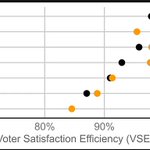
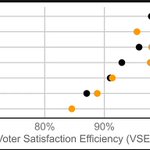
Fascinating that whether you're using 1000 STARs, 10 STARs, or 5 STARs, the results are practically identical.
STAR Voting should absolutely be taken seriously and adoption pursued.
What's also interesting is that when you add a Top 2 runoff to Approval, the results between STAR and Appoval are neck and neck. So, I think the simplicity of Approval cannot be overstated...for administrators and voters.
Seems wise to keep both STAR and Approval on the table depending on the district and the situation.
