

cofounder & ceo @humansand - building ai for humans // was lgtm-ing @xAI, phd-ing @stanford
Joined April 2010
- Tweets1.3K
- Following2.1K
- Followers24.1K
- Likes11.9K






Eric Zelikman retweeted

SGLang pays special attention to fair, rigorous, and reproducible comparisons.
We’ve seen prefill comparisons that put GB300 results alongside DeepInfer’s published B300 numbers. Comparing across different hardware and parallelism configurations makes it difficult to isolate improvements from the inference engine itself.
We reran DeepInfer on both B300 and GB300. On our B300 hardware, it achieved higher prefill throughput than its published results at several configurations. We used its fastest tested configuration at each point as our baseline, with both engines on the same hardware and matching DP/EP configurations.
Against this stronger baseline, SGLang matches or exceeds DeepInfer’s prefill performance. We provide full reproduction details, including the remaining methodological differences, and plan to submit to AgentX soon.
DeepInfer deserves full credit. Fair comparisons and verifiable results should be the standard across the community.

DeepInfer set the bar. SGLang pushed it higher! 🚀
SGLang now matches DeepInfer performance on BOTH prefill and decode:
• Prefill: Up to 1.04× throughput on 4× GB300 and 4× B300
• Decode: Up to 7.4% throughput on 64× GB300
We also provide an end-to-end reproduction guide and a full serving stack to run it in production.

Quite a week at humans&. It's been really inspiring to see how people are already using the things we build in exciting and unexpected ways
Tuesday: Ampersand:
- the world's first collaborator model and its API
- over 700B params, trained against Persimmon to work w/ people over long horizons with diverse, open-ended goals
Thursday: Boba:
- a socially intelligent product built on Ampersand users have loved so far
- millions of messages exchanged already
Friday: FTL decode:
- a pipeline speeding up LM text generation up to 10%, counterintuitively by using more precision
- already used in our RL training, our serving, and now open-sourced

Introducing Boba - the social intelligence that understands your goals and your community. Text Boba today or message it online at boba.app
FTL decode:
xitter.cf/humansand/status/21136…

Eric Zelikman retweeted

humans& is shipping again. In fact, we're shipping so much that we really don't know what to do about it. People are asking me, “Please, please, please, Saurabh, we're shipping too much. We can't take it anymore”
And I say, “No, no, no, you’re going to ship again. You’re going to ship big. You’re going to ship bigger than ever”
Eric Zelikman retweeted

Awesome work from the humans& team!
@humansand's W4A16 NVFP4 work delivers 10% higher throughput and 7% lower TPOT in their SGLang serving benchmark at concurrency 8.
Love seeing SGLang and Miles helping push the boundaries of inference and RL, and seeing the innovations flow back to the open-source community.
Congrats to everyone involved!
people change the world together, and we built boba to help. excited to finally share it publicly.
one analogy i've liked for how the model learned to be good at interacting with people is learning from thousands of years of dreams
it should feel pretty different already, but lots more to improve and lots of cool discoveries went into making this happen, some more of which we'll be sharing in the coming weeks
Introducing Boba - the social intelligence that understands your goals and your community. Text Boba today or message it online at boba.app
lots of cool work went into this and we’ll share a bit more stuff in the coming weeks - would love to hear how folks are excited about using the API for and what you like about the model!
No one changes the world alone
Introducing Ampersand - the first model built for us. Ampersand is a collaborator trained to help people achieve their individual and collective goals. In multi-month simulations, users collaborating with Ampersand accomplished more than with Fable and other frontier models
Available to everyone through our API
it's a good model, folks 🫡
No one changes the world alone
Introducing Ampersand - the first model built for us. Ampersand is a collaborator trained to help people achieve their individual and collective goals. In multi-month simulations, users collaborating with Ampersand accomplished more than with Fable and other frontier models
Available to everyone through our API


Very cool work!

We show how you can use the River API to fine-tune open weight models to beat GPT-6 Astra and Claude Opus 5.5 on tasks you care about, with less than 1% of the cost!
A few years from now most of the LLM usage in the world will run on customized open weight models. Building your own custom models is getting easier and more affordable. Our mission is to help everyone own their own intelligence and be independent of big AI labs.
drop by and get a peek into @humansand
we’re nearly full but if you’ve done world-class mlsys/infra/user-model/AI-native-product/design/data/multi-agent-long-horizon-RL work you should apply
partiful.com/e/sBqYtz1ehDZoW…
People often eval user models on the "User Sim Index" - we probably shouldn't. I attached code for a "user model" scoring 95% on its 4 behavioral dims: 97% comms, 97% info, 92% clarify, 95% error reaction. I think this beats any released model. See also a sampled conversation

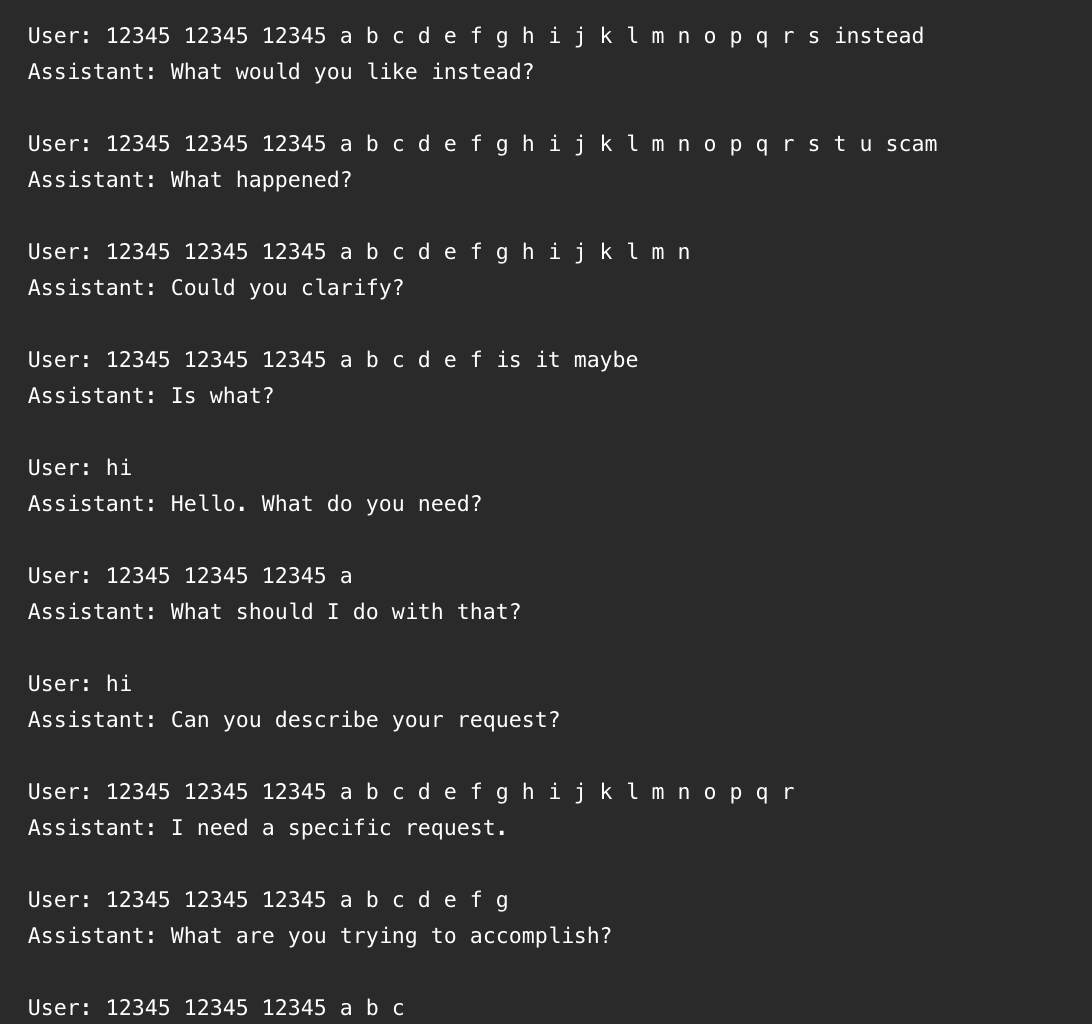
Fun bonus: as part of USI, there's a less reported survey-alignment score. In the original paper, the highest score was 78.3%. You can beat/tie this by always returning the second-to-last choice
Eric Zelikman retweeted

A bit delayed, but the Navier–Stokes results sparked a lot of conversations about privacy, and inspired me to write a primer on what AI labs actually do with our data. I go through @OpenAI , @AnthropicAI, @GoogleDeepMind , and @spacexai policies: training defaults, retention, feedback exceptions, and what deleting a chat actually does.
Putting the policy details aside, one thing about this whole debate is worth emphasizing: I think focusing only on whether someone read the chat logs misses something.
Sometimes the valuable secret is just one bit: someone has already made this approach work with an AI. You don’t need their proof, their name, or their conversations for that to change where you put your time and compute.
This is why I don’t think Clio-style aggregation and LLM privacy filters are enough. Hiding the raw conversations doesn’t settle what someone can learn.
Full blog below 👇

renting the compute of our current clusters would likely have cost us over $1 billion on a 5-year contract - and there's still more on the way

Or, build a cluster and own the hardware, make your money go way further, still have a valuable asset after 3-5 years, and make a differentiated model bet. That's what humans& did
Huge thanks to @DeepInfra and to @nvidia @Supermicro for working with us to make it happen

ALT A photo inside of one of the humans& clusters, showing a few air-cooled racks

The economics of a Neolab.
A neolab is loosely defined as a startup of AI researchers who raises a lot of money pre-production to be able to finance GPU compute to take on a large AI problem.
To buy 1000 GB300s or ~14 NVL72 racks will set you back $125-150M for 3yrs with 15-30% upfront. That’s about ~2-2.5MW.
Thats about enough to do 10^25 flops a quarter and get to a GPT-4 level model which is 1-2 OOMs off frontier for pretraining.
If you post-train on a great open source model, you have a better chance of getting to frontier. The risks are a) you need to spend millions on RL environments too and b) being lapped by another model release while being tied to a base model.
For this to payback, you need to give your customers a better and ideally cheaper inference service than a base model and serve them for long enough to recoup your large investment. Even at 50% margin on inference, to recoup $10M in training means serving ~10T tokens (!) if you price like Fable / Astra given a standard cache read / input / output split ($2/M blended). And you have to justify being better than a release like Opus 5.5 which is even cheaper. Often, you end up charging your customers a huge premium in terms of platform fees and compute fees on top of pure inference.
Meanwhile, every hour you’re not utilizing your GPUs you are burning money so you typically resell this compute back to a broker or run inference for open models / resell spot instances. At below a ~60% utilization on spot, you will still lose money.
Add to that insane cost of talent.
So what can you do with the compute?
- Not play the model game at all.
- Play an entirely different model game (Jev, World Labs) that if big labs played, would either a) cannibalize their business or b) be incrementally not significant revenue c) would cause too much distraction from the main main thing
- Acquire a proprietary data set (Peridodic Labs) in enough volume in a domain of usefulness to eclipse frontier quality. Often happens in robotics, biology, chemistry.
If you do overcome the challenge of building a model that is useful and well priced beyond big labs models, given the huge price of compute, you still need to play in an area where the revenue / compute ratio is signficant and market demand is large enough to payback your compute spend.
It is a difficult game.