

Linguistics, brewing, early music and cybersecurity. Foghlaimeoir teanga na Gaeltachta; tháim ag foghlaim Gaeilinn na nDéise. https://teapawt.net/t.co/ip364WOpeN
Gaillimh / Tiobraid Árann
Joined May 2010
- Tweets1.6K
- Following1.9K
- Followers600
- Likes3.2K


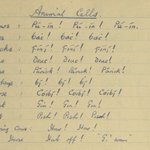



For anyone interested, Áine Uí Fhoghlú's 2004 UCC MPhil thesis "An briathar mí-rialta i nGaeluinn na nDéise" is now publicly accessible and well worth a read!
cora.ucc.ie/items/e95a65e5-0…
Scholars of Early Gaelic and Proto-Celtic, the publications of Kim McCone are being digitised and uploaded to his new website for free download. Quite a bit there already and looks like there's more to come!
kimmccone.org/


Duolingo has responded about its decision to replace the native speaker audio with the poorly pronounced TTS audio for its Irish course. Looks like they aren't planning to reverse this decision.
reddit.com/r/languagelearnin…
Interesting point in the latter half of this paragraph on Classical pronunciation, giving more insight into the nature of lengthening/diphthongisation of short vowels in Munster Irish when preceding fortis sonorants only when the sonorant is in the coda position of the syllable.

1
197
A lovely performance of Blind Blake's "Police Dog Blues" by Muireann Bradley at the Sligo Live Festival. Very impressed!
youtube.com/watch?v=hwnZlR7w…
132
Upon reflection, I've decided not to proceed in this Twitter thread format for various reasons. Instead, I've started a new blog! This will allow me to be much more detailed and I can easily make corrections and add new content (like audio files).
gaoidhiling.wordpress.com/

Introducing Developments in #DéiseIrish
1/ Introducing a new series of threads delving into the historical phonological and morphological developments of traditional Déise Irish. We'll explore the dialect that once spanned all of Waterford and parts of Tipperary.
Here's the introductory post redone in the new blog format:
gaoidhiling.wordpress.com/20…
1
165
Developments in #DéiseIrish #1
1/ Today, I'm focusing on the pronunciation of final broad ⟨-dh⟩/⟨-gh⟩ as seen in nouns like "biadh", "ogh" and "ordughadh". Also in the terminations of verbal forms like "do bhrisfeadh (sé)", "d'imtheóghfadh (sé)" and "do dúnadh".
Introducing Developments in #DéiseIrish
1/ Introducing a new series of threads delving into the historical phonological and morphological developments of traditional Déise Irish. We'll explore the dialect that once spanned all of Waterford and parts of Tipperary.
Introducing Developments in #DéiseIrish
1/ Introducing a new series of threads delving into the historical phonological and morphological developments of traditional Déise Irish. We'll explore the dialect that once spanned all of Waterford and parts of Tipperary.
An bhfuil "Sgéalaidhe Oirghiall: .i. sgéalaidhe Fearnmhuighe agus tuilleadh leis" le Seosamh Laoide ag aon duine? Táim ag tnúth leis na nótaíbh a bhaineann leis an gcanúint féin.
1
1
189


@ChronHib Surely you must have some thoughts on that recent article claiming that the origins of Goidelic began some 4,500 years ago. Is there any linguistic evidence to support these claims? You postulate something closer to 200-100 BCE, correct?
irishnews.com/news/northerni…

2
2
491
My first (Renaissance) recorder + music arrived today to feed my passion for early music. Fun times ahead!

1
6
250


One of the few recordings available of the last native Irish speakers of Tipperary. Séamus Ó Maolchathaigh helped document the linguistic features of the dialect, showing some of the features that were different from Waterford Irish.
youtu.be/7Q_A0bEpZy0
Lol! Looks like somebody was reading too much O'Donovan. It's a shame that the English page doesn't get updated more often to correct errors like this.
nualeargais.ie/gnag/gram.htm

1
222