

Assistant Professor @unimib, interested in Social Cognition and Learning
Joined October 2019
- Tweets214
- Following217
- Followers143
- Likes262
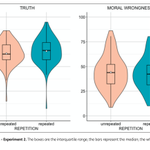



In a new paper published in PSPB, we show that immoral behaviors lead to stronger inferences about a target’s negative ability than inable behaviors do about negative morality - an asymmetric Horn Effect.
w/ @MarcoBicocca, Marcos Dono, and Alex Koch
researchgate.net/publication…

Simone Mattavelli retweeted

Our new work published in PSPB shows the primacy of morality in generalizations between social-evaluative dimensions.
@essematta Alex Koch, Marcos Dono @SPSPnews @unimib @ChicagoBooth
journals.sagepub.com/doi/10.…

New paper published in Memory & Cognition: We found that the Illusory Truth effect is greatly reduced - almost eliminated - when information is questioned rather than affirmed. w/@matteomotte and Claudia Bianchi
researchgate.net/publication…

Worth repeating: "Repeating statements increases source credibility".
Here is a free-to-access version of our paper on it.
researchgate.net/publication…


Our new paper published on PSPB shows that repeating statements increases source credibility
journals.sagepub.com/doi/abs…
@essematta Christian Unkelbach
@SPSPnews

New preprint out 🚀, w/ @MarcoBicocca and Christian Unkelbach.
We showed that repetition doesn’t just make statements seem more truthful - it also boosts the credibility of the source delivering them. 🧵
researchgate.net/publication…

Experiments 2-4 addressed procedural concerns by showing a 'generalized' effect: repetition-induced source credibility extended to truth judgments about entirely novel statements attributed to sources previously associated with repeated (vs. new) statements.
Simone Mattavelli retweeted
Our new paper published in PSPB shows the importance of multimodal cues for impression updating
w/Matteo Masi, @essematta, @fabiofas17
@unimib, @SurreyPsych, @SPSPnews
journals.sagepub.com/doi/10.…
Simone Mattavelli retweeted

New research helps us understand how we form and change our opinions about people in everyday life, where we often encounter multiple types of information about others.
✍️: Matteo Masi, @essematta, @fabiofas17, and @MarcoBicocca
Read more in #PSPB: ow.ly/NsU850ThuKY

ALT A person's face is show, blurred, in front of a black background.
What are the consequences of positive stereotypes exposure?
Our new paper, published in @irsp_rips, addresses this question.
w/ Claudia Bianchi, @MarcoBicocca, and @matteomotte
rips-irsp.com/articles/10.53…

Rejected after minor revision

The most peculiar way to lose a pole vaulting Olympic competition.
Athlete Anthony Ammirati, #today.
xitter.cf/i/status/1819765194244…
New preprint w/ @JerBena, @opatcorneille, and Christian Unkelbach on the "truth effect" and political communication!
researchgate.net/publication…

On target evaluations: Praises repeated more often led to more favorable evaluations of targets, while repeating derogations had a lesser (negative) impact.