






What’s the best way to run DeepSeek-V4.1-Flash on 4 DGX Sparks?
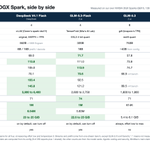
As I see it, there isn’t one answer. It depends on what you need. One fast user/agent, or many at once? Huge documents? Long agentic sessions? Original weights, or compressed? We needed these answers to figure out the optimal stacks for our CVE pipelines. So we took six community recipes, ran each exactly as its author serves it on the same four Sparks, and measured them all the same way, to see what each one is best at.
Quality first: on our tests it’s level. All six pass 71 of 75 qeval tasks and find every passphrase hidden in a 1M-token prompt, compressed weights included. So the choice comes down to how you use it:
@bertholomusai (TensorFold, 4-bit EXL3): the fastest single user (77 tok/s), the quickest reply while someone else’s long prompt is being read (0.9 s), and 16 full 1M-token sessions at once.
@Tech2Wild (TensorFold, 3.5-bit EXL3): the fastest coding for one user (134 tok/s), and the most memory left free on each node.
J-M-Recipes, @JamesMeadlock (vLLM on @christopherowen’s fork, original weights): the most users at once (32 seats, 288 tok/s with 16 users), quick replies during long reads (1.1 s), and 11.5 full 1M sessions. In our long-session agent tests it started the next turn fastest.
@majewskizby (SGLang, original weights): the fastest at reading huge documents, 1M tokens in 3.4 minutes.
@MiaAI_lab (TensorFold, original weights): 16 full 1M sessions at once on the original weights.
@MiaAI_lab (SGLang, original weights): the production line @majewskizby’s profile builds on.
Medians of three runs, temperature 0, thinking off, on an NVIDIA SN3700 switch.
All credit to the authors: these are their recipes, we only ran and measured them. Kudos for publishing them openly, with every setting, patch and number needed to reproduce them, and for the speed you ship at.
Fun note: several of these releases are days old. You also share fixes with each other: tonyd2wild’s RDMA patch is what got bertholomus’s engine running on our network, and @majewskizby’s MTU fix landed in Mia’s recipe this morning. You’ve made a model this size practical to run on four desktop boxes, and our CVE work now runs on it - thank you!

Me neither! I've been testing moving targets over the past week or so, and other than Minimax, these are my favorite right now, for a 4/6 DGX switched setup:


Nice numbers. What’s the setup? How many Sparks, which engine and weights (original or a quant), how many streams for the 380, and how long a prompt for the 17.5K prefill, cold or cached? We’re at 289 tok/s at 6 streams and 6.3K cold prefill on 4 Sparks, original weights.
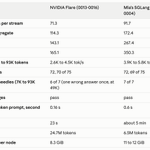
Mean of 8 task types (code, json, prose, math...). 1 stream: code 96 vs 122, prose 52 vs 71, math 83 vs 112 tok/s, Flare vs Mia SGLang. Temp 1, thinking off.

I would not jump to conclusions yet, but hopefully my data is solid and it gives a general baseline.
DeepSeek-V4.1-Flash-1017 (552B MoE, native MXFP4 experts / FP8), TP4 over 4 DGX Sparks. NVIDIA’s Flare vs MiaAI-Lab’s SGLang lane, same weights.
Yes. Same 4 Sparks, 1017 native weights, temp 1, thinking off. KV 24.7M vs 6.5M tokens, start 23 s vs ~5 min. But decode 71 vs 92 tok/s at 1 stream, 114 vs 172 at 4, 165 vs 350 at 16, prefill 2.6-4.5K vs 3.9-5.8K. qeval a draw (72/70 vs 72/69).

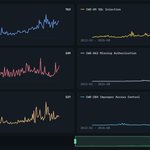
August 2026: 12,275 CVEs published in one month.
That's almost double the 12-month average of 6,256, and the average is climbing too.
If your triage process was sized for 2023 volumes, it's already underwater.
The fastest-growing bug class since 2023 is missing authorization: code that works fine but never checks who is asking.
613 of those CVEs in August alone.
That's also when AI coding tools went mainstream.
Coincidence is doing a lot of work here.
exploit-intel.com/stats


We've been doing this for a while, watching the process is like watching hours of potential frustration pass by as a timelapse. exploit-intel.com/blog/

100% with you on that. Wassenaar popped up first in my head, as that was my churn with 0day back in the day. The argument is not about full disclosure, but some sense of responsibility and self preservation when dealing with what others sometimes call a "weapon".
Agree with the sentiment, but no - you can't 'do whatever you please' with a 0-day just because the exploit is your IP. e.g. - Wassenaar puts strict export controls on intrusion software. Violate it and you can go to jail.
This may help - we actually find that a large portion of existing vulns have an incomplete patch, or more similar vulnerabilities in nearby code...
exploit-intel.com/blog/posts…
