

posting animals that have gone extinct in the Holocene ~ no AI, all images Public Domain or Creative Commons
The 6th Mass Extinction
Joined September 2026
- Tweets99
- Following23
- Followers13.6K
- Likes199




SURVIVOR SUNDAY
The Miller Lake lamprey (Entosphenus minimus) is the smallest parasitic lamprey, and native only to the Miller Lake drainage in Oregon. It was presumed extinct in 1958 after fisheries attempted to eradicate it to protect non-native trout populations.
1/2

ALT Brandon Swanson, Oregon Public Broadcasting

St. Croix Racer
(Borikenophis sanctaecrucis)
~ lives in: St. Croix, U.S. Virgin Islands
~ cause of decline: deforestation, invasive mongoose
~ last record: 1898
~ status: critically endangered (possibly extinct)
📸: Puerto Rican Racer (close relative), inaturalist.org/photos/89430…

Franklin's Bumblebee
(Bombus franklini)
~ lives in: 190 miles in Northern CA and southern OR
~ cause of decline: diseases from commercial bumblebees, habitat degradation, pesticides
~ last record: 2006
~ status: critically endangered (possibly extinct)
📸: James P. Strange

Red-Bellied Gracile Opossum
(Cryptonanus ignitus)
~ lived in: Jujuy, Argentina
~ cause of decline: deforestation of only known habitat
~ last record: 1962
~ status: extinct
📸: C. agricolai (close relative), by Thomaz de Carvalho Callado

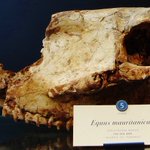
North African Zebra
(Equus mauritanicus)
~ lived in: North Africa
~ cause of decline: aridification
~ last record: 4000 BC
~ status: extinct
📸: commons.wikimedia.org/wiki/F…

Snail-Eating Coua
(Coua delalandei)
~ lived in: Île Sainte-Marie off the coast of Madagascar
~ cause of decline: complete deforestation of Île Sainte-Marie, over-hunting, decline of snails due to invasive rats
~ last record: 1834
~ status: extinct
📸: Nicolas Huet

SURVIVOR SUNDAY
The Hispaniolan solenodon (Solenodon paradoxus) is a venomous, nocturnal insectivore. It's also one of the last two endemic terrestrial mammals of Hispaniola.
In 1981, it was declared functionally extinct. Now it's Least Concern.
📸: Pedro Genaro Rodriguez
1/3

Solenodons are a unique family of mammals. 73 million years ago, they diverged from shrews, moles, and hedgehogs.
In the last 500 years, two solenodon species went extinct. Now there are just the Hispaniolan and Cuban solenodons.
📸: commons.wikimedia.org/wiki/F…
2/3


Hispaniola monkey
(Antillothrix bernensis)
~ lived in: Dominican Republic, Hispaniola
~ cause of decline: unknown
~ last record: c. 1850 BC
~ status: extinct
📸: First skull of Antillothrix bernensis, an extinct relict monkey from the Dominican Republic (Rosenberger et al)

Extinct Animal of the Day retweeted

No black-footed ferrets found in Meeteetse, 40 years after a rescue saved the species apnews.com/article/blackfoot…

Marcano's Solenodon
(Solenodon marcanoi)
~ lived in: Dominican Republic
~ cause of decline: likely invasive rats; possibly deforestation and introduced cats and dogs
~ last record: after 1492
~ status: extinct
📸: Solenodon paradoxus (close relative), by Glover M. Allen

Gerson's Hispaniola Tortoise
(Chelonoidis gersoni)
~ lived in: Southern Hispaniola
~ cause of decline: overhunting
~ last record: ~8000 - 5800 BCE
~ status: extinct
📸: red-footed tortoise (close relative), by Wikimedia user H. Zell

Extinct Animal of the Day retweeted

Someone bring him back please


Hispaniolan Island-Shrew
(Nesophontes zamicrus)
~ lived in: Hispaniola
~ cause of decline: likely invasive rats
~ last record: 1400s
~ status: extinct
~ smallest known non-volant endemic Caribbean land mammal
📸: Nesophontes edithae (close relative), commons.wikimedia.org/wiki/F…

Haitian Woodcock
(Scolopax brachycarpa)
~ lived in: Haiti, possibly all of Hispaniola
~ cause of decline: unknown
~ last record: 400 - 1400 CE (possibly lived into the 18th century)
~ status: extinct
📸: Eurasian Woodcock (close relative), by JJ Harrison

Hispaniolan Four-lined Skink
(Spondylurus haitiae)
~ lived in: Jérémie, Haiti
~ cause of decline: invasive mongooses and rats, deforestation
~ last record: 1857–58
~ status: critically endangered, likely extinct
📸: Spondylurus nitidus (close relative), commons.wikimedia.org/wiki/F…


