

I help Web3 companies build the right structure | CLCO 4+ Ventures
My newsletter 👉
Joined October 2011
- Tweets3.8K
- Following941
- Followers1.3K
- Likes832






Pinned Tweet
Hey builders/founders 👋, Frederik here
Looking to connect with people building in:
- Web3
- AI
- Tech
Drop 👋 and let's connect.
#connect #buildinpublic
Both bitcoin:native and ethereum:native are selling off.
The market is illiquid now at the weekend, so the question is if this is front running something or not.

Good Morning!
Saturday is a quieter day. A day for reflection. A day to catch up. So let us use it to grow together.
I am looking to connect with people in:
- Web3
- AI
- Tech
Let's #connect!
Good Morning!
Let us make this Friday a day when we connect with each other!
I am looking to connect with people in:
- Web3
- AI
- Tech
Let's #connect!
I think people have misunderstood Strategy and other Bitcoin treasury companies.
Bitcoin's price is back above what they paid. Yet they've stopped buying.
That should tell you something important. This was never about the Bitcoin price.
They are waiting for something else.
The flows, from Glassnode:
👉 At the peak, treasury companies absorbed about 147,000 BTC in a single month
👉 Through 2026, the monthly figure shrank
👉 For the last three months, it is close to zero
Their aggregate cost basis has gone flat, which is the same fact told differently
A separate dataset agrees. River has businesses going from +115,000 BTC in the second quarter to −2,000 in the third.
Here is what actually changed.
The model was never a bet on Bitcoin. It was a financing structure. When your shares trade above the value of what you hold, you issue stock, buy coins, and every existing shareholder ends up with more Bitcoin per share than they had before. The premium pays for the purchase.
Below that line, the same transaction runs in reverse. Issue shares at a discount to buy coins, and you destroy Bitcoin per share. The machine doesn’t just stop. It starts working against the people it was built for.
Only 4 of the 20 largest treasury companies now trade above that line.
You can see it in the filings. In the first four days of October, Strategy bought 334 Bitcoin for $28.7m — and spent about $176m buying back its own preferred shares.
Six times more on repairing the capital structure than on the thing the company exists to do.
It has since paused purchases for two weeks running. Sequans sold its last 314 coins and left entirely.
So the chart isn’t a story about conviction, or about Bitcoin being expensive.
It’s a story about one number.
The premium

Good Morning!
What a new lovely day to get new friends here on X!
I am looking to connect with people in:
- Web3
- AI
- Tech
Let's #connect
A hundred crypto projects shut down this year.
They raised about $1b between them.
They earned $250m — over their entire lifetimes.
The details, from DefiLlama’s research:
👉 100 shutdown announcements in 2026, 40 of them in a single 90-day stretch
👉 About $1b raised collectively
👉 About $250m in cumulative fees, across every year each of them operated
👉 Nine raised more than $50m on their own
The most common reason given for shutting down:
1️⃣ no product-market fit
2️⃣ money running out
3️⃣ revenue that never arrived
Twenty-five cents of revenue for every dollar raised, and that’s the lifetime figure, not an annual one.
Among them:
Blast, which took in more than $2b in deposits before deciding it had no credible path to economic viability.
Balancer. Radiant Capital. Neon EVM. Step Finance.
Now the part that should worry you more than the arithmetic.
That number is an undercount.
Shutting down properly takes two things: Somebody with the authority to decide it’s over, and the decency to say so in public. Plenty of projects have neither. They don’t close. The contracts keep running, the website stays up, the Discord goes quiet, and nothing is ever announced.
So this isn’t a count of failures. It’s a count of announcements.
Which means the hundred projects that told you are the honest end of the distribution.
A hundred projects said they were finished.
They raised $1b and earned $250m.
The ones still running aren’t necessarily doing better. They just haven’t said so.

Good Morning!
All my existing and new friends here on X.
I am looking to connect with people in:
- Web3
- AI
- Tech
Let's #connect
Do you remember when you joined X?
Me? 15 year ago today, and X was kind enough to remind me.
For most of this time, my account has been more or less unused.
15 years from now, it will be different. So let us build and connect.
#MyXAnniversary

Ethereum holds the funds; Tron moves them.
The total stablecoins supply is around USD 300bn, supplied across 47 chains. USDT and USDC make up around 85% of the total.
Here is the interesting division:
✅ Ethereum has 54% of the supply, but 15% of the volume
✅ Tron has 31% of the supply, but 73% of the volume
So, simply put: Ethereum holds the dollars. Tron moves them.
This comes down to different use cases.
Tron is increasingly acting as a settlement layer for individuals. Ethereum is the blockchain institutions use to hold stablecoins.

Good Morning!
It is so rewarding to connect and interact with people here on X.
I want to connect with more people in:
- Web3
- AI
- Tech
Let's #connect

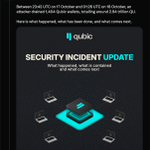
On Sunday, another blockchain was switched off. Not because it died, but because the people who run it decided to stop it.
It is still stopped.
Another exploit, or "security incident".
A fixed group of operators will now vote on who gets the stolen money back.
What happened on Qubic:
👉 17 October, 23:42 UTC: an attacker starts draining wallets
👉 18 October, 01:26 UTC: it ends, 104 minutes later
👉 1,404 wallets emptied, about 2.94 trillion QU, roughly $1.3m
👉 The chain is halted at a specific tick and has not restarted
The cause wasn’t cryptography. The attacker didn’t break in. He regenerated the keys.
Qubic says 87.1% of the funds never left the network and are frozen in place. The other 12.9% went to MEXC, which froze the receiving account within the hour.
Now the interesting part.
Qubic doesn’t have miners or ordinary validators. It has Computors: a fixed set of operators who process transactions and vote as a quorum. They stopped the chain. They will vote on the recovery plan. They will decide what happens to the frozen balances.
You can read that two ways, and both are true.
✅ It’s the fastest, most effective incident response of the year. The money is still there. Almost nothing escaped. Try that on a chain where nobody can agree to do anything.
✅ It also means the ledger was final until the people who run it decided it wasn’t, and that the ownership of 2.94 trillion tokens is now a governance question rather than a legal one.
This is where I think we are heading. So far in 2026, there have been around 650 incidents, and about USD 2.68bn has been drained. This is not sustainable.
The argument about whether a stablecoin issuer should be able to freeze a balance, or a chain should be able to reverse transactions, is lost.
The immutability has ended. There will be some exceptions, but this is the territory we are in.
The question was never whether anyone can reverse a blockchain. It’s who, under what process, and what you do if you disagree with them.
The chain stopped at tick 85,371,949.
The money is still there.
Whom it belongs to is now a matter of votes.

Good Morning!
I am looking to connect with people in:
- Web3
- AI
- Tech
Let's #connect
Having reached 1,000 followers I still mostly post into nothingness.
Engagement with others is still the way to go.
Good morning!
A friendly reminder to builders and founders that you should focus more on marketing and distribution than on building the product.
Frederik Lund retweeted
Good Morning!
I just reached 1K followers!
To me, this is surreal. I have had an account here for ages, but never taken the platform seriously - until now.
I am grateful for all of you that I have connected with here on X. I hope many meaningful relationships will be built.
Let us #connect

Good Morning!
I just reached 1K followers!
To me, this is surreal. I have had an account here for ages, but never taken the platform seriously - until now.
I am grateful for all of you that I have connected with here on X. I hope many meaningful relationships will be built.
Let us #connect