

Public health strategist decoding urban health & NCDs in Asia. Nutrition, Health, policy & climate—evidence-backed, actionable, real-world impact.
Joined November 2009
- Tweets10.4K
- Following284
- Followers882
- Likes2.1K






Pinned Tweet
This is me, and this is what I've spent my career fighting for.
Cleaner air. Better food. Healthier cities. A planet we can actually live on.
None of it happens alone. If any of this resonates, join me — let's amplify the impact together. 🌏

Every monsoon, Mumbai and Bengaluru go underwater. Every November, Delhi chokes on smog. And every year our city corporations show up with ex-gratia cheques, NDRF boats and “high-level meetings.”
This is not disaster management. This is paying for the same failure again and again, with our taxes and our lives.
Odisha brought cyclone deaths down from thousands to dozens by preparing before the storm. If one state can do it, every city’s excuse is pure negligence.


The purpose isn’t to create a scandal. It’s to break an illusion.
I found this on my bed of a 5-star hotel (Global Brand) in a major city in Asia. I informed the staff, who changed my room and apologised.
But the question remains: Can we take cleanliness for granted, even in 5-star hotels?
Has this happened to you? What did you do?


The point wasn’t to shame or blame anyone. It was to show where poverty and helplessness can push people.
Less than a foot of space to stand. One slip, and a life is lost.
Our cities should give people safety, dignity and space to live and work.

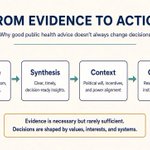
Evidence alone rarely changes decisions.
A study of 91 legal cases in China offers a useful lesson for public health.
When people resisted socially responsible advice, successful lawyers did not simply give them more evidence.
They connected the advice to the person’s own values and sense of responsibility.
Public health faces the same challenge.
We often ask:
“What evidence will convince them?”
Perhaps we should also ask:
“What values can make the right decision feel like their decision?”
Here is my take:
Good evidence tells people what should be done.
Good leadership helps them see why doing it is consistent with who they want to be.
That may be the difference between a good policy on paper and action in the real world.
Can we apply this to air pollution challenges in Asia?
#PublicHealth

A crane enters the tracks. A train crashes into it.
Where was the emergency warning system? Why wasn’t the track intrusion detected?
Automation can improve safety—but only when detection, fail-safe mechanisms and human oversight work together.
In injury prevention, who is accountable when every layer fails?
Knowing something is bad for you doesn’t always make you stop.
Food, tobacco, alcohol — the evidence may be clear. But habits, comfort, identity and social pressure shape our choices.
People don’t change just because they’re told what’s wrong. They need reasons, support and an environment that makes healthier choices easier.
What comes to your mind first: when you see ultra-processed food, tobacco or alcohol?
🤖 Made with AI

Indonesia’s fires. Delhi’s smog. North India’s toxic winter air.
Different sources. Same political question: who profits, who pays, and who escapes accountability?
Children breathe it. Workers endure it. Families bear the health costs.
Clean air should not depend on whose interests governments choose to protect.
🤖 Made with AI

In the past 20 years, Asia-Pacific lost 682,000 km² of forest.
Human expansion now threatens ~75% of Asia’s terrestrial protected areas.
We call this “development.”
But forests protect human health too: cooling, clean water, flood protection, livelihoods and mental wellbeing.
Who gets the profits from this model of development? AND who pays the cost of this development?
Delhi’s peak-season air has barely improved since 2016.
The only thing that’s grown is our outrage.
And in Jan–Sep this year, the months nobody tweets about smog, the air was worse than last year.
Pollution works 12 months a year. We protest for 3.
333,470 respiratory infections reported in areas affected by Indonesia’s fires.
The women, children and older people breathing this smoke didn’t start the fires.
Last year the world spent $2.9 trillion $ on militaries and the largest food aid agency on earth, got $6.5 billion only. It is less than one day of military spending.
The easy conclusion is that guns are starving children. It’s NOT.
China is the world’s second-biggest military spender at $336 billion. It sits in the lowest-hunger group on the Global Hunger Index.
Somalia ranks dead last, with a score of 47.0.
India ranks 100th of 122, with 29% of its children stunted.
Hunger isn’t a budget problem. It’s a priority problem. Governments that treat a child’s first 1,000 days as nation building beat hunger. Governments that treat nutrition as charity don’t.

Delhi just had its cleanest air in 7 years. Residents still involuntarily inhaled the equivalent of 3+ cigarettes a day, every single day, just by breathing.
Using the Berkeley Earth PM2.5-to-cigarette formula (22 µg/m³ ≈ 1 cigarette/day), Delhi’s 2025 average of 72 µg/m³ works out to roughly 1,200 cigarettes a year per person — including every infant and elderly person in the city.
We call that ‘the good year.'


Farmers in Punjab and Haryana are being praised for not burning crop residue.
But is that really a “favour” to Delhi?
Or is preventing pollution that harms millions simply a responsibility everyone shares?
🤖 Made with AI

“It’s my choice” is becoming the tobacco industry’s best defence.
Shisha is sold as a social experience, flavoured, fashionable and harmless-looking.
But WHO-linked research estimates water-pipe smoking could contribute to ~1 million lung cancer cases by 2050.
Personal freedom should not mean corporate freedom to engineer addiction.

India is not the dirty, ugly country social media keeps selling.
That stereotype cheats millions of Indians out of a more honest picture.
A friend captured this today while travelling to Rajasthan: open landscapes, greenery, beauty and life.
India may not have world-class infrastructure everywhere. But its smaller cities still hold something many richer places are losing: nature.
Asia and Europe should see this India too.
We are living in a world where cars can FLY.
But, climate disasters can still leave neighbourhoods BURNING, FLOODED and without POWER.
We call one “the future.”
The other?
We keep calling it a disaster.
Maybe the real failure is what we choose to invest in.
🤖 Made with AI


