
Engage, but don't overlook competence. Personal views.
Washington, DC
Joined April 2010
- Tweets2.6K
- Following1K
- Followers619
- Likes7.3K



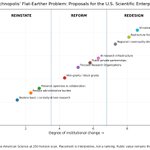


Project 2019
You are asking me to imagine 2029. I am sorry. I can't seem to get past 2019.
Perhaps it has something to do with who was in the room. And perhaps even more with who wasn’t.
substack.com/@mahmudfarooque…

More Than 225 Americans to Deliberate on the Future of U.S. Science Across Three States ecastnetwork.org/2026/10/02/… via @ecast

We're hosting one of three public forums on American Science this Saturday, October 3rd, in Charleston, West Virginia. The other two are @museumofscience and @azsciencecenter.

A national science think tank is holding a free public forum in Charleston on Saturday to help shape the future of American science, and it will pay you to attend.
wvgazettemail.com/news/kanaw…

Community Conversation on the Future of American Science scistarter.org/community-con… #citizenscience #WestVirginia #Charleston #Oct3

Mahmud Farooque retweeted

We are super excited to share the launch of our new talk show, How to Think About Technology, on which we examine . . . well, how to think about . . . .
It's a project that's been in the work for a few years now. It's a team effort that includes the work of the production team at Virginia Tech's Athenaeum, a center for academic media creation in Virginia Tech's Newman library, as well as guest hosts and contributors Paula Bialski, Gretchen Von Koenig, and Javaid Sofi . . . and more!
Our first episode on our present AI moment features conversations with Adam Wynne, Founder and Principal Engineer of Wynne Technologies, and danah boyd, Geri Gay Professor of Communication at Cornell University. Link below!
Later this week, we'll have our second episode on privacy and digital technologies posted, featuring Farzaneh Badiei, PhD, Founder of Digital Medusa, and Martin Eiermann, Assistant Professor of Sociology at University of Wisconsin - Madison.
We're always on the lookout for potential topics and guests, so please be in touch if you have thoughts. 😊

Perhaps this is how climate alarmists and tech alarmists in each camp will find common ground to regain what they lost. wsj.com/politics/populist-re…

Science and technology policy insiders are not immune to mistaking their privileged knowledge for privileged authority.


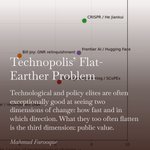
Technopolis’ Flat-Earther Problem
Technological and policy elites are often exceptionally good at seeing two dimensions of change: how fast and in which direction. What they too often flatten is the third dimension: public value.
mahmudfarooque892889.substac…

Technopolis’ Flat-Earther Problem
Technological and policy elites are often exceptionally good at seeing two dimensions of change: how fast and in which direction. What they too often flatten is the third dimension: public value.
mahmudfarooque892889.substac…
[1/2] My then six year old daughter’s reaction from the week and our town’s interfaith remembrance ceremony at the train station for the three lives lost twenty five years ago.


[2/2] I was on a New Jersey Transit train to Penn Station on my way to work at the New York Academy of Science in Midtown Manhattan when the first plane hit. I still remember the train conductor announcing, rather casually, something like (not an exact quote): “Folks, if you look to your right, you will see the World Trade Center on fire.” It must have been between 8:50 and 8:55 am. A deep, loud sigh came from our compartment as everyone turned to the right. From our vantage point, the towers looked like two cigarettes, with a small trail of black smoke coming from one, the North Tower. I remember everyone who had the option getting on their cell phones and calling someone. My initial thought was that it was probably a small plane that had crashed. I was recalling an incident just a couple of weeks earlier when a French stuntman had an accidental run-in with the Statue of Liberty’s torch while paragliding. When I reached Penn Station, the TV monitors were showing EMS personnel rushing to the Tower, which still looked like a localized incident. When I walked to take the R-train uptown, I considered taking it in the other direction to snap a few photos before going to work. When I reached the subway, I heard the announcement that trains were not running south of Canal Street. I decided I wasn’t going to walk all that way from Canal St to the WTC, so I headed to work. It was at the reception desk that I learned a second plane had hit and that this was no publicity stunt going sideways.
“So, the question is not whether philanthropy can do good. Of course it can. Philanthropy can fund neglected problems, support experimentation, protect fragile fields, and take risks that government cannot. The question is whether philanthropy strengthens democratic capacity or substitutes for it.” mahmudfarooque892889.substac…


Reality avoidance through a lab version of the thing, whether a digital twin of political, earth or biological systems without empirical evidence will perpetually lead to the idea of a solution and never an actual solution. There’s no substitute to experiments and engagement.


