

Workshop on Fine-Grained Visual Categorization (FGVC) - CVPR FGVC12 Workshop at CVPR 2025, Nashville
Joined December 2019
- Tweets50
- Following276
- Followers553
- Likes31





The challenge is to classify volumetric µCT images of foraminifera tests. With only 210 labeled out of 18,426 volumes, the goal is to develop an efficient species classification method that minimizes annotation time, leveraging semi-supervised learning.
[5/5]
With µCT scanning, we can scan thousands of forams in a single scan. By determining the species composition, we can efficiently understand how the environment has evolved.
[4/5]
Since certain types of foraminifera only live in specific conditions, identifying the composition of the foraminifera sediments allows us to gain insights into past environmental conditions.
[3/5]
Planktonic foraminifera (aka forams) are tiny organisms that inhabit the sea waters. Forams produce a unique calcium carbonate shell, called a test, which can consist of multiple chambers and elaborate structures. They are preserved in sea sediments for millions of years.
[2/5]
This competition aims to identify under-studied species based on their acoustic signatures from continuous audio data. The most effective solutions will demonstrate the ability to train reliable classifiers with limited labeled data.
[4/4]
Predicting the plant species present at a location is helpful for biodiversity management & conservation scenarios. It allows for building high-res maps of species composition and related indicators such as species diversity, endangered species, and invasive species.
[3/3]
This challenge aims to predict plant species in a given location and time using various possible predictors: satellite images and time series, climatic time series, and other rasterized environmental data: land cover, human footprint, bioclimatic, and soil variables.
[2/3]
PlantCLEF2025 presents a multi-label classification problem, aiming to predicting all plant species present in high-res images. The main difficulty lies in the shift between training data (single-label of individual plants) and test data (multi-label, high-res images).
[4/4]
Integrating AI into this process could significantly improve efficiency, allowing for broader ecological studies with reduced expert effort. However, developing AI models for this multi-label classification task remains a major challenge.
[3/4]
Vegetation plot inventories play a crucial role in ecological studies, providing standardized sampling methods for biodiversity assessment, long-term monitoring, and large-scale remote surveys.
[2/4]
Automated fungi recognition helps mycologists, citizen scientists, and nature enthusiasts to collect vital biodiversity data in the wild. But we need better tools to recognize rare species which are often missed. 🍄 #CitizenScience [2/2]
Thanks @kaggle for the support! And all the organizers including @FathomNet, @LifeCLEF, and @QIMCenter for running these amazing competitions!
Looking for a challenge? Along with FGVC12 at #CVPR2025, multiple fine-grained computer vision competitions have been launched. These well-curated datasets allow you to leverage your AI skills to boost applications with impact! Let's go: sites.google.com/view/fgvc12…
@CVPR @kaggle

We extended the deadline for Non-archival submissions to *April 02*. More infos on the call for papers and the link to the CMT portal can be found here: sites.google.com/view/fgvc12…
@CVPR #CVPR #CVPR2025 #AI


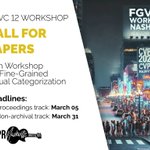
FGVC12 Workshop accepted to CVPR 2025, Nashville!
CALL FOR PAPERS: sites.google.com/view/fgvc12…
We discuss domains where expert knowledge is typically required and investigate artificial systems that can distinguish numerous very similar visual concepts.
#CVPR #CVPR2025 #AI

Final reminder for today's deadline March 07, 11:59pm PST.
A few hours left to polish and submit your 8-page paper to the CVPR workshop proceedings track.
To make planning easier for our paper chairs, please consider creating a CMT submission early in the process. Thanks!
cmt3.research.microsoft.com/…
Submission deadline is extended to **March 07**.
The CMT page is now online and we are looking forward to your submissions on AI systems for expert-tasks and fine-grained analysis.
More info at: sites.google.com/view/fgvc12…
@CVPR #CVPR #CVPR2025 #AI
FGVC12 Workshop accepted to CVPR 2025, Nashville!
CALL FOR PAPERS: sites.google.com/view/fgvc12…
We discuss domains where expert knowledge is typically required and investigate artificial systems that can distinguish numerous very similar visual concepts.
#CVPR #CVPR2025 #AI
FGVC12 Workshop accepted to CVPR 2025, Nashville!
CALL FOR PAPERS: sites.google.com/view/fgvc12…
We discuss domains where expert knowledge is typically required and investigate artificial systems that can distinguish numerous very similar visual concepts.
#CVPR #CVPR2025 #AI
Congratulations to our best paper awardees, Kam Woh Ng with ConceptHash: Interpretable Fine-Grained Hashing via Concept Discovery, and Yunhua Zhong with Low-Resource Vision Challenges for Foundation Models. Both authors receive free @CVPR registration


