



Chris retweeted

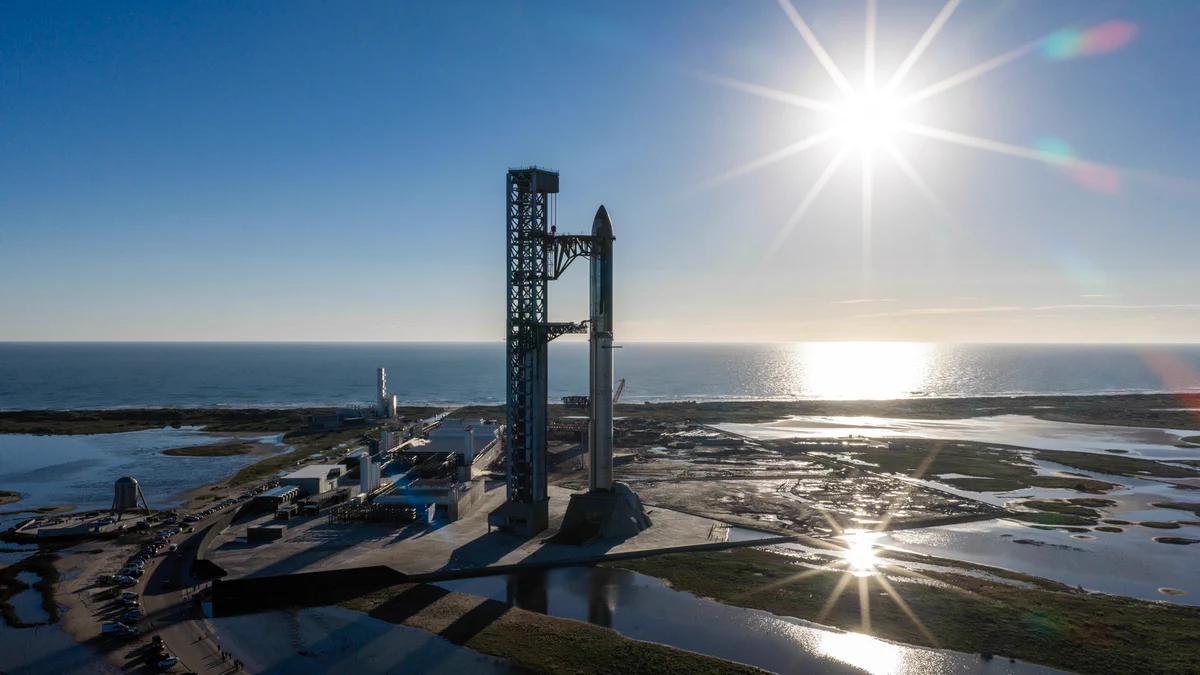
FULL SEQUENCE: Ship 42 returns to Starbase for the first ever Starship return to launch site, catch, and landing during Flight 15!


Chris retweeted

Live webcast of Starship's 15th flight test starts now → teapawt.net/i/broadcasts/2brajgZlO…
🤖 Made with AI


Today’s nationwide ground stop happened because our air traffic control system is operating on DECADES-OLD, analog equipment that simply cannot compete with the demands of the 21st century.
@FAANews is modernizing this aging infrastructure thanks to a $12.5 billion down payment secured by President Trump, but that isn't ENOUGH.
@POTUS is asking Congress to give us the resources to build a state-of-the-art air traffic control system. Let’s not do a patchwork fix to a system that’s critical for every single family.
It’s time for Congress to act. Give us the money to fix it. PASS THE MODERN SKIES ACT NOW.
1
63
Chris retweeted

BREAKING: U.S. nationwide ground stop lifted as of 8:15 PM ET.

Multiple airline sources tell @theaircurrent that the U.S. nationwide ground stop is set to be imminently lifted. Awaiting official word from FAA and the White House.
Chris retweeted

According to CBS News, citing several sources, an update to the private communications network - operated by L3Harris Technologies - that connects America’s air traffic control system caused the system to reboot, resulting in a system crash and the current nationwide ground stop across the United States.

As someone involved with the FAA SMART program as an operator, people seem to be mixing things up. SMART gives controllers routing advisories. It has nothing to do with the radios or frequencies they use to talk to pilots. Totally separate systems.

Coincidence?
"The US government has expanded the use of an AI tool for advising air traffic controllers to assist in managing air traffic across the entire national airspace system."
arstechnica.com/ai/2026/11/f…

4
626
Chris retweeted

There has been a temporary telecommunications outage - out of an abundance of caution all flights have been halted. Every flight has been accounted for and international flights will be handled on a case by case basis.

This is absolutely insane.
I did just get one email though.

We’ve monitored the status of the changes applied to improve serviceability and confirmed they're not taking as expected. We’re identifying alternate workstreams that can be applied to increase capacity in the face of sustained traffic management imbalances. More info under EX1550543 and MO1550821 in the Microsoft 365 admin center, as well as msft.it/6013xBHsf if the admin center is not available to you.
1
130

I literally cannot even book a conference room at my office.
We’re opening all available pathways to restore service, as our actions taken thus far have not provided the anticipated relief. We found a core process on affected servers is becoming overwhelmed, causing capacity loss. To validate a potential recovery, we're isolating a portion of infrastructure, restarting affected components, and reintroducing traffic to confirm the services remain stable before applying the change more broadly. More info under EX1550543 and MO1550821 in the Microsoft 365 admin center, as well as status.cloud.microsoft if the admin center is not available to you.
1
142


Incredible that this actually survived the impact.

NTSB investigators have recovered the cockpit voice recorder (CVR) of the Learjet 60 that crashed on Nov. 1 near Greenacres, Florida. The CVR was located at the site of initial impact. The CVR is being evaluated in the NTSB Vehicle Recorders Laboratory in Washington, D.C. The excavation work at the impact site has been completed.

ALT CVR from the Learjet 60.

ALT CVR from the Learjet 60 at the NTSB Vehicle Recorders Laboratory in Washington, D.C.

ALT CVR from the Learjet 60 at the NTSB Vehicle Recorders Laboratory in Washington, D.C.

ALT CVR from the Learjet 60 at the NTSB Vehicle Recorders Laboratory in Washington, D.C.
87

Chris retweeted

Writing this in my personal capacity, but I have been flying these types of aircraft for more than 20 years, with over 8,000 hours, and have reasonable familiarity with how the charter world operates. I feel compelled to post after seeing commentary about the Lear 60 crash, from missile strikes to DEI to critiquing this poor woman’s final radio calls.
That last part is what I find most troubling. She was the second-in-command (SIC), and while she was empowered to point out mistakes as part of good crew resource management, she was doing her job, communicating with ATC right to the end in a terrifying situation. She likely knew before many of those calls that she was going to die. I have heard final calls from friends, from military pilots with thousands of hours in fighter aircraft, and they are just as heartbreaking because they know the end is approaching.
I understand the public interest given the footage and audio. But you do not know the aircraft’s maintenance history, whether there was a structural failure, if any failure was induced by turbulence, overspeed, or overcontrol, or everything happening in that cockpit. I am sure weather will be part of the investigation, but beyond that, it is speculation. The charter industry routinely hires commercial pilots very early in their careers to gain experience alongside an ATP-qualified captain before they move up to the airlines. She would still have the appropriate training, qualifications, and checkouts by an FAA examiner or designee.
Let people investigate, learn, and share the facts. Be respectful to those who perished and the families who carry their memories. God bless them and their loved ones.
Chris retweeted

We've reviewed radar and temperature data surrounding the crash of N722BD. This loop depicts the rapid vertical development of a convective cell, which lofted plentiful moisture.
The aircraft entered this cell at 12:47-48 p.m., encountering severe icing and turbulence.
Chris retweeted

This Learjet crash sure looks like an icing situation. They were at 37,000 feet over a thunderstorm and suddenly started descending. There's a transcript of ATC calls that mentions the icing.
Ice accumulation is faster on tightly curved surfaces. The tailplane is basically small wings, which means tighter curves, so ice accumulates on the elevator at the back. The ice makes it less effective, you have to apply greater control deflection to keep the nose up, and then you run out of control authority, or push it too far and stall the tail. The nose pitches down and you pick up speed, exceeding limits of the aircraft. The horizontal stabilizer may have been torn off during descent, it would have an IAS of over 400KIAS at this point. That's over the 340KIAS limit. Mach number would be about 0.88, and when you factor in turbulence the stress on the airframe is even worse.
So, I expect the horizontal stabilizer didn't come off until the overspeed condition.


