

Maps that educate & inspire Join Lines & Legends for FREE: https://xitter.cf/t.co/MnnQxe9Ijw
Joined June 2025
- Tweets4.5K
- Following6.2K
- Followers11.8K
- Likes2.1K





Was this a religious war or a power struggle in disguise? Follow @forummapping for more maps like this.
6/ The toll: modern estimates run from 4.5 to 8 million dead, mostly civilians. Some German regions reported population drops of over half, though that includes people who fled.
5/ The Peace of Westphalia ended it on 24 October 1648. Sweden gained Swedish Pomerania, Bremen and Verden, and France gained territory in Alsace and Lorraine.
4/ Plot twist: Catholic France joined in 1635 on the side of Protestant Sweden and the Dutch. Its aim was to weaken the Habsburgs, who ruled both Austria and Spain.
3/ The war spread. In 1630 Sweden entered as a Lutheran power and won major victories under Gustavus Adolphus.
2/ The dark patch in the middle is the Holy Roman Empire, a loose patchwork of states under the emperor. The Habsburgs, in yellow, held Austria and the Bohemian lands at its core. The mapmaker notes not every state is shown.
1/ The spark came in May 1618, when Bohemian Protestant nobles threw Catholic imperial officials out of a window at Prague Castle. History calls it the Defenestration of Prague.
Europe in 1618: a patchwork of empires and hundreds of small states, about to tip into 30 years of war. The map before the storm.
a thread 🧵🗺️

Historians estimate Mansa Musa of Mali may have been the richest person in history — his gold spending on one pilgrimage disrupted Cairo's economy for years (1324).
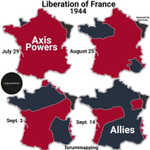
Watch the swastika get pushed off the map in four snapshots as Allied forces swept across France in the summer of 1944.

7/ We go deeper on how England got to the execution in the first place — the newsletter has the full year-by-year breakdown: buttondown.com/forummapping

6/ By 1660, with no workable alternative left, Parliament invited Charles II home. He landed at Dover that May and was crowned — the monarchy restored after an eleven-year gap that started with an execution and ended with an invitation.
5/ Oliver Cromwell ran the republic as Lord Protector until his death in 1658. His son Richard inherited the job and lasted less than a year before the army eased him out.
4/ Charles II spent about six weeks afterward as a fugitive in his own country, reportedly hiding at one point in an oak tree while Parliamentarian soldiers searched below, before escaping to France in disguise.
3/ Charles's exiled son didn't give up. Crowned King of Scots in 1651, he invaded England with a Scottish army — and was crushed by Cromwell at the Battle of Worcester on 3 September 1651.
2/ England abolished the monarchy entirely and became the Commonwealth. For the first time in its history, the answer to 'who is king' was nobody.
1/ Charles I lost the argument for good on 30 January 1649, beheaded outside the Banqueting House at Whitehall — still the only time an English monarch has been tried and executed by his own state.
England executed a king in 1649. Eleven years later it invited his son back to be king again. This is the story in between.
a thread 🧵🗺️