

ML Scientist | AI for Science & Experimentation | Bayesian Optimization
Joined May 2022
- Tweets23
- Following168
- Followers21
- Likes418





We built a universal HRMS-based detector for palladium impurities! 🧪💻 Our software spots Pd (and other elements) down to 10⁻⁸ M with insane sensitivity. Super excited to see it already crushing it in catalytic reaction analysis.
nature.com/articles/s41467-0…


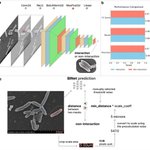
Great to see our deep learning-based computer vision methods for biofilm analysis (pubs.rsc.org/dd/article/2/5/…) being used to assess biofouling and on different plastics! 🧫
Published in Scientific Reports
nature.com/articles/s41598-0…

Here is a good paper written by my friend (scholar.google.com/citations…) about how biofilms can be represented as graphs to solve practical microbiological problems.
You can check it out here:
nature.com/articles/s41522-0…


In the recently published paper in @NatureComms, we have developed a search engine for multicharged ions in high-resolution mass spectra.
The software solution has a broad spectrum of possible applications, including the discovery of organic reactions.

AI-based search engine can help researchers find new chemical reactions in data archives phys.org/news/2025-03-ai-bas… via @physorg_com


Happy to share our work about generative modeling of annotated biofilm images is finally out in #npj_biofilms @Nature_NPJ
nature.com/articles/s41522-0…

Unfortunately, to obtain high-quality results, neural networks for detection and segmentation often require time-consuming training images annotating.
And here our pipeline comes to the rescue 🛟
We developed system that can generate annotated biofilm image datasets by input parameters such as biofouling stage, magnification, number of cells of different types etc.
Here is our web application. You can try:
app.ananikovlab.ai:8502

Konstantin Kozlov retweeted

Creating tables with Overleaf has never been easier! Our newest feature helps you create/edit tables in your project without writing code — you can also copy and paste tables and formatted text directly into Visual Editor, without losing the formatting! overleaf.com/blog/major-feat…
Konstantin Kozlov retweeted

🧪🖥️ "Revolutionizing #biofilm studies with #digital #biology! Combining SEM and deep neural networks for in-depth biofilm & #antibiotic effects studies. Analyzed > 70k bacterial cells 🦠 1000x faster than manually! 🧫🔬
Free open access by @digital_rsc
pubs.rsc.org/en/content/arti…

Check out our paper in @digital_rsc "Digital biology approach for macroscale studies of biofilm growth and biocide effects with electron microscopy ". We create computer vision system to perform an in-depth analysis of biofilm microscopic images
Paper: pubs.rsc.org/en/content/arti…


Konstantin Kozlov retweeted

“Emergent autonomous scientific research capabilities of large language models”, by @gpggrp’s @daniil_boiko and Robert MacKnight. Tweetorial will come later.
arxiv.org/abs/2304.05332

Konstantin Kozlov retweeted

These machine learning cheatsheets contain some of the best and well-organized ML content I've come across.
Sometimes, it's just good to understand the concept at a high level and it's context before going deep. This resource helps with that.
stanford.edu/~shervine/teach…

Konstantin Kozlov retweeted

We highlight a recent study from the @AnanikovLab that uses machine learning to improve the efficiency and accuracy of mass spectra data analysis (rdcu.be/cVTnP). nature.com/articles/s43588-0…
4ever in my heart
Our article just published in @J_A_C_S
Accelerating discoveries with machine learning analysis of mass spectrometry data. What can AI find in m/z peaks?
doi.org/10.1021/jacs.2c03631
#ArtificialIntelligence #ML #AI #machine_learning #NeuralNetworks
