

Scientist. Humanist. Never underestimate the difficulty of changing false beliefs by facts. - Henry Rosovsky
Joined September 2014
- Tweets1.7K
- Following213
- Followers390
- Likes5.5K


Pinned Tweet
Instead of "encoding," one should say "coordinating."
Instead of "processing," one should say "resonating."
Instead of "representing," one should say "embodying."
Free Recall retweeted

A Perspective in @NatRevNeurosci focuses on neural resonance theory in music, which summarizes how the dynamics of fundamental neural mechanisms can explain various aspects of music perception and performance. go.nature.com/41Qtner 🔒

ALT This is figure 2, which shows the predictions of neural resonance theory.
Free Recall retweeted

It's all about the waves, cats
Musical neurodynamics
nature.com/articles/s41583-0…
#neuroscience

An absolute intellectual giant who profoundly influenced my own intellectual development. RIP Michael Turvey. His 2018 book will, I suspect, become a landmark publication in cognitive science: amazon.com/Lectures-Percepti…
This Post is from an account that no longer exists. Learn more
Free Recall retweeted

This is a wild, hopeful story: grad students at @Northeastern successfully pushed back against digital workplace surveillance, through fearless solidarity and the bright light of publicity. It's a tale of hand-to-hand, victorious combat with the #ShittyTechnologyAdoptionCurve. 1/

ALT A flier inviting ISEC grad students to attend an unadvertised 'listening session' with vice-provost David Luzzi. It is surmounted with a sensor that has been removed from beneath a desk and annotated in Sharpie to read: 'If found by David Luzzi suck it.'
Free Recall retweeted

For those of you who want to learn about things like slow–fast dynamical systems, and piecewise-smooth dynamical systems (and there are some very cool things that can occur in them), I recommend the following books:
(1/n)

"Novel slow-fast behaviour in an oscillator driven by a frequency-switching force" (by Carles Bonet, Mike R. Jeffrey, Pau Martín, Josep M. Olm): arxiv.org/abs/2208.04577

Free Recall retweeted
"Novel slow-fast behaviour in an oscillator driven by a frequency-switching force" (by Carles Bonet, Mike R. Jeffrey, Pau Martín, Josep M. Olm): arxiv.org/abs/2208.04577
Free Recall retweeted

Absolutely fascinating: purely embodied dynamics can get you a long way in terms of behavioural complexity and adaptive mess (if not far in terms of size)
Before Brains, Mechanics May Have Ruled Animal Behavior | Quanta Magazine quantamagazine.org/before-br…
The moment when you serendipitously discover that @ylecun is a deep synth nerd--he has been hacking and performing with analog synthesizer since his teens--when googling about David Wessel. The world really is a small place.

Taken from @ylecun's keynote talk on David Wessel's vision for computer music and neural networks: youtu.be/gAbLlVhf1pg
Michaels & Carello (1981): on the radio and computer metaphors of ecological psychology and cognitive psychology, respectively, for perceiving and knowing in neurobiological systems.

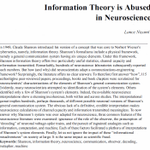
Nizami (2019), Information Theory is abused in neuroscience: "The paper scrutinizes neuroscientists' interpretations of the framework that underlies information theory, namely, the six physical elements that comprise Shannon's general communication system" philpapers.org/rec/NIZITI

Free Recall retweeted
1/n I’m experiencing a growing dissatisfaction with developmental studies which simply claim that infants and child do X at age Y, but not at age Z, with no attempt to identify the ontogenetic processes that produce these reliable "milestones."
1/n I’m experiencing a growing dissatisfaction with developmental studies which simply claim that infants and child do X at age Y, but not at age Z, with no attempt to identify the ontogenetic processes that produce these reliable "milestones."
5/n But, IMO, merely characterizing what infants & children can do at age X or that some developmental phenomenon occurs earlier in ontogeny is not particularly useful.