

Creative Innovation Leader | Bridging Brands & Technology across APAC | Applied AI & Creative Automation Pioneer | Speaker & Award-winning Digital Strategist
Mumbai, India
Joined December 2008
- Tweets2.5K
- Following761
- Followers735
- Likes758



Pinned Tweet
lovetheworkmore.com This is a superb initiative by Quynh Tran and Toan Mai! Please check it out!!! and Bookmark it!

1
2
Abhilash Krishnan retweeted

Maya-2 voice model weights are officially live! 🇮🇳🇮🇳
The frontier voice model for India is now completely open-weight.
• Outperforms ElevenLabs v3, Sarvam Bulbul v3, and Cartesia Sonic 3.5
• 1.5B+ people covered across all 28 states and 8 union territories
• SOTA voice synthesis across 11 official languages
• 20 native speakers pre-loaded, ready out of the box
• Best-in-class zero-shot voice cloning
Built by a team of five from the land of languages.
Go build and have fun!
Abhilash Krishnan retweeted

Introducing free People Data for ChatGPT & Claude.
Give your AI agents access to 270M+ company & people records in Alexandria.
Get 1,000 free credits a month to build prospect lists, find work emails, & research job history with the Firecrawl plugin.
firecrawl.dev/alexandria/cat…

Abhilash Krishnan retweeted

holy sh*t. Official Anthropic tip for Claude Code: stop burning Opus 5.5 context on tasks Haiku 5.5 can swarm, while Sonnet 5.5 builds
put the architect on call with /advisor
claude --advisor opus --subagents haiku
Sonnet 5.5 drives the primary session on high effort, writing diffs and running test suites
Haiku 5.5 subagents swarm the repo in parallel at 340 tok/s, handling file discovery and spec docs lookup
Opus 5.5 stays on call in the background as the advisor, only stepping in at three critical moments:
→ before a plan locks: does the implementation plan miss auth invariants or schema contracts?
→ when a test breaks twice: are we fixing the root cause or falling into a recursive rabbit hole?
→ before calling done: did the full diff introduce hidden regressions or break pre-flight rules?
Opus 5.5 reviews. Sonnet 5.5 builds. Haiku 5.5 swarms
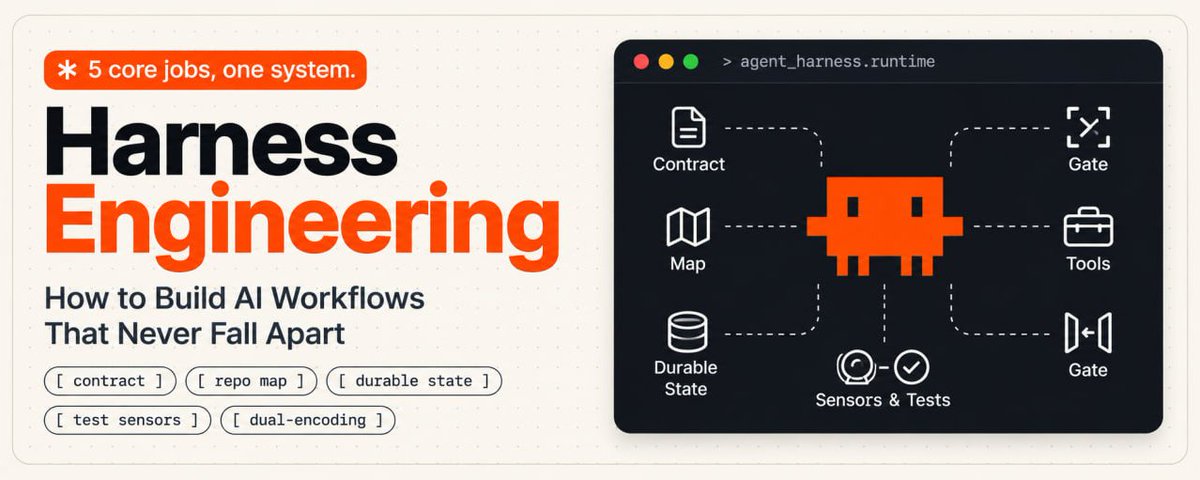
Jev engineering runs the identical pattern one layer down: mechanical decisions that need no reasoning (which file to open, which tool to invoke, retry or abort) execute in 16ms, so the frontier models only wake up when execution paths actually diverge
Plan on high. Delegate on medium. Keep Opus on call.
- the full advisor setup
> Opus 5.5 on call reads full session history and catches deep architectural traps
> Sonnet 5.5 lead drives edits, writes core logic, and executes test harnesses
> Haiku 5.5 subagents swarm AST parsing, grep scans, and API docs in parallel
> JEV micro-fork layer resolves 1,500+ mechanical routing branches in under 16ms
> advisor stays completely silent on routine bash execution to protect context
paste the setup and this prompt into Claude Code below:
"Configure my Claude Code workspace for hierarchical advisor orchestration:
1. Audit ~/.claude/settings.json and project config for model roles fitting lead, subagents, and advisor:
> Pin main session model: sonnet with effortLevel: high for primary execution
> Pin subagents model: haiku with effortLevel: medium for parallel file discovery and docs retrieval
> Pin advisor model: opus on call for strategic review
2. Enable the advisor tool in ~/.claude/settings.json:
> Set advisorModel to claude-opus-5-5
> Enable subagent parallel dispatcher pool (3x workers)
3. Configure automatic advisor consultation checkpoints in ~/.claude/CLAUDE.md:
> Consult /advisor opus before finalizing multi-file architecture plans
> Automatically summon /advisor opus when the same test or compiler error fails twice
> Enforce advisor diff contract audit before declaring tasks complete or staging git commits
4. Constrain subagent scopes:
> Haiku subagents return structured AST summaries and docs snippets only without modifying main session context
Show every configuration diff first. Do not apply edits until confirmed"
↳
code.claude.com/docs/en/advi…

Abhilash Krishnan retweeted

Todos los productos de Adobe reimplementados desde cero, gratuitos y de código abierto
→ getartcraft.com/apps

ALT Interfaz de herramientas creativas para edición de imágenes, ilustración, video y desarrollo de bibliotecas.
Abhilash Krishnan retweeted

Introducing Genex
The desktop app to build games with AI
→ Open source, MIT
→ Local models, or Claude Code / ChatGPT sub
→ Self-improving harness for game dev
→ Three.js + Blender, Meshy & other tools
→ Unity & Unreal plugins soon
genex.games/desktop
Abhilash Krishnan retweeted

Introducing Griffin, the first model to pass the video Turing test.
48% of people who talked to it live thought it was a real human. Previous systems have had a pass rate <3%. It is #1 on NVIDIA's benchmark for full-duplex AI video.
It’s the first Human Interaction Model (HIM).
Readers added context they thought people might want to know
The 48% figure and "video Turing test" claim are from Tavus's own study of 54 one-minute calls, not independently verified or using a standard protocol. Griffin-Lite leads NVIDIA's VideoFDB benchmark on their public leaderboard.
cellcog.ai/blog/tavus-gri…
research.nvidia.com/labs/amri/proj…
tech-ish.com/2026/10/02/tav…
Abhilash Krishnan retweeted

After co-inventing ChatGPT, I kept asking myself: why have superhuman chat models not led to AGI?
I’ve spent the last 2 years in stealth building a new way to train models (RLCD), and a new type of frontier AI model that we are releasing today: Jev
• 20-200x faster
• 40-400x cheaper (w/ output tokens free)
• Frontier composable intelligence optimized for decisions
AFAICT the shortest path to AI-based economic revolution
A very simple and effective idea in action!

introducing FindOut.fit
before a company hires you, they know almost everything about you.
before you join them, you know whatever they chose to tell you.
we thought candidates deserved better.
so we built due diligence for your next job.

1
45
Abhilash Krishnan retweeted

🔴 BOMBSHELL: Some Chinese developers just humiliated the entire paid AI video industry
You upload a photo
You upload an audio
And it generates a video of a person speaking in sync that lasts for minutes
It's called LongCat-Avatar
It's open source and on top of that FREE
What used to require a camera, studio, and editing now comes straight from a repo
I'll leave the repo link in the comments

Abhilash Krishnan retweeted

Today, we're sharing new research on Solaris, our first Interface World Model.
Solaris is a new kind of operating system that generates interactive interfaces frame by frame, in real time, with no code. We find that Solaris outperforms frontier LLMs when generating new interfaces, across structural similarity and information retention. Read more and request early access at the link below.
Abhilash Krishnan retweeted

Minimax H3 Max has generates video faster than you can watch it so I hooked it to a twitch livestream! Now you can watch infinite interdimensional cable - link to the stream below

Abhilash Krishnan retweeted

introducing Gemini Omni 1.1 Flash
this model brings a new suite of creative controls and generative video capabilities to developers
- extend scenes for longer storytelling
- specify first and last frames
- draft videos more efficiently in 360p
- upscale up to 4K resolution
- add video references in your multimodal input
now available via the Gemini API and in AI Studio
Abhilash Krishnan retweeted

We just open-sourced an entire marketing department.
Introducing Marketing OS by Arcads.
It does the work of your first six marketing hires.
📁 Marketing Department
┃
┣ 📁 Head of Marketing
┃ ┣ 📁 Positioning
┃ ┣ 📁 Pricing
┃ ┗ 📁 Competitor Teardowns
┃
┣ 📁 Copywriter
┃ ┣ 📁 Copy, Graded Before You See It
┃ ┣ 📁 Email Sequences
┃ ┗ 📁 Social Posts
┃
┣ 📁 Creative Strategist
┃ ┣ 📁 Hooks, Written Out
┃ ┣ 📁 Creative Fatigue vs Dead Audience
┃ ┗ 📁 Next Tests, Ranked
┃
┣ 📁 Launch Lead
┃ ┣ 📁 The 4 Weeks Before
┃ ┗ 📁 Product Hunt, Hour by Hour
┃
┣ 📁 SEO Lead
┃ ┣ 📁 GEO
┃ ┗ 📁 App Store Rankings
┃
┗ 📁 Analyst
┣ 📁 Site Audits, Scored 0-100
┣ 📁 Test Design
┗ 📁 Spotting AI Slop
And they hand work to each other:
Analyst finds the leak → Copywriter rewrites it → Creative Strategist tests it → Analyst grades the result
One Claude skill.
Comment "OS" and I'll send you the setup.
Abhilash Krishnan retweeted

I open-sourced the Sylva three.js site and the skills behind it.
I started with one reference and asked Opus 5 to recreate it in Three.js as a single HTML file (looped for 2 hours). The moss root is procedural geometry with around 130,000 instanced blades, and all the code is under 1 MB.
Live site: mengto.github.io/sylva/
Repo: github.com/MengTo/sylva
I turned the main interactions into three reusable skills:
- threejs-wireframe-scan-reveal
- threejs-pointer-orbit
- threejs-gpu-particle-spray
Skills repo: github.com/MengTo/Skills

I’m blown away by the quality of the landing pages that Opus 5 can create in Three.js.
Prompting it with "orbit using mouse" is enough to create a 3D parallax effect. The same goes for "add particles to pointer." It’s like creating a living, breathing world.
More prompts I used:
- Add a butterfly that flies to the branch and flies away when I mouse over it.
- During the intro, first load a wireframe of the branches, similar to the field-scanning effect in Death Stranding.
- Add a scan effect to the card images while they load.
Then I asked it to use the shader buttons and nav bar I made in previous projects.
As explained in my last video, I started with an inspiration and the prompt, “Recreate this in Three.js in a single HTML file. Self-verify until perfect.” Opus 5 ran for two hours. All the code is less than 1 MB.
Inspiration:
instagram.com/p/DYVXOx6kdmq
Let me know if I should open-source this.
Abhilash Krishnan retweeted

We’re taking India Back to School 🎒
for 15 days, 50 AI curious people will learn from the best, build, find real users and launch something of their own.
Only goal: become AI native.
Powered by @OpenAIDevs
Supported by @AWScloud and @DodoPayments
Apply: bts.aiweekends.xyz
Abhilash Krishnan retweeted

Goodbye clicking on Google Street View to check out the route!
In your browser, with Hop.Earth you can actually drive anywhere in the world🚀
You can also create multiplayer races🚗🏎🚓
The world is generated ahead of you in real-time from OpenStreetMap data combined with satellite elevation data as you drive.
Just added a WIP of night mode and replaced the placeholder terrain/road textures with some nicer physics-based textures. Also now anywhere you go a million street lights will be added too. This is actually slowly starting to look like the promised Need For Speed + Google Maps
#threejs #gamedev #indiedev
Single player mode:
Just find a location, click anywhere on the map and click "Hop Here". After parachuting down hold X to call the car to the road.
Multiplayer mode:
Click on "Create race" and select start and finish points. A route will be plotted. Click on Share Race to get the link and start racing!
Abhilash Krishnan retweeted

Super proud of my repo file-ITR.
It has 170 starts, and 36 forks.
People with 8-10 years of industry experience are raising PRs on it and using it to streamline their ITR filling.
The reason I’m proud is because this is the first time I have done something which people are using.
