

The fastest & most entertaining way to digest freight news. Join 15k+ others and subscribe (it's free) at https://xitter.cf/t.co/dWmhrEQh5w.
Joined May 2021
- Tweets12.2K
- Following1.4K
- Followers10.4K
- Likes30.9K







Pinned Tweet
Carrier Profits Fell 80%. He Grew to 650 Trucks.
Gabrielius Stonys is the Co-Founder of Spotter Labs, a software company offering autonomous dispatching to long-haul spot market trucking in the US. Since co-founding Spotter Labs in 2019, Gabriel has grown the company’s fleet to 650 trucks through one of the toughest freight markets on record. He breaks down why trucking was slow to adopt automation and why they chose to grow rather than scale down when carrier profitability collapsed.
(0:00) Intro
(1:07) Immigrating to Chicago at 12
(4:37) Starting Spotter Labs
(6:01) Raising a $2.5M Pre-Seed in 2020
(7:27) Landing GTS as the First Customer
(10:28) The Double Intermediary Market
(13:15) Why Carriers Ignored Automation
(15:46) Building Their Own Fleet
(18:06) The Freight Market Collapse
(22:11) Growing to 650 Trucks in a Down Market
AI could give some brokerages an advantage that grows with every new application. Mike Carter, Founder at Vooma, explains how connecting AI across quoting, load coverage, and other workflows could change the way brokerages operate.
“I think that we’re going to see flywheels start to turn in businesses that figure out how to use AI because, you know, you have your agent that’s helping you with quoting.
If you’re running a split model, there’s a bunch of information on the carrier side that takes various layers of human conversation, maybe to make it back and forth, but when you start to introduce AI in multiple parts of the business that becomes part of a hive mind where that information is instantly accessible to the agent that’s helping you quote, helping you cover a load, things like that.
I think we’ll start to see compounding advantage so the businesses that are thinking about deploying it in like multiple places- maybe not the boldest prediction, but -
It makes sense though.”
Rewatch the full episode with Mike on YouTube, or listen to it on Apple Podcasts, and Spotify, by searching 'The FreightCaviar Podcast'.
Obsessing over competitors can lead companies to lose sight of the people they’re building for. Sushanth Raman, CEO at Pallet, explains why solving customer problems, rather than chasing competitors’ latest moves, can be the key to standing out.
“If you’re gonna focus on your competition, you’re gonna make a bunch of really stupid decisions because you’re too concerned about what features are launching and so on.
I just am gonna look at my customer and figure out how to just go solve your problems and I don’t really give a ***** about what everybody else is doing, I’m gonna build a far more interesting experience. What matters is, am I solving the client problems in a way that’s repeatable, successful?
You should not pay attention to your competition because you want unique insights and you actually want to play the game in your own way, otherwise you’re just gonna become the average everyone else
Rewatch the full episode with Sushanth on YouTube, or listen to it on Apple Podcasts, and Spotify, by searching 'The FreightCaviar Podcast'.
Gabrielius Stonys, Co-Founder of Spotter Labs, looks back at the breaking point: carrier earnings plunged from $95 to $14 an hour, the company was burning $200K a month, and he was told to choose between the fleet and the tech.
“Peidi says, ‘Gabe, we got to choose, one or the other or we're going to die. We're burning $200K per month.’ So we built 50 trucks. We went through the pains, but the moment we started making money, the market went ‘boom’.
Ukraine war starts in 2022 of February. The market was trading at $95 per hour. Then it dropped to 60 within a month because the fuel costs went up. Then it dropped to 40 within another two months because rates started going down. And by 2024 it was at $14. So you're talking about an 80% collapse in carrier profitability, within like a year and a half.
Back then, my focus was trying to build an automated dispatcher. Peidi was running the fleet, and Peidi says, ‘Gabe, we got to choose one or the other or we're going to die. We're burning $200K per month.’ And I look at him and I said, ‘I'm not letting go of my baby.’”
Full episode on YouTube, Apple Podcasts, and Spotify.

Carrier Profits Fell 80%. He Grew to 650 Trucks.
Gabrielius Stonys is the Co-Founder of Spotter Labs, a software company offering autonomous dispatching to long-haul spot market trucking in the US. Since co-founding Spotter Labs in 2019, Gabriel has grown the company’s fleet to 650 trucks through one of the toughest freight markets on record. He breaks down why trucking was slow to adopt automation and why they chose to grow rather than scale down when carrier profitability collapsed.
(0:00) Intro
(1:07) Immigrating to Chicago at 12
(4:37) Starting Spotter Labs
(6:01) Raising a $2.5M Pre-Seed in 2020
(7:27) Landing GTS as the First Customer
(10:28) The Double Intermediary Market
(13:15) Why Carriers Ignored Automation
(15:46) Building Their Own Fleet
(18:06) The Freight Market Collapse
(22:11) Growing to 650 Trucks in a Down Market

📈 Knight-Swift Wants Double-Digit Rate Increases.
Knight-Swift will open its November bid season seeking “low-to-mid double digits” in truckload rate increases, CEO Adam Miller said.
Truckload revenue per loaded mile, excluding fuel, rose 10% year over year in Q3, while the average tractor count fell 4%. Miller said Knight-Swift’s load rejection rate was two to three times the market average, with spot pricing above contract rates.
In its Logistics segment, estimated brokerage loads fell 32.5%, but revenue per load jumped 46.7% to $2,885.
Brokerage gross margin rose to 18.9% from 17.8%, while segment revenue slipped 1% to $139 million. Logistics’ adjusted operating ratio improved to 93.1% from 94.3%.
Image Source: Swift Transportation
News Source: FreightWaves

🚨 AI Equipment Theft Tops $150 Million This Year.
Thefts of data-center equipment, chips, and computing components have risen 34% since 2024, according to Overhaul’s AI Infrastructure Intel Report.
Deception accounted for 92% of the high-value technology shipment thefts it studied, with criminals using fraudulent carrier identities, double brokering, spoofed communications, and falsified paperwork.
A single flagship AI server rack costs roughly $3 million, according to Overhaul, and one truckload routinely carries eight figures in value before the equipment is installed.
“Visibility into a shipment alone isn’t enough to stop it from being taken,” Overhaul founder and CEO Barry Conlon said.
Image Source: FreightWaves
News Source: Overhaul

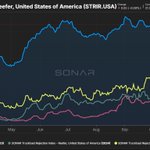
❄️ Reefer Rejections Hold Above 20%.
Reefer tender rejections have held around 20%–22% since early September, compared with roughly 11% for dry van, according to Arrive Logistics’ October market report.
Arrive expects holiday food shipments and demand for freeze protection to further tighten reefer capacity. The report also flags higher fuel costs and lengthy payment terms as financial pressure on carriers, warning that some could park trucks or close.
Meanwhile, September Class 8 orders rose to about 10,300 from 8,580 in August but remained below replacement levels. The average age of a U.S. Class 8 tractor held at 6.4 years, its highest level in more than a decade.
Image & News Source: Arrive Logistics, SONAR

FREIGHT GONG FRIDAY - OCTOBER 23RD, 2026 (Presented by Epay Manager) xitter.cf/i/broadcasts/1XxygwdpD…

Dishonesty in freight may win you a load, but it can cost you far more in the long run. Ty Schroeder, Account Specialist at BBI Logistics, explains why dishonest behavior spreads through the industry and why it rarely stays hidden.
“Being dishonest only gets you so far. You might be able to cover a load, get a load one times, two times, three times, but overall I think it always catches up to you. Being honest goes a long way.
If there is a broker that is dishonest, you hear about it. They are dealt with accordingly. It’s very contagious, it’ll spread like wildfire. You have people that are doing a couple shady things and everybody else around them feels like it’s ok. At the end of the day I do think if you are dishonest it does catch up to you.”
Rewatch the full episode with Ty Schroeder on YouTube, or listen to it on Apple Podcasts, and Spotify, by searching 'The FreightCaviar Podcast'.

🚨 New York Busts 16 in Staged Truck-Crash Ring.
New York state investigators arrested 16 people accused of staging crashes and faking injuries to collect nearly $500,000 from insurers, in one of the first major enforcement actions since Gov. Kathy Hochul made auto insurance fraud a priority.
In the Bronx, investigators say a group deliberately sideswiped a tractor-trailer on the Cross Bronx Expressway and staged a separate collision that generated more than $154,000 in medical bills.
New York insurers reported 43,811 suspected motor-vehicle fraud incidents in 2025, and Hochul's office estimates staged crashes add as much as $300 a year to the average driver's premium.
Image Source: X (Governor Kathy Hochul)
News Source: Transport Topics

⚖️ New Mexico Jury Hands Down $47M Verdict.
A New Mexico jury awarded $47 million to Austin Drewry Jackson and his mother after a 2022 collision with a Pilot Thomas Logistics tanker truck near Carlsbad, New Mexico.
Jackson, then 21, suffered severe brain and spinal injuries, and the defense's first settlement offer was $100,000.
"That offer did not come close to acknowledging the harm Austin suffered or the care he will need," said James Tawney, the family's attorney.
The verdict lands as a U.S. Chamber Institute for Legal Reform study found the median trucking verdict nearly quadrupled, from $760,000 in 2023 to $3 million in 2026.
Image Source: FreightWaves
News Source: FreightWaves & Transport Topics

📈 Spot Rates Hold Firm As Truck Supply Shrinks.
Spot freight rates stayed roughly flat last week even as load volumes softened, DAT and Truckstop reported, because truck postings are running 21% to 27% below year-ago levels.
That capacity squeeze has pushed linehaul rates roughly a third above last year’s, with dry van up 35%, refrigerated up 33%, and flatbed up 29%.
DAT analyst Dean Croke said flatbed pricing is running 26% above its nine-year seasonal average, well outside the historical range for this point in the year.
DAT’s national averages: $3.09 a mile for dry van, $3.66 for refrigerated, and $3.64 for flatbed, all down slightly week over week as falling diesel prices trimmed fuel surcharges.
Image & News Source: FTR, Truckstop.com, Truck News, DAT

Gabrielius Stonys, Co-Founder of Spotter Labs, shares how the company went from nearly collapsing seven times to scaling its trucking operation from 50 to 650 trucks, using technology to survive the worst freight market.
“We almost died seven times between 2022 and 2025 December.
You said pissing off your investors and getting assets…Your investors are like, ‘Gabriel, we don't want you to buy assets. You got this money to create automations and tech’ right?
That's exactly right. They said, ‘What the hell are you guys doing? This is not what you sold us on’. And we said, ‘We still believe in the vision we're still following, it’s just going to have to go a different route.’ So, that's what we did. And then when the market finally collapsed, we were all left on our own and it was a do or die, and we decided to use the tech to lift us out of the water.
So we almost died seven times between 2022 and 2025 December, and each time was different. Some of it was money related, some of it was compliance related. Some of it was insurance related.
Have you raised money since?
No.
And do you still have 50 trucks?
650.
You have 650 trucks?”
Full episode on YouTube, Apple Podcasts, and Spotify.
Carrier Profits Fell 80%. He Grew to 650 Trucks.
Gabrielius Stonys is the Co-Founder of Spotter Labs, a software company offering autonomous dispatching to long-haul spot market trucking in the US. Since co-founding Spotter Labs in 2019, Gabriel has grown the company’s fleet to 650 trucks through one of the toughest freight markets on record. He breaks down why trucking was slow to adopt automation and why they chose to grow rather than scale down when carrier profitability collapsed.
(0:00) Intro
(1:07) Immigrating to Chicago at 12
(4:37) Starting Spotter Labs
(6:01) Raising a $2.5M Pre-Seed in 2020
(7:27) Landing GTS as the First Customer
(10:28) The Double Intermediary Market
(13:15) Why Carriers Ignored Automation
(15:46) Building Their Own Fleet
(18:06) The Freight Market Collapse
(22:11) Growing to 650 Trucks in a Down Market
⚖️ C.H. Robinson’s $711M Reckoning
A Texas judge has upheld the $604 million jury verdict against C.H. Robinson. With interest, the judgment now exceeds $711 million. The company disputes the ruling and is expected to appeal.
But the impact extends beyond the courtroom.
Ferguson’s logistics VP Nick Palmucci said shippers once focused on rates, service, and claims. Now, “we lead off with your safety strategy.”
ArcBest CEO Seth Runser confirmed similar pressure, with customers asking more questions about driver training and safety practices.
ArcBest has also re-vetted carriers it hadn't used recently, using internal and external screening software to check their safety records.
Source: FreightWaves & Transport Topics
