

Senior Economist at Uber Freight Mazen Danaf sharing market insights for truckers, carriers, shippers, and brokers 🚚🚛
United States
Joined April 2023
- Tweets316
- Following358
- Followers2K
- Likes300



#manufacturing output is much weaker than originally thought according to revised data by the Fed.
The #freight market: I told you so.

1
2
234
🧭 🚚 Navigating #Tariffs: How much can shippers save on #freight costs?
Over the past few weeks, I received a recurring question from shippers: "With sales softening, our finance teams are pushing hard for cost cuts. As a #recession looms, how much can we save on freight rates?"
While the desire for savings is understandable, my advice is not what everyone wants to hear: Don't bet on dramatic rate drops. Let's look at the data 🧵 1/4
Trucking Cost Per Revenue Mile:
Carriers are currently losing money on the spot market and barely breaking even on contract freight. This means contract rates have very little room to fall considering the already razor-thin margins. Spot loads can dip below operating costs in the short term, but only to cover variable costs for immediate survival. 🧵 3/4

2
3
753
Bottom line: while the current low rates offer some relief for shippers, rates might not go lower, even with a recession.
For more insights on #tariffs and the #freight market, check out our latest Freight Economist Report:
uberfreight.com/resource-lib…

2
3
544
Can a recession lower truckload rates? 🚚
Recession probability:
🚩 60% (J.P. Morgan Research)
⚠️ 45% (Goldman Sachs)
⚠️ 40% (Morgan Stanley)
However, trucking rates have already seen the worst: They dropped in 2022 and 2023 more than during the Great Financial Crisis!
Despite uncertainty, fundamentals suggest rates are unlikely to fall much further, even if we see a recession.

2
4
652
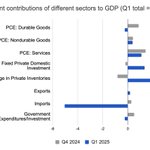
Q1 #GDP dipped (-0.3%) as a surge in #imports and pre-stocking took center stage. Imports, which count negatively towards GDP, dragged it down by a significant 5%, partially balanced by a 2.3% rise in private #inventories (also import-driven). Notably, Q1 saw slight dips in durable goods (-0.3%) and government spending (-0.3%).

286

Carriers added 9,600 #trucking jobs in March. I find this counter-seasonal and counter-cyclical. I shared my thoughts with @FreightWaves today:
“This uptick might represent a delayed hiring response following January’s temporary spot market tightening due to weather disruptions, which preceded an anticipated collapse similar to the previous year”.
Given recent negative sentiment and market softness, I expect this to reverse in the coming weeks.

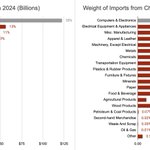
Which commodities were hit the hardest in "Liberation Day" #tariffs?
(Note that some goods were excluded from tariffs like metals, lumber, semiconductors, and energy products).

8
527
To calculate #tariffs, the White House used a simple formula. In their calculations, they referenced an interesting paper by Cavallo et al. (2021). Let's look at some nuggets from that paper.
ustr.gov/issue-areas/recipro…

Now let’s look at the elasticity of imports with respect to import prices.
This measures the percentage drop in imports for every 1% increase in import prices. Research suggests these elasticities vary widely, from -0.76 to -10, depending on whether we're looking at short-term or long-term effects.
Assuming φ is 1, if the elasticity is -0.76, a 22% average tariff rate would reduce imports by approximately 18% (applied individually to each country). With an elasticity of -2, imports would fall sharply by 46%. And if we use an elasticity of -4, as the White House did, we'd see a dramatic 77% decrease in imports.
1
3
254
Bottom line
U.S. retailers will absorb tariff costs, unable to raise prices for consumers. Consequently, they'll reduce import volumes. Due to the slow adjustment of short-term supply chains, expect empty shelves rather than price hikes. This will create significant challenges for US #freight, particularly #intermodal, which heavily relies on imports.
2
258