

Join 45,000+ investors who get our independent research on markets, DeFi, and the frontier. 7 days a week. Signal, not noise.
Joined February 2026
- Tweets737
- Following70
- Followers198
- Likes0




A country under strain can drift into managed decline, break in a chaotic collapse or rebuild through renewal, with Japan, Greece and Germany as examples. The three are discussed as possibilities for France, not a forecast.
A 20x leveraged position can be liquidated after roughly a 4.5% adverse move.
Makes a little more sense when you see something like last October, when 1.6 million traders got wiped out in a single day, with more than $19 billion in digital asset positions being liquidated.
Bitcoin fell 54% from its October 2025 peak to its July 2026 low.
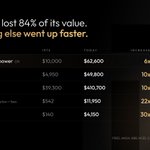
That sounds awful, until you realize that the previous three major cycles saw declines of 77%, 84%, and 86%.

3 years ago, Micron lost almost $6 billion in a single year.
Memory chips were the worst business in tech.
The product is a commodity.
& when supply catches up, prices don't collapse.
For example:
Qimonda went insolvent in 2009. Elpida went bankrupt in 2012.
But then Micron announced 16 long-term customer agreements at minimum prices, backed by about $22 billion in cash deposits and commitments.
By the next quarter:
• Agreements: 16 to 26
• Commitments: $22 billion to $32 billion
• Cash deposits in one quarter: $12.3 billion
This is a perfect example of “following the money.”
Something to think about when you’re constructing your portfolio, especially in tumultuous times.
If you got something from this post and want to see more content like it in the future…
Follow us @futurefinc.
This simplified banking example assumes a 10% reserve ratio to illustrate repeated lending and deposits. It is a model, not a statement of current U.S. reserve rules or the full limits on bank lending.
By Wednesday morning, someone will show you a chart proving the election is great for stocks.
Someone else will show you one proving it’s terrible. Both will use real data.
One pattern has held 19 times out of 19 since 1950.
See what it is, and why it has mattered more than who wins.
#Midterms #StockMarket #Investing
futurefinance.com/report/the…

Microsoft’s AI chief says building AI that can feel would be reckless, and he’d call on everyone to stop if it ever started to.
Meanwhile a $115 billion chip deal landed and OpenAI quietly shrank its fundraising goal.
See why one executive thinks some AI should never be built.
$MSFT $MRVL $LITE
#AI #AINews
futurefinance.com/report/ai-…

French officials reported about 550,000 protesters across the country as France's 10-year borrowing cost reached a 24-year high in October 2026. This report outlines why the situation may matter to investors elsewhere, while noting the outcome is still open.
Oil just dipped below $100, and stocks are bouncing after Friday’s worst day since June.
But there’s a catch for your gas bill and your 401(k), and it comes after Tuesday’s midterms.
See what could reverse the dip.
#Oil #StockMarket #Markets
futurefinance.com/report/mar…

China held 1,054 tons of gold in 2009.
Today, it reports roughly 2,366 tons.
That's a 124% increase.
Central banks don't accumulate gold for no reason.
They're clearly thinking about what their reserves will be worth decades from now.
The 10-year Treasury yield started 2026 near 4.15%.
It reached 5.35% in October.
That's a major change in the cost of money.
Important to keep in mind that mortgages, business loans, and stock valuations all have to compete with higher government bond yields.
If you own an S&P 500 index fund, about half of every dollar now depends on one theme.
According to JPMorgan strategist, Michael Cembalest, 41 AI-linked companies make up 49% of the index's value.
For context:
• Tech peaked at about a third of the index in 2000
• The last theme this big was the railroads
• That was the 19th century
Something else to look at is margin debt…
The money investors borrow from brokers to buy stocks hit a record $1.5 trillion in June.
As a share of the economy, it's about 4.6%.
At the March 2000 top, it was 3%.
At the 2021 peak, 3.8%.
So… yeah, half the market is essentially one trade, partly powered by a record high of borrowed money.
The point of this post isn’t to steer you away from investing in the S&P 500, we just want you to know what you’re actually invested in.
Plenty of people simply follow the crowd without properly constructing their portfolio to weather all storms.
If you got something from this post and want to see more content…
Subscribe to our free newsletter, Future Finance (link in bio).
This Harvard lecture frames probability and statistics as tools for handling uncertainty. They help quantify beliefs and update them as evidence changes, rather than assuming every outcome is knowable.
Rome didn’t crash its currency overnight.
It shaved a little silver off each coin. Then a little more. Over a couple of centuries, the denarius went from nearly pure silver to almost none.
Nobody noticed until it was too late.
Sound familiar?
Every time money changed form, trust moved somewhere new.
Shells → Trust the tribe
Coins → Trust the king
Paper → Trust the bank
Fiat → Trust the government
Bitcoin → Trust the math
Those who win follow the trust.
The dollar has lost more than 95% of its purchasing power since 1913.
The crazy part?
It’s all part of the plan.
A system that needs inflation to work will always pay savers last (if at all).
Things that were “too risky” until they weren’t:
• Paper money
• Buying stocks online
• Storing money on your phone
Today’s risky idea is tomorrow’s default.
The returns go to people who saw it early.
3 questions to ask before you invest in anything:
1. Who controls it?
2. Who can print more of it?
3. What happens to it if trust breaks?