

Deputy Director, Heliophysics Science Division @NASA GSFC
- Tweets169
- Following332
- Followers299
- Likes1.7K


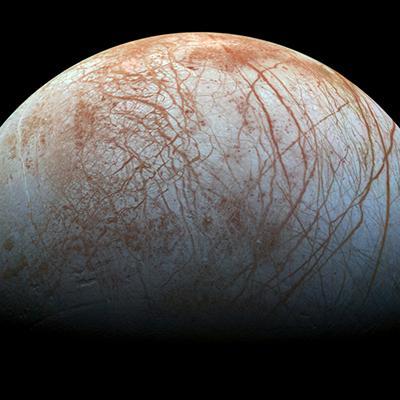

ALT An illustration of the Europa Clipper spacecraft passing over the surface of Jupiter's moon Europa. The spacecraft appears small at a distance, with sunlight glinting off its solar panel wings. Europa's surface has rough, blue ice, with a geyser spout. Jupiter rises over the horizon in the background.


ALT A group of people wearing laboratory coats, caps and masks are gathered behind two signs on the floor reading "JAXA" and "Mitsubishi Electric". Behind them, you can see an instrument on a metal platform.

ALT A group of people from NASA and JAXA pose for a photograph in front of a sign that reads "Mitsubishi Electric. Kamakura Words Showroom".


ALT A very close-up shot taken by NASA's Perseverance Mars rover overlooking its workspace where it collected a rock sample. This close up shot shows an array of white, brown, and black colors on this unique rock. Credit: NASA/JPL-Caltech/MSSS


ALT Artist's conception of the complex magnetic field environment at Mars. Yellow lines represent magnetic field lines from the Sun carried by the solar wind, blue lines represent Martian surface magnetic fields, white sparks are reconnection activity, and red lines are reconnected magnetic fields that link the surface to space via the Martian magnetotail. Credit: Anil Rao/Univ. of Colorado/MAVEN/NASA GSFC


ALT In this Webb image, Neptune resembles a pearl with rings that look like ethereal concentric ovals around it. There are 2 thinner, crisper rings and 2 broader, fainter rings. A few extremely bright patches on the lower half of Neptune represent methane ice clouds. Six tiny white dots, which are six of Neptune’s 14 moons, are scattered among the rings. The background of the image is black.


ALT The shoebox-sized GTOSat sits on a lab bench. Its solar panels are folded on top. Credit: Lauren Blum


ALT The NASA "meatball" logo against a black background.

ALT An artist rendition of the MAVEN spacecraft over Mars. On the right of the image there is text that reads "MAVEN mission extended to 2025"

ALT An artist's rendition of the MAVEN spacecraft orbiting over Mars, both in the foreground of the image. In the distance behind MAVEN, planet Earth sits. (Courtesy NASA/GSFC)


ALT An illustration of NASA's MAVEN orbiter above Mars, with its unfurled solar panels and antennas

ALT An illustration of the United Arab Emirates’ Hope Probe in orbit around Mars

ALT A photo of Mars taken by the Hope Probe, with one hemisphere illuminated by sunlight and billowing dust clouds visible. Image credit: Emirates Mars Mission / EXI

ALT Image of woman with title "Dr. Gina DiBraccio"

ALT A woman smiles in a photo.

ALT Space weather analyst Carina Alden stands with her eyes closed and arms spread out to the side.