

Let's explore the broad field of geography ❤️ | Country facts, maps, space, wildlife, flags, locations, and much more
1 AU from raging fire
Joined December 2023
- Tweets11K
- Following241
- Followers5.8K
- Likes25.1K









Geography Host retweeted
"The world's largest country subdivision"
This is Sakha Republic, Russia 🇷🇺. With an area of roughly 3.1 million sq km (1.2 million sq miles), it is the world's largest country subdivision.
The world's "most populous country subdivision" is Uttar Pradesh state of India 🇮🇳.

Geography Host retweeted
"A meteorite crater possibly older than 500,000 years old"
This is Lonar crater (Lonar lake) in Maharashtra, 🇮🇳 India. It is 150 m (490 ft) deep, and has an average diameter of 1,830 m (6,000 ft).
The crater's age was previously estimated to be 52,000 ± 6,000 years. Newer studies suggest an age of 576,000 ± 47,000 years.

Geography Host retweeted
Paris at night, captured from the International Space Station (Credit: NASA)

Geography Host retweeted
Mount Fuji 🇯🇵 without snow in November 2024.
In November, Mount Fuji is almost always snow-covered.

Geography Host retweeted
Buenos Aires Metropolitan Area 🇦🇷
In areas that appear yellow-orange, low-pressure sodium light bulbs are common.
Downtown Buenos Aires and much of its surrounding area are illuminated by bright white lighting characteristic of modern LED bulbs.
(Image Credit: NASA)

Geography Host retweeted
Split Apple Rock is a famous granite rock formation in Tasman Bay/Te Tai-o-Aorere, New Zealand 🇳🇿.
It is believed that the rock was split because of ice wedging some 120 million years ago.
Ice wedging is a type of weathering in which cracks in rock fill with water, and when the temperature drops, water freezes and expands. This causes the splitting or break-up of rock.

Geography Host retweeted
2004 Indian Ocean earthquake and tsunami animation.
The tsunami's propagation took 5 hours to reach Western Australia and nearly 11 hours to reach the South African coast.
Geography Host retweeted
Uranus was discovered on March 13, 1781, by astronomer William Herschel.
The planet takes about 84 Earth years to complete one orbit around the Sun. It has completed only 2 full orbits since its discovery in 1781.
Neptune was discovered in 1846. Since its discovery, Neptune has completed only 1 full orbit around the Sun. Neptune takes about 165 Earth years to complete one orbit.
Pluto was discovered in 1930. Since its discovery, Pluto has not yet completed a full orbit. Pluto takes about 248 Earth years to complete one orbit.


Geography Host retweeted
This mountain was considered the tallest in the world until 1808.
Nanda Devi (7,816 m/25,643 ft), located in Uttarakhand, India, is the 23rd tallest mountain in the world.

Geography Host retweeted
The Eiffel Tower 🇫🇷 was originally intended to be a temporary structure for the 1889 World’s Fair.

Geography Host retweeted
The Pacific Ocean is shrinking, while the Atlantic Ocean is widening as tectonic plates move.


Geography Host retweeted
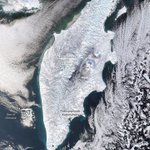
Record breaking snowfall blankets Russia’s Kamchatka Peninsula this January.


