

I believe Faith, Hope and Love always Kindness and Love for all Lives and peace for the World
Casper WY
Joined August 2023
- Tweets123K
- Following4.9K
- Followers2.6K
- Likes74.1K









Matthew Gerhard retweeted
I AM hoping this account is still not on lock down for the day. The thing is, there seems to be so much information that needs to come out. The time is coming, the trumpets are going to sound and the draw bridge will open both cities in one.

Matthew Gerhard retweeted
The thing about the trumpets are they are on the city walls, the draw bridge is for the river that flows between the city of gold. It is truly hard to explain but there is a golden rope on one side of the river that goes to the Fly Fishing Statue, it glows like never seen before.

Matthew Gerhard retweeted
Dropping a few coins into a body of water helps it rise up a tunnel or tube primarily by displacing the water and forcing it upward.
That is what happened yesterday, two coins pushed the water up and out the tunnel by popular bridge.

Matthew Gerhard retweeted
Dropping a few heavy, dense items like coins rapidly increases the water's height compared to dropping lighter objects that would just float on top without displacing their full volume.

Matthew Gerhard retweeted
Hot steel bridges are often sprayed with water during hot weather to cool the metal down and prevent it from expanding and jamming. That is one of the issues with the first street bridge, It is always hot and it was jammed and it was trying to move.

Matthew Gerhard retweeted
Last night, the bridge outside where I stay, it was smoking so much and I was getting sick. I have never seen so much white smoke on the ground and there where two different black clouds meeting over the top of it.

Matthew Gerhard retweeted
The fact that water is flowing out means the tubes are doing exactly what they were designed to do, but the presence of sand is a serious red flag.
The sand is coming out the first two and then rocks are coming out the third one.

Matthew Gerhard retweeted
It sounds like you are describing a drainage scupper system or weep holes designed to manage water runoff around a bridge structure.

Matthew Gerhard retweeted
Why Rocks Coming Out Changes Everything
When these systems are built, the layer closest to the weep hole is made of large, coarse drain gravel (rocks), followed by a filter layer, and then the native soil or sand.

Matthew Gerhard retweeted
The first two tubes are washing out fine sand, which means the filter fabric has failed, and the deepest layers of supportive soil are actively eroding away.

Matthew Gerhard retweeted
The third tube washing out actual rocks means the heavy drainage gravel barrier itself is now collapsing and being pushed right through the pipe.

Matthew Gerhard retweeted
This indicates that large underground voids (hollow spaces) have already formed behind that concrete pad. Without that gravel and sand to distribute the weight, the concrete pad or the bridge approach above it has lost its foundational support.

Matthew Gerhard retweeted
This creates a high risk of a sudden sinkhole or a collapse of the concrete slab when heavy weight passes over it.
The issue is, for four years, I stated this, protested the River and the bridge being unstable and the cops just beat and arrested me.

Matthew Gerhard retweeted
2. Extensive "Soot Webs"
What look like heavy black cobwebs or soot webs under a bridge are often exhaust soot mixed with dust and oil, but they can also be bacterial matting or chemical efflorescence feeding on moisture leaking through concrete cracks.

Matthew Gerhard retweeted
This confirms that the underside of the deck is subjected to severe moisture trapping and lack of maintenance, accelerating the rust eating holes into the steel.

Matthew Gerhard retweeted
1. Holes Starting in the Steel (Advanced Corrosion)
Holes in the steel girders or support beams mean the metal has rusted entirely through. This is called pack rust or structural section loss. Steel bridges rely on the exact thickness of their steel to hold heavy weight.

Matthew Gerhard retweeted
Once holes form, the load-bearing capacity of the steel drops catastrophically. The steel can buckle or snap under a heavy load.

Matthew Gerhard retweeted
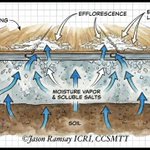
Efflorescence is a physical and chemical process where water-soluble salts migrate through a porous material like concrete or brick. As the water reaches the surface and evaporates, it leaves behind a white, powdery or crystalline deposit—most commonly calcium carbonate

Matthew Gerhard retweeted
The Chemical Reactions
Formation of Free Lime: During cement hydration (when water mixes with cement), calcium silicate hydrate and calcium hydroxide (\(Ca(OH)_2\), also known as free lime) are created.

