

Fontics is the fastest way to build scenarios, sensitivities and stress tests in Excel.
United States
Joined May 2025
- Tweets322
- Following207
- Followers78
- Likes29








The future of investment modelling is already here. It's just not evenly distributed.
You can already cut 90% of the time spent on investment modelling in Excel by combining AI and Non-AI automation.
- AI tools (like Claude) are great at Data Analysis and Model Scaffolding
- Non-AI tools (like Fontics) are great at Deal Structuring and Model Assurance
Fontics is the leading Non-AI Excel software to analyze deals in Investment Banking, Private Equity, Real Estate, Project Finance, Private Credit and Equity Research.
Takes less than 2 minutes from sign up to completing your first analysis!


1
93
ow do you run a sensitivity on WACC in your valuation?
This question came up on almost every deal. The IC asks what
happens to the valuation if WACC moves 50bps. Then 100bps. Then the other way.
1
2
45
Three steps:
→ Add a module
→ Link the input (WACC) and the output (Valuation)
→ Evaluate
You get 11 data points, a clean output table and a fully formatted chart, right in your existing model. 100% deterministic.
1
2
No prompts. No uploads. No AI.
Download the sample model and try it yourself: lnkd.in/esEJSwdH
Fontics works on any model in Excel or Google Sheets.
Try it free for 14 days: fontics.com
4
Your IC will ask the scenario you didn’t run: rates +100bps, exit multiple −1x, revenue −15%. All at once.
Fontics answers in seconds, inside your Excel or Sheets model. Deterministic, traceable, no AI.
14 days free → fontics.com

25
The Definitive Guide to Validating AI-Generated Models in Excel.
⁉️ AI can build financial models 2–5× faster, but speed is useless if the output cannot be trusted.
✅ This step-by-step guide shows you how to validate any AI-generated Excel model in just 10–15 minutes, helping you catch hallucinations, broken logic, and unreliable assumptions before they affect your analysis.
☀️☀️☀️
INTRODUCTION
Even if your firm hasn’t adopted AI yet, there’s a good chance that within the next 3-6 months, a non-trivial share of the models you receive will have been partially or largely built with AI.
So the question has changed from "Can AI build the model" to "How can we trust its outputs"?
This framework draws on 10+ years building models in IB/PE, Quants and FP&A; software testing and 2+ years working with AI-in-Excel.
You probably use most of these techniques already. The power comes from using them together, at scale.
☀️☀️☀️
1. BUILD: make the model easier to trust
a./ Components: Don’t one-shot the entire model. Build smaller modules, validate them individually, then connect them.
b./ Specificity: Be precise. Instead of “build a revenue model,” specify: “build revenue by 4 markets and 3 product lines.”
c./ Conventions: Force consistent modelling standards. Use short, readable formulas, clear flags and consistent conventions such as FAST.
☀️☀️☀️
2. FLEX: stress-test the model’s logic
a./ Driver analysis: Identify what actually drives the output. If terminal value drives 10% or 90% of your DCF, investigate.
b./ Negative tests: Push inputs outside their normal ranges .e.g. negative tax rates. Unexpected behaviour often exposes hidden errors.
c./ Sensitivity analysis: Repeatedly flex the 6–10 inputs responsible for 80%+ of the output. Look for discontinuities, strange relationships and inconsistent behaviour.
☀️☀️☀️
3. CHECK: inspect the model itself
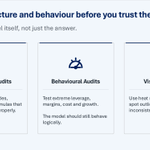
a./ Structural audits: Find orphan hardcodes, broken formulas, inconsistent ranges and formulas that don’t drag correctly across periods.
b./ Behavioural audits: What happens at 95% leverage? 2% EBITDA margin? -5% revenue growth? The model should remain logically consistent even under extreme assumptions.
c./ Visualize: Build heat-maps for key outputs and chart important line items. Patterns, jumps and outliers often reveal problems faster than inspecting formulas cell by cell.
☀️☀️☀️
CLOSING
The key principle: maker ≠ checker
AI can hallucinate. And the tool that built the model should not be your only tool for checking it.
This framework won’t guarantee an error-free model. But it will catch many of the subtle errors that can derail an investment analysis without being immediately obvious.
☀️☀️☀️
WHAT NEXT
For a 25+ sheet model, a thorough review like this can take 60–90 minutes.
With Fontics, you the same validation and much more in 10–15 minutes.
Build. Flex. Check. That’s how I’d validate an AI-generated models.
What stands out the most for you?


1
64


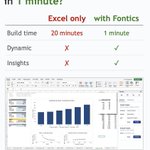
Can you build your base, bull and bear scenarios in 1 minute?
With Excel only:
- Build in 20 minutes
- Not dynamic
- No insights
With Fontics:
- Build in 1 minute
- Dynamic
- Insights on each assumption
While everyone’s adding AI. We took it out to ensure you get the right answer every time without hallucinations!

1
29
Can you run Monte Carlo Simulations for $15/mo?
Monte Carlo Simulations were never too difficult to learn. They were just too expensive to run.
With @Risk and Oracle Crystal Ball,
- Cost from $2000/yr
- No monthly plans
- Not support in Google Sheets
With Fontics,
- Cost from $144/yr
- Monthly plans from $15/mo
- Supported in Google Sheets

1
25


The $10 alternative to late nights in Investment Banking
… and you don’t need AI this time.
Are you an investment banking analyst?
You will work for 12 to 16 hours every day and spend 5+ hours grinding in Excel.
With Fontics, you can get 3+ hours back, every day:
- Review deals
- Evaluate risks and
- Audit models in minutes
…and cut 5 hours of analysis to 1.
No AI. Just fast, structured analysis so you can make investment recommendations with confidence while cutting up to 90% of deal review time.
Starts at $10/month.
*hush hush: it also works on Google Sheets

1
23
Run investment-grade deal reviews in Google Sheets in minutes.
No AI, just fast, structured analysis so you can review 3–5x more deals every week.
With Fontics you can:
- Map the main drivers of any deal in seconds
- Run 10 scenarios in any model in seconds
- Run stress tests in any model in seconds
- Refine complex deal structures in minutes
- Audit a 50-sheet model in minutes
Use your favourite Excel tools within Google Sheets
- Goal Seek
- Data Tables
- Solvers and 10+ more...
Deliver investment-grade analysis in minutes with modules built for private markets deal analysis including:
- Scenario analysis
- Scenario optimization
- Sensitivity analysis
- Driver analysis
- Football field analysis
- Model audits
- Monte Carlo simulations
Fontics is also available in Excel. Pay once, access in Google Sheets and Excel.
Plans start at $10/month. Try 14-days for free.

ALT Run investment-grade deal reviews in Google Sheets in minutes, No AI
1
34
Plans start at $10/month. Try 14-days for free at fontics.com
5