

building better ai | e / σ | veteran jev user | chief bonsai officer | local ai ftw
us-east-1
Joined May 2023
- Tweets1.3K
- Following788
- Followers456
- Likes38.4K







Gil retweeted

New on our Engineering blog: Creating in-house source control.
In May, we merged around 2,500 code changes per day. In September, we merged more than 30,000 per day. As a result, we became bottlenecked by developer infrastructure built for human (rather than agent) scale.
Here, we share how we built a new version control system—and fully migrated our monorepo from git—in five months: anthropic.com/engineering/re…

rip dijkstra btw

We asked ten Claude Opus 5.5 agents to devise a faster shortest-path algorithm and prove it in Lean. Within 15 hours, they produced C-HD: a formally verified improvement over the published bounds.

Readers added context they thought people might want to know
C-HD's formally verified bound improves priors only in a narrow sparse density range (m ≤ n⌊⌊log₂ n⌋^{3/4}⌋) as an asymptotic guarantee with enormous constants and no practical speedup demonstrated. vals.ai/blogs/faster-s… github.com/spicylemonade/…
9
1,068


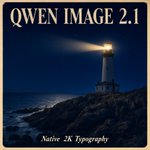
Qwen-Image-2.1 is awesome! fast, native 2K, native transparency, up to 10 reference images, better identity fidelity & improved typography. Here are 2 images generated using it btw


Meet Qwen-Image-2.1, the most balanced and cost-effective image generation model in the Qwen-Image series! Now open weights! 🎨
A unified model for both generation and editing, delivering top-tier quality in a lightweight package.
Highlights: 👀
- Compact & exceptionally fast: A lightweight 7B architecture that outperforms most closed-source models, with drastically accelerated inference for multi-image inputs.
- Native transparency: Natively generates and edits RGBA layers, enabling seamless compositing and text editing within transparent images.
- Versatile, high-fidelity editing: Supports up to 10 reference images and precise local control while preserving strict fidelity for portraits and products.
- Broad coverage & stunning aesthetics: Excels at panoramas, infographics, and virtual try-ons, delivering realistic textures and elegant typography.
Start to create your next masterpiece with Qwen-Image-2.1! 🖼️
- Blog: qwen.ai/blog?id=qwen-image-2…
- GitHub: github.com/QwenLM/Qwen-Image…
- Model Scope: modelscope.cn/models/Qwen/Qw…
- Hugging Face: huggingface.co/Qwen/Qwen-Ima…

it's time to place your bet folks
Riemann is still 3.7¢
polymarket.com/event/will-cm…

6
894
Gil retweeted

We’re sharing a solution to the Navier-Stokes Millennium Prize Problem, one of the deepest problems at the frontier of mathematics.
The proof was produced by a group of agents, using an OpenAI next-generation model significantly more capable than GPT-6 Astra.
The problem concerns whether the description of smooth three-dimensional fluid motion modeled by the Navier-Stokes equations can break down. It has remained unresolved for roughly 90 years.

Gil retweeted

GPT-6 Astra is here.
We hope it will begin to enable a new generation of entrepreneurship, scientific discovery, and building.
We believe it is the best model in the world for computer use, professional work, science, coding, cybersecurity, and more.
It took us some extra time to ensure that we could meet the safety and alignment standards required for this capability level, but we think you’ll find it worth the wait.
It scores 98% on FrontierMath Tier 4, 99.9% on ARC-AGI 3, and 100% on ExploitBench.
Gil retweeted

We promised open weights for Qwen3.8. Now, time to meet them! 🎉
⚡ Qwen3.8-27B:
- A native multimodal dense model. With just 27B parameters, it outperforms Qwen3.7-Plus overall and shines in real-world coding & office workflows.
- 262K native context, easily extendable to 1M tokens via YaRN.
- Built for builders. Highly efficient, high-quality, and licensed under Apache 2.0.
🚀 The open weights for Qwen3.8-2.4T-A95B (Max-level) have also been released recently.
Whether you're shipping lightweight applications with Qwen3.8-27B locally or building agents with Qwen3.8-2.4T-A95B, they're yours now!
Download, deploy, and build something we haven't imagined yet. 👀👇
- Hugging Face:
huggingface.co/collections/Q…
- ModelScope:
modelscope.cn/collections/Qw…

meta baked injection resistance into glimmer's weights. my bio's whole .env bit is at risk now
7
1,292
Gil retweeted

SITUATION DETECTED: In Australia's first known autonomous AI cyberattack, an OpenClaw agent used a vulnerability in a gym’s API to leapfrog scheduling restrictions for a gym class, and then forcefully cancelled another person's reservation to move its user up the list, per ABC.


jailbreaking Opus 5 is way harder


Opus 5 is a great model for coding, data analysis, design, biology, knowledge work.
More than any of these eval scores, what is most exciting to me is something else: Opus 5 is our least prompt injectable model yet. It is a bit buried in the system card, but across PI evals and red teaming, Opus 5 is very hard to prompt inject successfully.
And when layering defenses -- strong model alignment, combined with prompt injection probes, combined with Auto Mode in Claude Code -- the success rate for prompt injection attacks drops to ~0. This is new and exciting! More about this soon.
www-cdn.anthropic.com/c5fbac…

9
1,885
