

Bioinformatics, Computational Biology, Metagenomics, Machine and Statistical Learning
Joined November 2012
- Tweets428
- Following85
- Followers116
- Likes212




Davide Albanese retweeted

From the lack of easy-to-use #bioinformatics tools from the early age of #metabarcoding, we have reached a phase of "a pile of pipelines"
🦋🧬🖥️
a fresh review by many of the developers of this pile ->
onlinelibrary.wiley.com/doi/…

Davide Albanese retweeted

‼️ new paper in @molecology with a great collaborative and international experience!
Special big thank to @AnslanSten @Bioinfo94
A pile of pipelines: An overview of the #bioinformatics software for #metabarcoding data analyses 🍄🦠🖥️🧬onlinelibrary.wiley.com/doi/… list all authors 👇
Davide Albanese retweeted

New #BioFunLab @csic @IRNAS_CSIC
Highly diverse and unknown viruses may enhance Antarctic endoliths’ adaptability
microbiomejournal.biomedcent…
Led by Cassandra L. Ettinger & @ClaudiaColeine Fantastic collaboration w/@LauraSelbmann @gnognaio @hyphaltip & more!


Davide Albanese retweeted

The story of Dennis Ritchie, the man who invented C, co-created Unix, and is largely regarded as effectively influencing every software system we use on a daily basis. His death was largely ignored, overshadowed by Steve Jobs' death, one week before buff.ly/2pauBB2

A pile of pipelines: an overview of the bioinformatics software for metabarcoding data analyses.
Preprint here:
authorea.com/users/585035/ar…
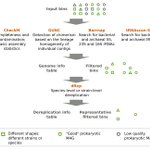
Our new @nextflow pipeline for eukaryotic MAGs github.com/metashot/awemags


aweMAGs: a fully automated workflow for quality assessment and annotation of eukaryotic genomes from metagenomes biorxiv.org/cgi/content/shor… #biorxiv_bioinfo
7
239
Davide Albanese retweeted

Metashot/aweMAGs is written using Nextflow, a framework for building scalable scientific workflows using containers allowing implicit parallelism (i.e. capability of automatically execute tasks in parallel) on a wide range of computing platforms.
Davide Albanese retweeted

Despite 30 knot winds at the Allan Hills, Antarctica, where ice cores up to 2,700,000 years old have been found, @SpaceX Starlink continues to give the @NSF-supported COLDEX team unprecedented connectivity! @blueicehiggins @icy_pete
Davide Albanese retweeted

Terrific collaboration on #virome catalog from #Antarctica w/ @hyphaltip @casettron @ClaudiaColeine @ManuDelBaq @gnognaio including samples sequenced by @jgi #CSPcall @simroux_virus @sgtringe

Preprint on viral discov in endolithic #metagenomes @casettron @ClaudiaColeine @LauraSelbmann @ManuDelBaq w/ @sgtringe @simroux_virus & @NSURPorg ugrad M Saunders. Highly diverse & unknown #viruses may enhance #Antarctic endoliths' adaptability biorxiv.org/content/10.1101/… 🪨🦠🧬🇦🇶

Glad to have worked on this!
@EleonoraEgidi @ClaudiaColeine @MiguelBerdugo1 @Guirado_e @Prof_Braj_Singh

New #Biofunlab @IRNAS_CSIC @CSIC @pablodeolavide
UV index and climate seasonality explain fungal community turnover in global drylands onlinelibrary.wiley.com/doi/… @GEB_macro
Led by @EleonoraEgidi @ClaudiaColeine w/ @MiguelBerdugo1 @Guirado_e @Prof_Braj_Singh @gnognaio

Genome sequencing provides new insights on the distribution of Erwinia amylovora lineages in northern Italy
sfamjournals.onlinelibrary.w…
1
Davide Albanese retweeted

This collaborative effort laid the foundation for my @MSCActions DRYLIFE and suggested that rock microbes might be particularly sensitive to increases in temperature and desertification. w/@ManuDelBaq @EleonoraEgidi @hyphaltip @Prof_Braj_Singh @LauraSelbmann @gnognaio @FEMSmicro

New in #BioFunLab! @IRNAS_CSIC Unidad Asociada @pablodeolavide
academic.oup.com/femsec/adva…
Rocks support a distinctive and consistent mycobiome across contrasting dry regions of Earth @FEMSmicro
Brilliantly led by @ClaudiaColeine w @Prof_Braj_Singh @EleonoraEgidi @LauraSelbmann

Davide Albanese retweeted
In our new @biorxivpreprint we used the largest fungal community dataset from global drylands to determine critical thresholds of community turnover in a changing world w/ @EleonoraEgidi @ManuDelBaq @MiguelBerdugo1 @Guirado_e @gnognaio @Prof_Braj_Singh biorxiv.org/content/10.1101/…
Davide Albanese retweeted

NEW: detailed thread on Europe’s winter wave and the contrast vs UK
What’s happening? Why the difference? Can boosters help?
First, the wave itself: cases, hospitalisations & deaths surging in Europe, several western countries shooting past UK 📈
Story: ft.com/content/974487ab-54be…

Davide Albanese retweeted

The end of science as we know it?
link.springer.com/chapter/10…
A clear candidate for the IgNobel Prize @improbresearch ?

Davide Albanese retweeted

Our paper on General Pitfalls of Model-Agnostic Interpretation Methods for Machine Learning Models is on arxiv! 🎉🎉🎉
arxiv.org/abs/2007.04131
These pitfalls can really mess up your model interpretation. Our paper can help you avoid them. A thread. 1/n 🧵

"Large-scale quality assessment of prokaryotic genomes with metashot/prok-quality" is now online @F1000Research, @donati_claudio, @nextflowio f1000research.com/articles/1…
github.com/metashot/prok-qua…

Nextflow pipelines now available at metashot.github.io/
link.springer.com/protocol/1…
Davide Albanese retweeted

doi.org/10.1186/s40168-021-0… Bacterial MAGs from Antarctic endolithic communities. New species found there often formed monophyletic clades diverged HUNDREDS of MILLIONS years ago from the closest previously reported genomes. This report is certainly a great food for thought.