




Jordan retweeted

Huge congrats to the @Architect_Fi team.
We’re glad to witness this massive milestone for compute markets and our industry.
Only the tip of the iceberg!

Announcement: Architect, @Luxor, and @hyperbolic_labs have executed the first OTC option on compute. Through our CFTC Introducing Broker we structured a bespoke $5M put option on B200 GPUs settling against @silicondata’s index. Luxor priced and was counterparty to Hyperbolic.


Jordan retweeted
Tired of waiting behind red tape? Racks fixes this.

CME's compute futures will not launch Monday. NYMEX consented on November 4, at the CFTC's request, to another 60 days of review — the new deadline is January 8, 2027.
The contracts, cash-settled futures on Silicon Data's H100 and B200 rental indexes at 730 GPU-hours each, were first set for October 5. The first regulated market for hedging GPU rent now slips into 2027 before trading a single contract.
$CME
Jordan retweeted
The Great Rack Spread

The "Rack Spread" is unfolding, token prices are falling while GPU prices climb
Change since mid-July:
- B300 GPU rentals up 106%
- B200 up 66%
- H100 up 17%
- Average token prices down 58%
Charts of the Week: a16z.news/p/charts-of-the-we…


Jordan retweeted

Delaying compute futures has a real cost for US innovation. Some of the largest data center lenders have hit their risk limits. Give them a liquid market to hedge compute price risk and they can free up lending capacity. It's the lack of a hedging instrument that has caused credit spreads to blow out.
We support the @CFTC’s commitment to getting this right. The good news is we already have standards for building these markets properly: independent benchmarks, transparent methodologies and regulatory access to the underlying data. Apply them to compute and let well-designed futures move forward.
Our comment letter: regulations.gov/comment/CFTC…
Jordan retweeted

Top commodity brokers are gearing up to trade derivatives tied to the cost of renting computing power for AI bloomberg.com/news/articles/…

Jordan retweeted

Given the recent volatility, the need for price discovery and risk-management tools for compute has never been clearer.
Thank you @citicsintl for the podcast opportunity—and for the chance to connect with clients across Asia around @CMEGroup compute futures.
The compute market is growing up. 📈youtube.com/watch?v=39inZajI…
Jordan retweeted
The need for a product (like @RacksHQ) is becoming more obvious with the nascent state of compute markets.
@BrettHarrison and @andrawesbahou giving free alfa here in their recent @Blockworks discussion

Jordan retweeted

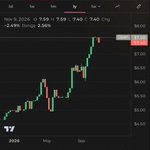
Massive 40% repricing of NVIDIA B300 hardware. When @Kimi_Moonshot realeased KimiK3 in mid-july, they *single handedly* caused the most violent repricing of NVIDIA AI Infrastructure, (40% in 3 months) with no stop in sight. They caused a major depletion of Supermicro's short lead-time hardware in end September, which exacerbated the pricing. Lead times exploded from 4 weeks to 32 weeks.
Kimik3 is uniquely suited to run on B300 hardware, which is why our Bloomberg: $DESKB300 index exploded over the summer.

Nvidia hardware is an appreciating asset, with B300 value up 40% in 3 months.
"The B300 Summer". In July, @Kimi_Moonshot released KimiK3, expanding B300 demand and value. By late September @Supermicro "Gold SKU" supply on 4-week lead time was depleted, triggering a continued value increase, with no sign of slowing down.
Residual value for Nvidia hardware is increasing.
@NVIDIAAIInfra @JensenHuang

ALT Nvidia B300 hardware value up 40% in 3 months due to open source software.
Jordan retweeted

Compute wars in a difficult spot. A lot of irrational behavior that amplifies the worst SV tendencies
“If you overbuy, you could bankrupt the company by having too many lease commitments, and if you underbuy, you could knock down your growth trajectory and have a bunch of unhappy users,”


Jordan retweeted
Every commodity you can't store ends up with a futures market. That's why we built Racks.
Racks Season Zero is now live ↓

I just published an essay at The Sequence about the case for AI compute as a commodity: thesequence.substack.com/p/t…
Start with a strange property of GPUs: an unused hour of capacity disappears forever. You can warehouse wheat, store oil, and resell a chip. You cannot recover yesterday’s idle GPU-hour.
That makes compute surprisingly similar to electricity and freight: expensive infrastructure selling a service whose value depends on timing, location, and availability.
Commodity markets developed ways to manage precisely these problems. Standardized grades made grain tradable. Futures helped producers and buyers manage prices. Credit financed the infrastructure behind supply.
AI is beginning to build its own version of that machinery.
But the details matter. Eight GPUs scattered across unrelated machines cannot necessarily replace one tightly connected cluster. A price hedge can protect your budget without securing a single GPU.
The essay explores how compute benchmarks, capacity contracts, derivatives, and financing could fit together, and why hardware turnover and fragmented markets make this difficult.
We spend enormous effort improving the machines that produce AI. The markets that allocate their capacity deserve just as much attention.
How we price and finance compute will ultimately help determine who can build with it and at what scale.