

CMO at Humanity Labs | Building the AI Workforce for the Human Firm | AI-native, AI-first | In the great debate, I believe that ST:TAS is canon.
New York, NY, USA
Joined June 2008
- Tweets5.3K
- Following4.7K
- Followers5.4K
- Likes578





Grad Conn retweeted

Republican voters showed up this week. A lot of them just walked into the booth and voted Democrat.
That's how the GOP lost 7 Senate seats while its own data team spent election week feeling pretty good about the numbers.
The thing they were watching has a name in campaign world. Data people call it composition, which is a fancy way of asking whether the folks voting this year look like the folks who voted for you last time. Same people turn out, you win. JD says that number kept coming back fine, and in Florida the electorate landed 9 points more Republican than Democrat, only a couple points off 2024.
The problem is that number can only see who walks in the door. Once someone's inside the booth, the model has no clue what they did. A guy who voted Trump in 2024 and voted for the Democrat on Tuesday shows up on that dashboard as a turnout win.
And there were a lot of those guys. NBC's exit poll found 7% of Trump 2024 voters went Democrat for the House, while only 2% of Harris voters crossed over the other way. In Kansas it was 10% of Trump voters, which is how Adam Hamilton became the first Kansas Democrat elected to the Senate in nearly a century.
Republicans tried to spend their way out of it too. They outspent Democrats on Senate ads $227 million to $154 million down the stretch and still lost 10 of 11 battleground states.
Anyone who's sat through a weekly business review knows this trap. I ran them at Epic, Affirm and Apollo. You track how many people log in every day, the number looks great, and nobody notices that a chunk of those logins are people on their way to cancel, because a login looks the same either way.
JD's other pollster went about it differently. He went straight to the Trump voters who had left and asked what would bring them back. End the war, deal with prices, put America first, change the relationship with Israel. Those four answers covered almost everyone, and JD says the same pollster called a 13-point generic ballot loss the day before.
He asked the people who left what it would take to get them back. That one question told him more than $227 million in ads could.

One of the things the data analysts on our side obsessed over was "composition"—whether the electorate looked close enough to 2024 for Republicans to win. And despite polls that showed a Democrat blowout, the data kept on telling us the same story: in some states turnout was merely OK, in other states it was downright amazing, and in no state was it catastrophic. There was a genuine sense of optimism on our team: our people were showing up.
So, I asked the smartest data guy I know, does that mean we're going to shock the world? "No," he told me. "We might do better than the polls suggest. But the data is telling us that a lot of Trump/Vance 2024 voters are pissed and planning to vote for the other guys. Our voters are turning out, but they may not vote for us."
Well, that looks prophetic now. Our voters did show up. In Florida, for example, the electorate was 9 points more Republican than Democrat, just a couple points worse than 2024. Undoubtedly there were places we could have done better on turnout. But the main problem is not turnout. The main problem is that many people who voted for Trump/Vance in 2024 voted for Democrats in 2026.
There will be a lot of infighting and arguing over what happened and why that is. One of the pollsters I really respect told me that our economic messaging wasn’t sharp enough down the stretch. I’m sure that’s true.
But the real reason we lost is obvious to almost everyone.
Another pollster—one of the smartest people I know in politics, told me yesterday we’d lose the generic ballot by 13 points. I felt negative going into Tuesday, but even I was shocked by this. In his polling, he saw that a lot of Trump 2024 voters were angry and planning to vote for Democrats. He asked those voters who had abandoned us what would cause them to come back on our team. The top four answers, accounting for nearly all of the responses were:
1) End the war
2) Focus on cost of living/inflation
3) Put America First
4) Change our relationship to Israel
Our voters showed up. And the above four reasons are why many of them voted for Democrats. This is according to a pollster who nailed the results. While many spent Monday attacking Rachel Campos Duffy for calling for a diplomatic resolution to the conflict, it turns out her political advice was sound. (She’s also a great person.)
In the next few months, there's going to be a lot of gaslighting. Expect to hear any number of establishment politicians say the solution to our woes is amnesty. I'm open to the idea that we should change enforcement—by focusing more on businesses that hire illegal labor, for instance. But anyone pushing amnesty is lying to you.
The reason we lost is the war. The president himself said so last night.
If you'd like to argue it was worth it, that losing the Senate for the next 6 years was worth it, then do so. Argue it was a worthwhile cost to pay. Agree or disagree, that's at least honest.
But everyone knows why we lost. And any honest conversation about where we go from here must start there.
I remain hopeful about our country. To the people who are pissed off and want to say, “I told you so”: you’re right, you did tell us so. Take that energy into electing Republicans who share your worldview. To the people who are just pissed at the results, you should be. Let’s take that anger and get back to the work of saving our country.
Grad Conn retweeted

Here’s a story for you. We started filming without owning the title and had to do alternates.
Taft Broadcasting owned the title Ghostbusters as part of their half-hour sitcom starring Larry Storch and Forrest Tucker (F-Troop) and a gorilla chasing ghosts. I had never heard of it. They didn’t have proton packs or Bill Murray. Columbia paid $500,000 to buy the name, but they really should have paid Dean Martin, from whom I first heard the term.
In the film Scared Stiff (1953), he and Jerry Lewis (check out his acrobatic stair descent) are in an old haunted castle, and Lizabeth Scott asks Dean: “Who are you guys?” And Dean answers: “You’ve heard of Trustbusters and Gangbusters, we’re Ghostbusters!”
For my research writing the first movie, I watched every single ‘ghost’ comedy ever made. Bowery Boys, Hope and Crosby, Abbot and Costello, Martin and Lewis all did such films.
Happy Halloween 2026.

Grad Conn retweeted

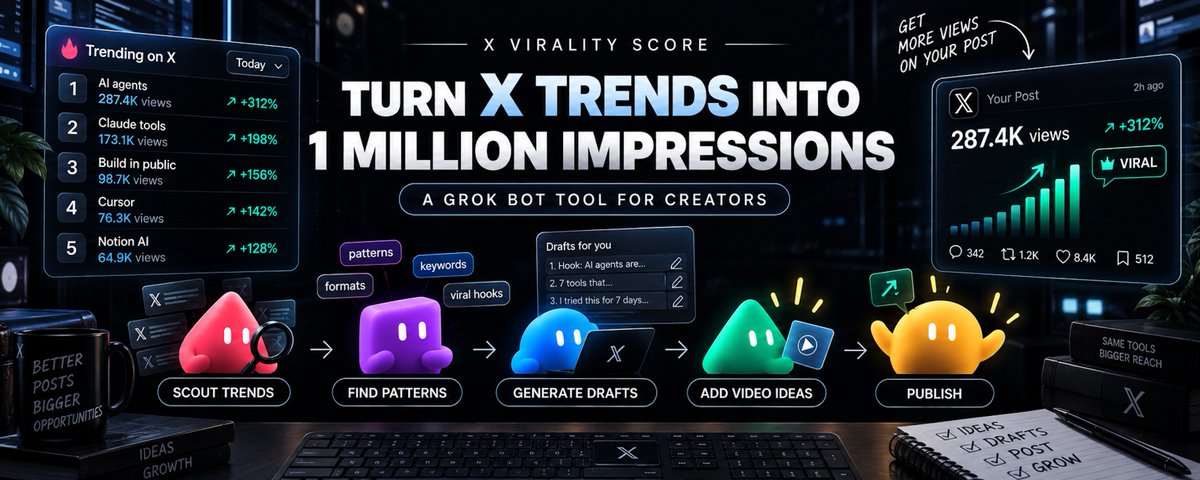
My Grok Bot now decides what I post every morning to get over 100k impressions per post
here's everything it does:
1. Scout.
it reads the 18 accounts I learn from and keeps only original posts that cleared 5,000 views. anything past 10k gets a star. replies don't count.
2. Pattern miner.
it doesn't copy posts. it pulls what keeps showing up in the winners: cold opens, numbered stacks, named tools, soft calls to action.
3. Draft writer.
patterns go in, ready English drafts come out, each with a short video tip. same energy that already traveled, none of the original wording.
4. Weather check.
every day it also scans ~20 fresh AI posts from the last 48 hours outside my list. my watchlist is school. outsiders are the weather.
5. Noon digest.
everything lands before noon: the hits, the patterns, the drafts. I open it with coffee instead of scrolling for an hour.
6. The board.
one screen with my X Score, a daily target and a DONE / NOT DONE chip on every hit. I see what's left at a glance.
the result: I ship 1-2 posts a day without guessing. and the formats it chases are the same kind that took one of my posts to 5M views per month.
it never posts for me. I pick the draft, fix it in my voice, hit publish.
it's free. the repo, the live board and the Grok Bot template are in the article below

Readers added context they thought people might want to know
Recent posts by this account have 10k-36k views, not over 100k impressions. The described system is an experimental manual tool per its repo and docs; the public board is a static demo with placeholders.
github.com/monkeyteamvip/…
monkeyteamvip.github.io/kiosa-board/
x.com/thegreatest_sv…
x.com/thegreatest_sv…
x.com/thegreatest_sv…
Grad Conn retweeted

This is perhaps one of the great ironies of our time: China is increasingly shaping the future of AI, yet very few people in the West have the faintest idea how its key thinkers see it - its philosophers, sociologists or ethicists.
As is too often the case, we - much like the frog in the well - assume our own AI debate covers every possible view, when much of it springs from the same cultural soil, built on assumptions about what defines us that we don’t even know we’re making.
Take for instance the assumption that intelligence is a key part of what makes us human. It’s so intuitively obvious to us that we literally named our species after it - Homo sapiens (Latin for "wise man").
If you think about it, just this assumption explains a large share of the anxiety: if intelligence is what makes us human, then artificial intelligence - or super intelligence - threatens the very thing that makes us us: we’re about to compete with artificial or super “us”. No wonder this feels existential.
But China has a tradition of thought as old as ours, if not older, and every bit as rich and sophisticated, which never placed intelligence at the core of what makes us human, and so meets the thinking machine from a completely different starting point.
Have you, for instance, ever heard of Zhao Tingyang? Probably not, and yet he may be the most original thinker on AI you’ve never read. He’s one of China’s most prominent philosophers, at the Chinese Academy of Social Sciences. While Silicon Valley spends billions trying to make AI share our values, he for one argues that doing so “may very well be a suicidal mistake”.
Sounds pretty important to hear him out, don’t you think?
Or take Liu Yongmou, a philosopher of technology at Renmin University in Beijing. His thinking is almost the opposite of ours. Where we fear machines that become more and more like us, he says that “humanity’s biggest problem is the machinization of humans, not the humanization of machines.”
You could even go back to antiquity, when, in many ways, we started asking questions about AI.
Did you know, for instance, that Aristotle, in the Politics, imagined a world where “the shuttle would weave and the plectrum touch the lyre without a hand to guide them”, and wondered about the social order consequences of this (mostly whether slaves would still be needed)?
There are Chinese equivalents to this. For instance, in the Zhuangzi, a foundational Taoist classic, you’ll find a similar thought experiment, with a completely different worry attached. An old gardener is watering his vegetables by hand, hauling water out of a well jar by jar. A visitor shows him a labor-saving device, and the gardener turns it down for the reason that whoever uses machines ends up with 机心 (jīxīn), a “machine-heart” - a mind that schemes, calculates and loses its simplicity. “It is not that I do not know [the machine],” he says, “but I should be ashamed to use it.”
Two labor-saving machines, two very different questions: where Aristotle wondered what automation would do to the social order, the Zhuangzi wondered what it would do to us, on the inside. Which, you’ll notice, is exactly Liu Yongmou’s worry, more than two thousand years earlier.
In fact, as we’ll see, 心 (xīn), the heart, is a motif that runs deep through the Chinese AI debate. It appears both in the fear, from Zhuangzi to Liu Yongmou, that machines could give us a “machine-heart” and its mirror image: the ambition to give machines a heart of their own. Zhu Songchun, who heads the Beijing Institute for General Artificial Intelligence, wants “to set a heart for machines” (为机器立心, wèi jīqì lì xīn).
“Heart” in the Chinese sense, that is, which differs totally from the Valentine's Day fluff we’ve reduced it to. 心 (xīn) means heart and mind at once: it’s where we feel but also where we think, tell right from wrong and care for others.
And, crucially, it’s in the heart that the quality Confucianism sees as the very definition of a human being takes root: 仁 (rén). We need two words to translate it, “benevolence” and “humaneness”, but in Chinese they’re one and the same: to be benevolent is to be human. It’s not about intelligence.
This is the entire point of my new article: to step out of our well for a moment and peer over the edge of China's.
What you’ll find there will, I think, surprise you, with questions you’d never thought to ask: from Zhao Tingyang warning that AI’s bad consequences can at least be fought, but that “humanity may die of all the good things AI creates”, to whether the fear that AI will make us “useless” rests on the false premise that a person is worth what they’re useful for.
A premise that a 2,300-year-old Taoist tree, which survived precisely because it was useless, demolished long ago. Could our predicted uselessness turn out, much like that tree’s, to be our saving grace?
Chinese thinkers’ answers to these questions are, I think, among the most interesting anyone has given to the defining question of our time. Whether or not you agree with them, they’re the intellectual backdrop of a country shaping much of AI, and with it our future: you might as well know what they think.
Enjoy the read here: arnaudbertrand.substack.com/…

Grad Conn retweeted

Rita Moreno performed “Fever” with Animal on The Muppet Show (1976) — a comedic performance that earned her an Emmy Award.
Grad Conn retweeted

The most insane paid ads program in Silicon Valley, behind Wispr Flow's $0 to $2B run
1/ "10 really good creators can get you to $50M a year"
-> The model: brands recruit creators to film their ads and pay them a percent of the ad spend
2/ A year ago Wispr Flow stopped organic UGC completely and put everything into paid
-> 500 to 700 new UGC ads a month now, aiming for 1,000
3/ They took the paid ads playbook of killer ecom brands
-> SF finally figured out what the best DTC brands have been doing for years
4/ Their view: organic only works with real talent on the team, while paid works for anyone who can ship enough different ads
-> You don't need a genius to win on paid, you need lots of ads that each look and sound different and a system that keeps them coming
5/ Ecom brands pay creators a cut of each sale. SaaS brands pay a cut of the ad spend, since a software sale can take weeks to close
6/ Wispr pays 7% of ad spend, uncapped, paid out every 7 days
7/ New creators get a guaranteed minimum, which is how Wispr signed good ones before it had a track record
-> $1,000 for 20 to 25 videos a month. A creator who earns $500 in commissions gets the other $500, and once they earn more than $1,000 on their own the guarantee stops
8/ Each creator works on one customer segment
-> A customer no ad was speaking to, a format nobody could shoot, a country with nothing running. One creator per gap
9/ No two videos are allowed to look alike
-> Meta's Andromeda clusters videos that are 50 to 60% similar and suppresses them, so 1,000 talking heads get treated as one ad
10/ They recruit on Instagram with keyword search
-> Search "UGC creator", "tech", "SaaS", mine the followers and comments of every good creator, send 100 to 200 DMs in a week
11/ 50 creators accepted out of 5,000+ applications
-> $220k paid out so far, top creator makes $12k a month
12/ Creators get $100 for referring someone at their level or above
-> No beginners on the team
13/ They scaled 5 creators, then 10, then 20, then 40, and stopped at 40 to 60
-> The whole climb from 5 to 50 took four months
14/ Creators are run like a sales team
-> 30-minute onboarding each, a weekly call with the media buyer, 1:1s, creator coaches
15/ Creators see the ad account
-> Every Thursday the media buyer walks them through what's working, which customers to target next and what to test
16/ One media buyer runs all of it: 50 creators, 700 ads a month
17/ The same creator ads run on Meta, AppLovin and TikTok
18/ The group stays small on purpose
-> $100k paid to 20 creators looks better to creators than $200k paid to 1,000
19/ Creators see which ad is winning and start making their own version of it. Wispr stops this and pushes them to film something new instead
-> Meta treats the copy as the same ad as the original, so the copy never gets shown
20/ Why other creator programs fail: brands accept everyone who applies, nobody coaches the creators, and creators join without understanding they only get paid when their ads perform
21/ Meta charges more every year for the same amount of reach, and that cost is out of Wispr's hands. The one thing they control is how good and how different their ads are, so that's where the money goes
-> Last quarter Meta showed 14% more ads than the quarter before and still raised the price of each one by 12%
22/ The guy who built it joined Wispr Flow at 19, before the product existed, with a 2.5 GPA
-> 25 months later: $280M Series B at a $2B valuation

Grad Conn retweeted

🦔The Blue Cross Blue Shield Association says insurers paid out nearly $1 billion more than usual from AI-assisted hospital documentation in 2024-2025. Hospitals use AI to scan records and find secondary diagnoses that human reviewers missed. More diagnoses means higher reimbursements. But treatment levels haven't gone up.
BCBSA's SVP of data science said AI is "identifying more billable conditions, not sicker patients." Insurers now deploy their own AI to deny those same claims. Patients pay for both through higher premiums.
My Take
This might be the most American healthcare story I've ever read. Hospitals bought AI to find more things to bill for. Insurers bought AI to deny those bills. The technology cost money on each end and the tab went straight to patients through higher premiums. A billion dollars moved and no one got any healthier. The only thing that changed was the size of the invoices.
Two sides of a trillion-dollar industry found a new tool to fight over the same pool of money and the person in the hospital bed pays for all of it. Premiums go up, denials go up, and the AI vendors collect from everyone. If you want to know who AI works for, stop reading the press releases and look at where the money goes. In healthcare it went straight into the billing department.
Hedgie🤗


Grad Conn retweeted

this is the first AI setup that genuinely scared me
GPT-6 Sol thinks. Jev decides. Grok Bot does the work. together they do a whole team's job for pocket change
alone, each one hits a wall. Jev can't write a sentence. Sol has no computer or phone of its own. and one builder put the last part best: "12 Grok Bots without Jev are just 12 tabs"
i couldn't find anyone running all three together. so i spent the last 48 hours wiring them into one team:
→ one group chat, 4 Grok Bots: Boss, Scout, Writer, Closer. they pass work to each other, you just read the chat
→ Boss plans the day with GPT-6 Sol. in one public test Sol did the same job as Opus 5.5 for $0.08 instead of $0.69, 4x faster
→ Scout pulls every lead in your niche and Jev asks each one 6 quick questions. one builder ran 3,412 leads like this: 20,472 decisions in 15.7 seconds for $0.41
→ only real buyers reach Writer, and Sol drafts every pitch. tricky lead? Jev tells Sol to think harder. easy one? it tells it to relax. that trick alone cut one setup's bill in half
→ Closer sends from your email after you tap approve. Telegram gets the scoreboard every night
the 6-hour job of reading leads now takes 16 seconds. your laptop stays shut
most people pay their smartest AI to say "skip" all day. this stack pays Jev a fraction of a cent for it
Claire Vo already runs about 30 Grok Bots. one prints her kids a newspaper every morning. another gets 5-star reviews from customers who have no idea it's a bot
every day you wait, someone's Scout reaches the client you would've gotten
bookmark this before someone's bot takes your clients


Grad Conn retweeted

Jev + GPT-6 Astra just built the most TERRIFYING AI trading setup on the internet...
[this article covers 90% of what is required to build quant-level systems]
/1 GPT-6 Astra reads the order book, the tape and 3 correlated futures
/2 Jev turns the signal into a trade and checks the risk limit
/3 computer use clicks the order screen, no broker API needed
/4 the full loop runs in 6 ms, signal to fill
steal this setup in the article below👇


Grad Conn retweeted

founders and marketers: you need an optimized "about us" page on your site
i work with billion dollar tech companies and bootstrapped SaaS. The About Us is one of the first pages we optimize
here's how (8 points):
(P.S. I explain why this is important at the bottom of the post)
here's how:
1. start with a clear value prop sentence: "[COMPANY] is a [CATEGORY] that [DOES XYZ] for [ICP]."
2. add your core services under a "what [COMPANY] does" H2 subheading. Put each service/feature/product in an H3 subheading. Write 2-3 sentences about what you do, and what outcome it produces.
3. next, add a "what makes [COMPANY] different" H2 subheading. List about 5 core differentiators in H3 subheadings. Give specific, quantifiable differentiators and call out competitors by name. Example: [COMPANY] offers month-to-month payment terms, whereas options like [COMPETITOR] have mandated 12-month contracts. Again: 2-3 sentences per differentiator.
4. your next H2 should be "who uses [COMPANY]." Add bullet points that call out your exact ICP segments. Example: "B2B SaaS marketing teams at 50 to 200-employees."
5. now add a "the team behind [COMPANY]" H2 subheading. Include the names of the founders, quick backstories, company origin story, team composition, and links to social pages (especially the founder(s) socials). You only need about 2 sentences per backstory/origin story.
6. add a "how [COMPANY] works" section. Include info like communication channels, response times, who on the team customers will work with, turnaround time, and onboarding process.
7. now for the most important section for AI Search: add a "key facts" H2. This should be an HTML <table> or <dl> (definition list) so it's crawlable. Include the following rows:
Company Name
Type
Founded
Founder
Headquarters
Website
Core Offering
Pricing
Contract Terms
Services
Communication
Notable Clients
Customers Served
Projects Delivered
Competitors
Social
8. finally, add your FAQ section. Put "frequently asked questions" in an H2 subheading with your questions as H3s. Only 2-3 sentences per answer.
Here's why this page is so important:
1. it helps train AI to talk about your brand accurately
2. it strengthens the E-E-A-T score of your entire domain
3. in a world where everything seems fake, make your brand human
shoot me a DM if you want a live demo of the lowest hanging fruit to rank in AI Search (tailored to your specific site)
i hope this helps someone!


Grad Conn retweeted

Gavin Baker: "The Magnificent 7 will go from $10-12 trillion to $50-100 trillion. But one or two of them will go extinct."
His foundation-model survival list is short:
- Google — search-plus-Gemini flywheel
- Meta — Llama + ad-revenue self-funding
- xAI — X + Tesla data footprint
Anthropic, OpenAI, everyone else — Baker treats them as commoditized.
His FOMO warning: "Application SaaS is done. If you went all-in on crypto and SaaS in 2021, don't repeat the trade."
On AGI: "Elon says 3 years. I say 5 is safer."
On regulation: "The leading labs weaponized fear of China. There's going to be no regulation."
The math he keeps quoting: $12T → $100T is 8x. But 1-2 die means winners take 30-40% of the total, not 14%.
Baker's frame: no regulation + AGI in 5 years + Mag 7 8x = biggest enterprise-value transfer in market history is happening right now.

Gavin Baker: "AI models will go to zero. Data centers are commodity. Energy is commodity. Only two things in the whole stack have real value: data moats and reinforcement learning."
His survival list is short:
- Google — already multi-trillion, safe
- xAI — his call: worth over $1T combined with X
- Anthropic — the other closed model that survives
Microsoft, OpenAI, Meta — chose open source. Baker treats them as commoditized.
What he actually buys: things that increase GPU utilization. Take a GPU from 30% utilized to 60%, you've doubled the output of the AI factory.
The math he keeps quoting: GPUs got 50x faster in 4 years. Nvidia sells for $50,000 what Taiwan makes from $700 of sand.
Baker's frame: don't rent intelligence. Own the thing it runs on.
Full breakdown — in the article below.
Grad Conn retweeted

I just read what Zuck wrote about Muse connectors.
A few things I think this means:
1. We’re witnessing the agentification of consumer apps.
2. Zuck believes Muse reaching 100M+ users feels entirely possible.
3. Whoever you connect to becomes your new landlord, so pick carefully.
4. Connectors become the new app listings (valuable real estate).
5. Being early could be as valuable as being early to the App Store in 2009.
6. Meta sees what people want, which providers convert, and what users will pay. That gives it the power to rank connectors, charge for distribution, and launch competing services.
7. The opportunity map includes agent native APIs, connector agencies, SEO for agents, identity and reliability infrastructure, and vertical connector marketplaces.
8. We’re moving from humans choosing apps to agents choosing businesses.
9. Every business will need an agent strategy, just like every business needed a mobile strategy.
10. Kinda crazy to say but a 3 person API company could reach 10M+ users through one great connector.
11. Connectors could create an entirely new second-order economy. The biggest opportunity may be helping businesses distribute, price, and optimize their services for agents.
12. Your API becomes more important than your app. Weird to think about but true.
13. Zuck wants Muse to own the moment between wanting something and getting it. He is coming for the app economy. Will he win? Right now it's Instinct vs Muse vs Grokbot. TBD.

Opening access for developers to build Muse connectors. You bring the API -- Muse brings the agent, the browser, and the context of what the person actually wants. People reach your service just by asking for it, and their agent takes it from there.
New connectors are live today. Come build with us. muse.ai/platform
Grad Conn retweeted

this is the most important thing youll read all year
"Everyone is telling you to learn the tools. I'm telling you to build the brain that makes the tools worth using"


Grad Conn retweeted

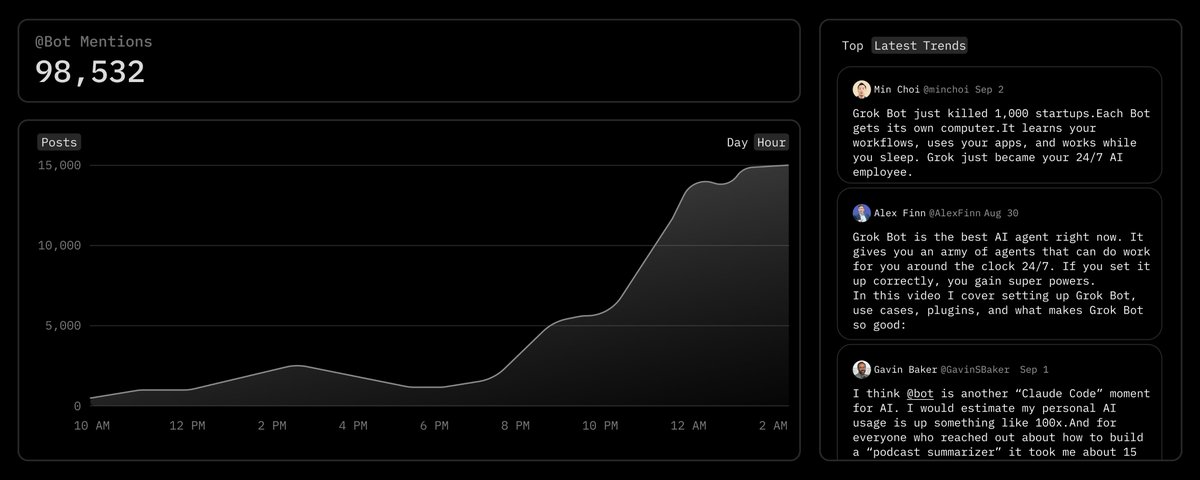
BREAKING: SpaceXAI has added a new guide called “Grok Bot 101”
It explains how to create a personal AI teammate in just 10 to 15 minutes, teach it real workflows, connect apps, and build teams of specialized bots that continue working in the cloud even after you close your laptop.
Here is the full guide in simple terms:
• What is Grok Bot
Grok Bot is an AI agent with its own persistent computer in the cloud. It has a desktop, files, terminal, browser, and apps. It can browse the web, use software, write and run code, and complete tasks just like someone using a computer.
You can access the same computer from your phone or desktop. When needed, Grok Bot can hand control back to you for a CAPTCHA, 2FA, or secure login.
• Creating a bot
Give the bot a name, title, and detailed instructions. You can explain the workflow through chat or record yourself completing the task.
Once trained, the bot can repeat that workflow whenever needed. It can also use MCP servers, plugins, skills, and connected services such as Gmail, Google Calendar, Google Drive, and Slack.
• Three ways to use Grok Bot
Send it a message in chat.
Create schedules or triggers, such as monitoring a Slack thread or GitHub PR.
Allow bots to message and activate other bots.
• Permissions and safety
You can write rules in normal language explaining what the bot can and cannot do.
A separate review agent checks proposed actions and can allow them, block them, or ask you for approval. Allow and block lists provide additional control, while the work runs inside an isolated environment.
One important detail: if you log into a website with one bot, other bots using that shared cloud computer can also access it.
• Multi-bot teams
You can create specialist bots for different jobs and let them work together.
One bot can ask another for help, several bots can work inside a group chat, and a scheduled routine can move a task through multiple specialists until the work is finished.
• Personal CRM
The author created a bot that turned the 800 to 900 people he follows on X into a private Notion CRM containing public profile information.
It helps him find and reconnect with people when traveling.
• Arnold, the fitness bot
He replaced a complicated fitness app with a Grok Bot strength-training coach named Arnold.
The bot uses MCP servers, plugins, and skills while requiring less maintenance. Its behavior can be updated simply by chatting with it.
• Building software
Grok Bot gathers information from Slack, Notion, GitHub, documentation, and other sources. It then creates a clean prompt and sends it to a specialized Cursor cloud agent that builds the software.
Grok Bot handles the planning and coordination, while the coding agent handles the actual build.
• Searching company knowledge
Grok Bot can search across codebases, Slack conversations, Notion pages, GitHub, and internal documents to answer product or company questions.
This helps people find information faster and reduces the need to interrupt coworkers.
• The biggest takeaway
Instead of repeatedly building scripts or complicated apps, you can describe a workflow to Grok Bot, improve it through chat, reuse it, and let it continue working in the cloud.
Grok Bot is not just another chatbot. It is a real AI teammate with a computer that can use tools, coordinate specialists, and get actual work done.
The future of work is becoming incredibly exciting.
x.ai/bot/guides/grok-bot-101
Grad Conn retweeted

Many years ago I ran marketing for a consumer app company.
We spent over $100 million testing ads and landing pages. We tried literally thousands of things and TWO tactics stood out:
1) Attractive women beat everything. We tested hundreds of images and the winner was always... a hot woman. Our perennial champion was Scandinavian.
2) The "buy button" can never be too big. We kept testing bigger and bigger buttons to the point of absurdity and the click rates only went up.
These two rules still apply today.
(@aussieflya, this one is for you.)
This quoted post is unavailable.
Grad Conn retweeted

Hashimoto's rule for AI agents is that every mistake becomes a permanent fix. This playbook turns it into six layers.
The document was compiled independently from work by HashiCorp cofounder Mitchell Hashimoto, OpenAI, Martin Fowler, LangChain, and Cursor, and it argues the model is the least important part of an agent. It boils everything down to one formula. Agent equals model plus harness.
The harness is everything wrapped around the model. Rule files it reads before starting, tests that check its work after, a loop that retries and then escalates, files that remember state between sessions, permissions that decide what it can touch, and logs that show what it did.
The evidence is what makes the playbook worth reading. Hold the model fixed, change only the harness, and the results move more than a model upgrade would.
LangChain's coding agent climbed from outside the top 30 to 5th on Terminal Bench 2.0 without touching the model. An OpenAI team shipped a million-line codebase across roughly 1,500 pull requests with no manually written code, and estimated it took a tenth of the time writing it by hand would have. One practitioner's write-up cited in the playbook reports the same Claude Sonnet 4.5 going from 31 percent to 75 percent on the GAIA benchmark with only the harness changed.
The idea I keep coming back to is that ratchet. Every time the agent makes a mistake, you engineer a fix so it never makes that mistake again. The fix lives in a rule file entry, a test, or a permission boundary that holds for every future run, instead of a prompt tweak that dies with the conversation.
The playbook's tell for a healthy system is that the rule file grows fast at first and then slows down. Early on you're adding several rules a day, and once the common failures are covered it settles to about one a week.
It also draws a line around when not to bother. One-off questions and brainstorming don't need any of this. The harness earns its cost when the same workflow runs repeatedly, mistakes have consequences, and nobody is watching.
The model is the intelligence. The harness is the reason it ships.


