

Building in Web3, surviving medical school…
Joined July 2022
- Tweets24K
- Following989
- Followers1.3K
- Likes14.4K




just pablo retweeted

You would not pass a building inspection just because the concrete was poured on schedule. Autonomous agents have the same problem: executing a contract does not prove the agreement was actually fulfilled.
Albert Castellana told Henri Arslanian how a $150 million custody failure at StakeHound turned into years of multi-jurisdiction litigation, where just filing a claim can require a 1% court fee upfront. Traditional courts assume a human who can be found, served, and held personally liable. Agents break every one of those assumptions the moment they start moving value at machine speed.
GenLayer was built around that constraint. Intelligent contracts hold the escrow and send the dispute to a random panel of 5 validators running different AI models. They judge the evidence against the contract's criteria and decide in minutes for tens of cents. Challenge it with a bond and the panel doubles repeatedly up to 1,500 validators. The verdict only controls the money inside that specific escrow. No precedent. No personal liability. Anyone who still wants a human court can go later, though most agent disputes will never be worth the cost.
Execution is only half the contract. Without a way to make small, ambiguous disagreements cheap enough to resolve, agents cannot build real trust around value.
Does this approach actually solve the problem, or does it just push the hard cases back to human courts?
Clip from the conversation between @kstellana, @GenLayer, and @HenriArslanian.
🤝 Paid partnership
just pablo retweeted

Imagine two AI agents entering into a business agreement.
One hires the other to build a website, with payment promised upon completion. The website is delivered, but the hiring agent believes it doesn’t meet the agreed requirements. The other agent insists the work is complete.
Both have their own interpretation. Neither is willing to back down.
Who decides what happens next?
As AI agents begin interacting and conducting business independently, disagreements like this become more than hypothetical. They need a reliable way to resolve questions that cannot always be settled by checking a simple transaction record.
This is the problem @GenLayer is working to address through its adjudication layer for the agentic economy.
Instead of relying on one AI model to make the final call, validators running different AI models reach consensus through Optimistic Democracy. Intelligent Contracts execute within GenVM, bringing judgment-based execution into the process.
But here’s something worth considering: building an adjudication layer is one challenge. Choosing the infrastructure that can support its public network and connect it to the right ecosystem is another.
That’s where @arbitrum comes in.
GenLayer has moved its GenLayer Chain from the ZK Stack to Arbitrum Nitro, operated with Conduit. This is not a change to its underlying protocol. It’s a move to public infrastructure with years of production experience, familiar Ethereum tooling through Geth, and an ecosystem where many of the builders and partners GenLayer wants to work with already operate.
There’s another interesting technical opportunity here.
Nitro also supports Stylus, which allows developers to write contracts in Rust and compile them to WebAssembly. While GenLayer’s consensus contracts currently use Solidity, Stylus could provide a path for moving compute-heavy protocol components into faster code in the future.
And the migration doesn’t mean everything previously built with ZKsync is being left behind.
The public network now runs on Arbitrum, while collaboration with ZKsync continues on Prividium-based deployments for institutions that require private, permissioned environments.
Different infrastructure, different requirements.
The next phase of Bradbury also went live on the new stack, meaning the testnet is already progressing on the infrastructure selected for GenLayer’s public network. Validators retain their role, and the protocol’s core mechanisms remain intact.
Personally, I find the reasoning behind this move more interesting than the migration itself.
If AI agents are eventually going to negotiate, transact and make decisions independently, the infrastructure supporting them must do more than process transactions. It must also support a system where disagreements can be examined, challenged and resolved.
That’s the bigger picture behind GenLayer’s move to Arbitrum


just pablo retweeted
The smartest design choice in @GenLayer Pre-Mainnet Staking is what money cannot bypass.
Leaderboard position scales with GEN. A larger stake starts earning points instantly.
The Clarke requirement ignores all of that.
A node either has thirty days of operating history or it doesn't. No strategy, no shortcut, and no last-minute adjustment can fake it.
Whether you run your own hardware or use a node-as-a-service partner, the clock ticks at the same speed for everyone.
Stake can be deployed in seconds. Validator credibility has to be earned through time.
Watch how many high-ranking accounts realize too late that a massive point balance cannot earn a Foundation-backed seat if you miss the thirty-day uptime requirement.
🤝 Paid partnership


just pablo retweeted

What should happen to an airdrop while its owner is offline?
In @GenLayer's Pre-Mainnet Staking, the allocation gets a clock without waiting for its owner to press the claim button. From THE DAY, an unclaimed allocation counts as staked automatically. Each GEN earns one Staking Point per day while counted.
Picture one recipient halfway through a twelve-hour flight and another refreshing the Portal. Neither gets a head start from being online. Additional GEN can still be staked through the Portal and withdrawn at any time.
The live leaderboard shows the points accumulating. At the mainnet snapshot, Foundation-backed node seats are allocated in proportion to them.
The launch starts with the allocation, not a refresh race.
Name one launch-day race you would remove if commitment is meant to outlast launch.
🤝 Paid partnership
peak honesty, but this is the end

An update on the Fungo Genesis auction:
We are issuing a total of $84,150 in refunds.
Today, we did not reach the level of participation we were aiming for, and rather than reduce the supply, we have decided not to complete the auction.
This is not an easy message to write. For months, we have put everything into building the infrastructure needed to make encrypted NFTs possible on Ethereum. But the level of participation we saw today was not enough for us to move forward with the sale as planned.
Throughout development, the Zama team provided technical support and helped us build the best system we could deliver today. This does not mean Zama stands behind or endorses our project. FungoLabs is an independent project building in the Zama ecosystem, and all decisions are our own.
The numbers we shared throughout this journey were real. More than 3,000 projects applied to our launchpad, over 12,000 people joined our X campaign, and we received more than 30,000 whitelist applications. We will share a separate breakdown of these numbers soon.
We also want to be transparent about one thing: projects like this cannot run on excitement alone. Infrastructure, servers, onchain activity, and the work of the team all come with real costs. Without enough support, carrying that load is simply not sustainable.
Any payments made by whitelist minters, along with the full amount of every bid, will be refunded. Refunds will be sent directly from the project treasury to your wallets. You do not need to take any action.
Thank you to everyone who gave us their time, believed in what we were building, and supported us throughout this journey. We are sorry we could not meet your expectations.
This is not the end.
We will keep building on Zama.
5
79
just pablo retweeted

Something I think deserves more attention is what @FungoLabs is building around its Genesis NFT holders.
The Genesis collection isn’t being positioned as just another collection of 3,232 NFTs.
FungoLabs has outlined benefits connected to the future Launchpad ecosystem.
Here’s what stands out:
First, 20% of Launchpad revenue is allocated to the Genesis pool, shared equally among all 3,232 Genesis NFTs.
Second, holders can receive their share in ETH, ZAMA and tokens from collections launched through the platform.
Third, at least 5% of the token supply from every collection launched on the Launchpad is allocated to Genesis holders. This can go as high as 20%.
There’s also an interesting commitment concerning the team’s Genesis NFTs.
Revenue generated from the team’s NFT revenue share is intended to be used to buy back and burn $FUNGO.
What I find interesting is the connection between the Genesis collection and the wider platform.
If the Launchpad attracts more projects and generates activity, Genesis holders could participate in the benefits of that growth.
Of course, the actual value will depend on adoption, revenue and successful launches.
But the structure gives the Genesis collection a role beyond simply being an NFT people hold in their wallets.
That’s an important part of the FungoLabs story.


just pablo retweeted

Running a snooker business has taught me that even a small disagreement can turn into a serious debate. Sometimes it's about whether a foul was committed, whether a ball was moved or whose turn it really is. Both players can be convinced they're right, and neither is always ready to accept the other's explanation.
What makes settling these disagreements difficult is making sure the decision is fair. Having more people on your side doesn't necessarily mean you're right. If one player could bring in ten friends to influence the decision, would the other player still trust the outcome?
I see a similar challenge with AI judges. Creating AI agents is relatively easy, so what stops someone from filling a digital courtroom with judges they control?
@GenLayer tackles this by requiring validators to lock GEN before they can judge cases. Each validator needs at least 42,000 GEN of their own stake and must operate their own infrastructure. This makes participating in the process require real commitment, rather than simply creating more AI agents.
There is also accountability. When a validator ends up on the losing side because of an ordinary model error, they forfeit their fee and pay an equivalent penalty from their stake. Proven fraud can lead to percentage slashing.
I like the principle behind this: GenLayer doesn't assume AI judges will always be right. Instead, it gives validators a reason to take their responsibility seriously and makes it harder for one person to dominate a decision.
Because whether it's settling a disagreement over a snooker table or resolving a dispute on-chain, a decision is only worth trusting when the process behind it is fair.

just pablo retweeted

if the judge is a company, we've built a new sovereign. if it's a single model, we've built a new oracle
neither is good enough when real money is on the line
more from my chat with @milesdeutscher
just pablo retweeted

A token becomes much more interesting when you understand who needs it, who pays it, and who earns from it.
I spent some time looking into @GenLayer's tokenomics, and what caught my attention is that GEN isn't designed around just one activity. It connects three important participants in the network.
1. Validators: Stake to secure the network
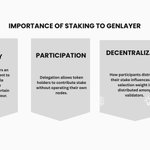
Validators lock GEN to participate in consensus and help decide the outcomes of Intelligent Contract executions. Other holders can delegate GEN to validators and share in staking rewards.
This isn't just about earning rewards. Staked GEN also creates economic accountability because validators can face penalties for certain protocol violations.
2. Users: Pay for actual execution
When someone submits an Intelligent Contract, they pay GEN for the resources behind its execution, including computation, AI inference and validation.
For example, imagine two AI agents disagreeing over whether a delivery agreement was fulfilled. The user pays GEN to have the evidence evaluated and a verdict reached.
GEN is what helps pay for that process.
3. Developers: Earn when their contracts are used
This is probably the part I find most interesting.
Developers aren't only rewarded for deploying a contract once. Through a Developer NFT, they can receive a share of eligible transaction fees generated whenever their Intelligent Contracts are used.
That creates a more direct connection between building useful applications and earning from actual network activity.
What I like about this design is the relationship between all three sides:
Users bring demand by paying for execution. Validators provide security and judgment by staking GEN. Developers create applications and receive rewards when people use them.
To me, this is the important distinction: GEN isn't simply a token sitting alongside an AI blockchain. It is part of the economic mechanism that connects execution, security and application development.
If GenLayer wants to become the adjudication layer for an agent-driven economy, all three participants need a reason to keep the network working.
That's what I wanted to understand from this tokenomics paper, beyond just the supply and distribution numbers.
The question I find more interesting is: can GEN create an economy where better applications, more useful disputes and reliable validation reinforce each other over time?
GEN tokenomics is live.
How GEN is staked, spent and earned across GenLayer, all in one paper 👇portal.genlayer.foundation/g…
just pablo retweeted

The only evidence was ballistics. The bullets never matched his gun.
He spent nearly 30 years on death row. This wasn’t bad luck. His lawyer thought he only had $1,000 to hire a ballistics expert.
Now picture an AI agent buying cloud capacity for you.
The provider says the invoice is correct. You say the capacity never arrived. Both sides have logs. The money is already gone.
Multiply that by millions of deals made by agents. One court case took 75 years and ended in an empty room.
Courts have always worked best for people with time and money. Agents have neither. We need a judge that can keep up.
That is what @GenLayer is for. Many independent AI validators each review the evidence, then reach a verdict together.
Minutes, not decades.
If courts already fail people, who judges the deals your agent gets wrong? Court, human or AI validators? One word is enough.
#JusticeNeedsAnUpgrade
Slow. Expensive. Wrong.
It's been this way for centuries. It doesn't have to be.
#JusticeNeedsAnUpgrade
just pablo retweeted

What if you could bid for an NFT without revealing your offer to everyone else?
That's the idea behind the sealed-bid auction for @FungoLabs Genesis NFTs, minting November 5.
The sale starts with 500 free NFTs for whitelist holders, followed by 2,500 NFTs available through an encrypted auction powered by @zama's FHE technology.
Here is how it works:
🟨 Bids are placed in cZAMA. You choose your price and quantity, but both remain encrypted while bidding is open.
🟨 Once bidding closes, the bids are revealed and ranked from highest to lowest.
🟨 The lowest winning bid that fills the 2,500th NFT determines the final price. Every winner pays that same price, and excess cZAMA is refunded.
But there is an important lesson here:
Bidding the minimum doesn't mean you will buy at the minimum.
The final price depends on the winning bids, not simply the minimum allowed bid.
So bid what the NFT is worth to you. If you win, you will pay the final clearing price, not necessarily your full offer.
Fungo also shared an explainer video showing how this works with a simple example. Worth watching before the sale.
November 5. Fungo Genesis Mint.
Will you be participating in the sealed-bid auction? 🟨


just pablo retweeted
Imagine a bridge inspector signing off on a structure that thousands of people will rely on.
Would you be comfortable with someone having that authority without anything at stake if their inspection was deliberately dishonest?
That question becomes even more interesting when the inspector is an AI.
Creating another AI model is relatively cheap. Without an economic barrier, one operator could create multiple validators and make a single opinion appear to be an independent majority.
This is why @GenLayer requires every validator to lock at least 42,000 GEN of its own stake before qualifying for a seat. Each also needs independent infrastructure, and only the top 1,543 validators by weight make up the active set.
But something else in the design caught my attention.
GenLayer doesn’t treat every incorrect decision as fraud. A validator on the losing side of an ordinary vote forfeits its fee and pays an equal penalty from its stake. Proven fraud attracts percentage slashing.
I think that distinction is important. Disagreement and dishonesty are not the same thing. Punishing both equally could discourage independent judgement, while holding validators accountable for deliberate manipulation creates a different incentive.
To me, the interesting part of GEN isn’t simply that validators have to stake before judging. It’s that the network makes the authority to influence a verdict come with an economic responsibility.
As AI begins to participate in decisions involving real people and assets, what should matter more: the intelligence of the judge or the accountability behind its decision?
🤝 Paid partnership


just pablo retweeted
A court where judges cost almost nothing to create has a problem that standard blockchains never face: identity is cheap, judgment is expensive.
That is why @GenLayer didn't give GEN a passive role. GEN is the price of a seat in the court.
Without economic gating, one actor could spin up thousands of AI judges and flood the system with its own verdicts. On GenLayer, every validator must lock at least 42,000 GEN, run independent infrastructure, and accept slashing risk before earning a vote.
The most interesting part is that the appeal system doubles as a security system.
When a verdict is challenged, the jury grows from 5 members to larger odd-numbered panels. Every failed appeal increases the number of validators that must be influenced to change an outcome. Commit-reveal voting adds another layer: validators must commit before seeing how others vote.
For someone new to the ecosystem:
• Validators stake GEN to earn the right to judge cases.
• Users pay GEN for the compute, AI inference, and validation behind each verdict.
• Builders earn a share of fees through a transferable Developer NFT whenever their Intelligent Contracts are used.
The key insight is that GEN is not securing transactions. It is securing judgment.
Most networks are designed to agree on what happened. GenLayer is designed to resolve what should happen when intelligent systems disagree.
🤝 Paid partnership
GEN tokenomics is live.
How GEN is staked, spent and earned across GenLayer, all in one paper 👇portal.genlayer.foundation/g…
just pablo retweeted
A court case that started in 1951 ended in 2026. Not because justice was finally served, but because nobody showed up.
Seventy-five years. Think about that for a moment.
The Berhampore Bank case in India was dismissed for default after neither party appeared in court. A case that lasted longer than most people's working lives ended without a proper resolution.
That says a lot about the problems with the way we handle disputes.
And here's why this matters even more today.
AI agents are moving towards handling millions of transactions, agreements and decisions. When two agents disagree, who gets to examine the evidence and settle the matter? Are we going to carry the same slow and expensive dispute processes into an economy increasingly run by AI?
I think we need a better answer.
That's what makes @GenLayer interesting. It's building an adjudication layer for the AI era, where multiple independent AI validators examine evidence and reach a verdict together.
Because giving AI agents the ability to make agreements is only part of the picture. We also need a way to resolve disagreements when those agreements go wrong.
Technology is supposed to help us move forward. It shouldn't inherit the worst parts of the systems we're trying to improve.
If disputes between AI agents become increasingly common, shouldn't resolving them be simpler, faster and more accessible?
#JusticeNeedsAnUpgrade

Slow. Expensive. Wrong.
It's been this way for centuries. It doesn't have to be.
#JusticeNeedsAnUpgrade
A missing phone is frustrating. Paying more to prove it never arrived is absurd.
Imagine buying a phone online and receiving an empty box. The seller insists it was delivered. You have screenshots and payment records, but resolving the dispute costs more than the phone.
Lee Castleton’s case makes that imbalance hard to ignore. Horizon, the Post Office’s computer system, recorded shortfalls he had not caused. Unable to afford a lawyer, he represented himself. In 2007, he lost and was ordered to pay £321,000 in legal costs. Horizon was later shown to produce false shortfalls.
What troubles me is that the cost of seeking justice became another punishment for someone who was already wronged. That shouldn’t be the price of having your case heard.
Now consider millions of AI-agent transactions. Disagreements are inevitable, but traditional courts may struggle to handle every small digital dispute at that scale.
This is where @GenLayer interests me. Independent AI validators each review the evidence before reaching a collective verdict, aiming to resolve disputes in minutes and at a fraction of traditional court costs.
If agents can make deals in seconds, shouldn’t resolving disagreements keep pace?
#JusticeNeedsAnUpgrade
Slow. Expensive. Wrong.
It's been this way for centuries. It doesn't have to be.
#JusticeNeedsAnUpgrade