

@hackerfren
🇺🇸Account based in
About this account
- Account based in
- United States
- Connected via
- United States App Store
Account-level information from X, not a live location or the device used for a specific post.
Hacker | Pilot | Lifter | OSCE3, CISSP, CCNP | Top 20 Hack the Box | World’s first Certified Offensive AI Expert (COAE) | reviews & writeups | meme magic 🐸
NC, United States
Joined September 2023
- Tweets3.2K
- Following768
- Followers2.6K
- Likes11.2K




Pinned Tweet
youtu.be/Mr1-phRij48?si=2lQM…
Check out my CYBR.SEC.CON. talk on how agentic AI is changing competitive hacking and the offensive cybersecurity landscape overall.
I took first blood times on Hack the Box machines going back since the start of the platform and did statistical analysis and found that solve times are decreasing by ~16% a year. Watch the full talk to see some of the other interesting trends I was able to parse out of the data.
If you still want to go deeper you can also check out the full whitepaper:
suzulabs.com/suzu-labs-blog/…


I found the Virtual Reality room at the Fargo ND airport. What a strange thing to find much less have at an airport.
There also shouldn’t terminals like this open to the public in a closed room with no cameras. People like me are gonna get themselves in trouble.


The php2shell thing quickly showed me how little most people know about how memory management works and how hard things like this are to actually port into a reliable exploit.
My first thought looking at the vulns was “this is neat” not that the internet was going to break.
So far I’m glad I turned out to be mostly right I suppose.
Jacob Krell retweeted

My amazing teammates at @SuzuLabs had this made for me to commemorate my 100k YouTube subscribers milestone. For those that don’t know, I used to be a pro wrestler back in the late eighties. @thehackermaker


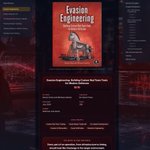
Evasion Engineering by Dennis Chow and Michael LaSalvia and published by @nostarch hangs everything on one concrete, repeatable idea. Make the operation look like it belongs.
The book in one sentence: Every part of an operation, from infrastructure to timing, should look like it belongs in the target environment.
Chapter 3 rotates source IP addresses through disposable AWS infrastructure so heavy enumeration survives IP blocklisting. Chapter 4 runs command-and-control over Firestore, and Chapter 8 stages data in uncompressed CAB files disguised as Windows update clutter, then exfiltrates it as hex-encoded Cloud Logging entries.
The techniques alone are worth the price of admission, and they will bump an operators evasion capability up a level. As of this writing, the labs teach tradecraft that actually performs, with custom ciphers tuned to stay inside the Shannon entropy window EDRs scan for, in-memory execution that sidesteps file-based detection, and an exfiltration pipeline built to bypass DLP. These are approaches that enable evasion of modern EDR and defensive systems right now, and that currency is rare.
I came in with an OSCE3 background and still came out with techniques I can use on the next engagement. What changed most is how I reason about tooling. A payload that dodges one signature still produces binary, process, network, cloud, and timing signals someone can correlate, and designing for the complete footprint is a harder and more valuable discipline than any single packing trick.
Part III is the weak stretch. Chapters 9 and 10 hold genuinely useful detection and purple-team material, but both pull away from the offensive-evasion thread that made Parts I and II strong. I also wanted more reasoning and fewer pages of code. The implementations show how the authors build these tools, and several would have worked better in a reference appendix.
Read it as an engineering book about the signals your tools leave behind, and it easily earns its 8/10.
jacobkrell.com/writeups/book…

My GitHub account was restored this morning, hurray!
I was not expecting a turn around in under 24 hours to be honest.
Jacob Krell retweeted
AI is changing how we approach security research. In just 20 minutes, a language model wrote a functional script to bypass jailbreak detection. While the code needs cleanup, the speed of iteration is a game changer for automation. @Jr0dR87 #CyberSecurity #AI
I had the chance to sit down with the CYBR.HAK.CAST podcast and discuss my path into cybersecurity, the death of the CTF due to agentic AI, and the rise in usefulness of deception technologies such as honey pots due to increased ai usage in offensive operations.
Listen in on one of the platforms below!
YouTube: youtu.be/0FB2ee-VpqY?si=_lpB…
Apple: podcasts.apple.com/us/podcas…
Spotify: open.spotify.com/episode/2hA…
CYBR SEC Media: cybrsecmedia.com/chasing-the…

There goes my free time for the next couple years! Starting my Computer Science Masters online in the spring at Georgia Tech.
Going to do the AI concentration, with a thesis that continues the work i have recently started regarding agentic swarms and inter-agent communications

The Spacecraft Hacker's Handbook published by No Starch Press and written by Andrzej Olchawa and Milenko Starcik is ambitious, practical, and deeply rewarding. It takes you from knowing almost nothing about space missions to having intelligent conversations about their architecture and enough methodology to conduct your own security research.
I came in with no real understanding of how spacecraft, ground stations, mission control systems, or satellite terminals worked. I finished the book with a working mental model of those systems and a clear sense of where I could keep learning on my own.
That is a significant achievement in a 344-page book. The authors compress what feels like an entire introductory course into an information-dense technical survey without getting stuck in the mathematics of signals or orbital mechanics. The most useful lesson is how many boundaries exist across a space system, and how those boundaries interact. Ground stations, mission control software, flight software, communications protocols, user terminals, and navigation receivers each create opportunities for research. The only thing likely to slow some readers down is also one of the book's biggest strengths: it covers a broad range of concepts in a relatively small page count, which makes the reading technically dense. That compression is part of why it works.
An 8.5/10 feels right for this fantastic introduction to space security. What keeps it from a perfect score is largely the same thing that makes it worth reading. So many concepts in 344 pages that the book stays technically dense and may put off readers looking for a lighter introduction. More than once I photographed a dense page and passed it to ChatGPT to explain every abbreviation before I could move on.
Check at the full review on my website:
jacobkrell.com/writeups/book…


Jacob Krell retweeted

The Spacecraft Hacker’s Handbook authors Andrzej Olchawa (@0x4ndy) and Milenko Starcik showed @davidbombal how patched web vulnerabilities in mission control software could expose files and send commands to a spacecraft simulator.
Watch the interview: youtube.com/watch?v=v0wB8Zal…
and preorder the book! nostarch.com/spacecraft-hack…

I had a chance to write for Dark Reading on the OpenAI Hugging Face attack and the need for human in the loop and "fail close" deterministic control systems.
Rules that agents can reason around following are not strong security controls.

AI Model Rules Are Not Security Controls: bit.ly/4i5g1U1 Commentary by Jacob Krell, Senior Director: Secure AI Solutions & Cybersecurity, Suzu Labs

My full review for Heavy Wizardry 101 By David Martinez Oliveira (Pico) and published by No Starch Press is now live: jacobkrell.com/writeups/book…
Heavy Wizardry 101 earns its hardcover. Pico takes you from foundational computer architecture through C and assembly exploit development, ending with a fully functional assembly worm that propagates across x86_64, ARM, MIPS, and RISC-V. The wizard theming runs deeper than decoration. Chapter titles like "Spell of the Binary Oracle" and "Veil of Ash" match the actual progression from apprentice to practitioner, and by the final chapters I genuinely felt like one.
This is the only No Starch Press book on my shelf with a hardcover, and the production quality matches the content. The technical depth and usefulness of what Pico covers made me feel like it earned that printing. 464 pages of C and assembly exploit development across four architectures is a lot of material, and the physical book holds up as a reference I'll keep reaching for.
I came into this with solid x86 assembly experience and limited exposure to the other architectures. The book's approach of implementing every concept across all four forced a kind of understanding I didn't expect. Instead of memorizing opcodes and register names per Instruction Set Architecture (ISA), I started recognizing the principles that carry across all of them. That shift from architecture-specific memorization to first-principles fluency is the most valuable thing I took from this book.
The trade-off is density. Pico does not hold your hand. He expects you to parse assembly, understand basic systems concepts, and keep pace with substantial blocks of code. There were stretches where I was reading more code than I fully absorbed in a single pass. The sheer volume of assembly across four architectures is tough to get through at times, but working that close to the hardware, across that many ISAs, is exactly what makes you feel like a wizard by the end. The title is fitting.
9/10. The only thing keeping it from a perfect score is that the density of cross-architecture assembly might be too intimidating for someone brand new to the subject. Everything else earned its place.
