

Educator & Investor; Power to the people.
Joined April 2015
- Tweets2K
- Following53
- Followers14.5K
- Likes3.5K





Live with @metanova_labs Subnet 68 on Bittensor. Healthcare supercycle.


Jack Ai-Leung retweeted

500,000+ hours of raw video behind one robotics model. A city subsidising companies' data purchases.
China's robotics data work is turning into a supply chain.
This is THOR Signals, our new series on the robotics data market, starting with China.
For context, China accounted for 59% of global industrial robot installations in 2025. Within that industry, three roles are taking shape:
• @beingbeyond_: model development
BeingBeyond builds models that help robots understand their surroundings and perform physical tasks. For Being-H0.8, the model behind those 500,000+ hours, raw video was filtered, reconstructed and reviewed before training.
• @PaXiniAI: specialist data supply
PaXini makes tactile sensors and training data combining vision, touch and movement. BeingBeyond names it an important data partner for Being-H0.8.
• @LightwheelAI: connecting training with deployment
Lightwheel supplies simulation, demonstration data and evaluation, and reported about $100M in Q1 2026 orders. At automaker Geely, factory demonstrations feed training, and testing shows where more data is needed.
Government is shaping demand too. Hangzhou's 2026–2027 action plan subsidises companies' purchases of data products and services (up to 30%, capped at RMB300,000). The national pilot base there invited outside data partners on 30 September across 25 task scenarios.
What we don't know yet: how much teams outsource, and which services they buy repeatedly.
For THOR, that's the question: which tasks do teams commission externally, and why choose a specialist over building in-house?
More from THOR in China to come.
THOR Signals · China

Building a world where users can protect their traffic is the right thing to do
That is why UR (SN25) replaces identities with integer counters in its anonymised data exports, carrying nothing across blocks and nothing back to a real user, and verifies every route with four Ed25519 signatures that prove a live egress without ever revealing who stood at either end
Self sovereign currencies and identities are congruent and unstoppable
Jack Ai-Leung retweeted
Robotics training data needs to reflect the environments where robots will work.
@haitzu on THOR’s open data marketplace at Exploit Summit:
“If these robots need to be everywhere, what we need to do is to get as many people from around the world contributing that data.”
My friends @axisrobotics just launched base:0x5be75e3b0aff5d1a042a5363ae36acb1d6d755ea today on Coinbase and Upbit
I invited founder Chris to discuss their approach to robotics learning, especially building a globally distributed contribution model to source diverse datasets for robotics training
Clanker season is upon us
Timestamps:
0:00 Intro
0:30 What is Axis Robotics?
2:38 Are we at the GPT moment for robotics?
4:31 Working with research labs
7:00 How contributors create robot training data
7:58 From Surge AI to robotics: the founding story
10:05 Raising $12M
12:05 The research paper: does messy sim data work?
14:31 Is 100,000 hours enough?
15:29 Crowdsourcing data from around the world
17:33 Why diversity beats hours (the OpenAI call)
18:24 Data vendor, or something bigger?
20:30 Case study: Booster Robotics
23:06 How Axis competes with Surge
25:58 What's next for Axis

Jack Ai-Leung retweeted

Great piece from Shayon
TL;DR:
- training data is a one-off purchase per model run
- agents search the web every time they act, so retrieval is the far bigger market
- a lot of that traffic gets through more reliably on residential connections
That's the network we've been building for the last 3 years. We have over 100k providers, giving us a diverse range of residential IPs around the world, and each one makes the network stronger
Agents can already use it too, with the same benefits people get, and our MCP server makes it easy to plug in
Usually, what an agent reads can be traced back to whoever is running it. On UR, that traffic is encrypted across the network, and sites see a provider's connection, not who's behind the request
Privacy for humans and agents alike


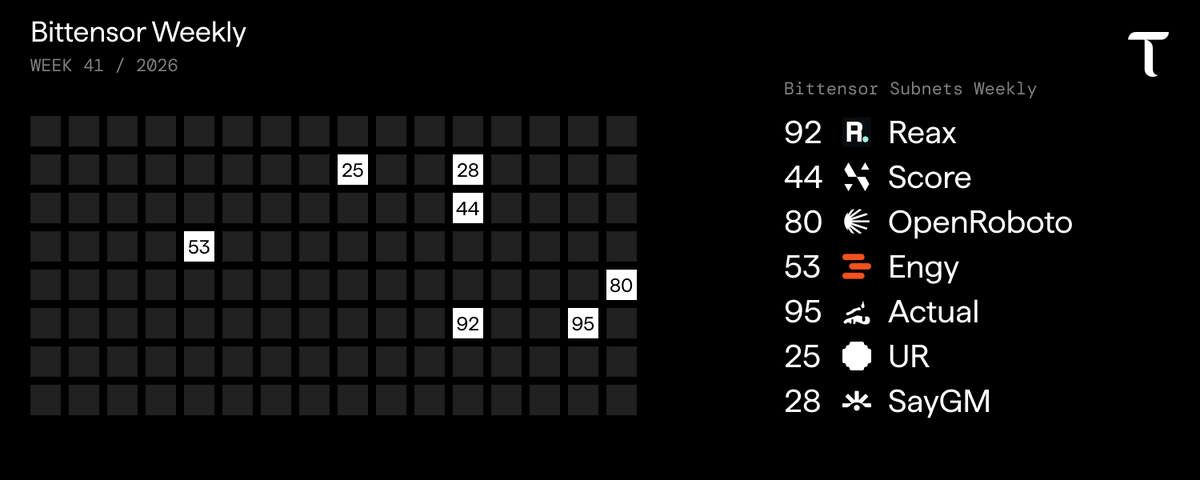
SCORE (SN44) remains one of the stand out MONSTER subnets which has been unstoppable over the last 12 months for Bittensor investors
There were many who liked the name last year, but many who didn't; if everyone thought they were the best, then it would be fairly priced
I find that divisive subnets are often the best investments
I met Max and co last year and they had a massive chip on their shoulder
he wanted to show the world what he was capable of, and he's showing it today
God speed team SN44
P.S. SN44 price is up, so is our data & design capability at Khala!


What are traits of a monster subnet in $TAO?
Here's @webuildscore (SN44) riding from #34 to #6
1. Starts small: 10x return from a top 10 is hard; Low base, long runway required. There's a reason the market doesn't like it - go find out if the market is wrong - that's where value is
2. Unique Product: Durable thesis on their tech stack w/ consideration for moat; Need taste, clear product velocity, iterating to victory
3. Superior Mgmt: Small companies need to make mistakes quickly + learn; Founders need to not be scared. Do not buy a subnet if you don't understand the person(s) leading the ship.
OK now that you have found the monster
HODL
Then re-evaluate as you collect more data
maybe you can find the next monster
Who do you think is the next monster?

In the UR (SN25) September Letter to Tokenholders, we outlined some core observations + objectives:
1) privacy is crypto's best-performing corner and the strongest moat (A16z: "privacy will be the most important moat"), UR's goal is to make privacy a seamless internet default for 1 billion people built on Bittensor
2) UR is live on mainnet, and we will be scaling our "Network Operator" franchise model, whereby SN25 token holders will have an ever increasing utility as demand scales
3) UR will grow miners ~10x (100k → 1M) via Bittensor, and we will ~50x active miners on Bittensor via our existing 100k fleet of miners. More people participating in the movement for privacy via Bittensor
ur.xyz/investors/letter-to-t…

Jack Ai-Leung retweeted

Subnet 25 @urnetwork will have more miners than the rest of Bittensor combined by a long shot (50x+) and they all strengthen the product ever so slightly. Ingenious incentive design by @xcolwell, truly a gifted builder. $TAO

UR is live on mainnet on SN25!
- Our 100k+ network providers are being transitioned to Bittensor miners
- Our validator is active, setting weights and verifying traffic
- It's permissionless for anyone to become a miner or validator
- Launch of Network Capacity Reserve (more info below)
After many weeks of hard work and countless hours spent to get here, we are proud of this milestone and appreciate all your patience on the journey
The job is far from complete but this is a big step forward by moving our infrastructure onchain. The core mission is very important to us and it's critical we build with intention, while properly testing these new changes
UR is building the privacy network for everyone and we are excited to be building this alongside the Bittensor community
Together we will help empower people across the world to have privacy online

No matter what they say, privacy is not the refuge of people who have something to hide, nor a premium feature to be granted to the deserving few.
It is the ordinary condition of a free human life, which is why technologists have an obligation to make privacy first the mandate for the people.
With Bittensor, we found a home of the people dedicated to the movement for open source software
It is the worthy place to chase the dream of individual ownership and freedom via new privacy first protocols
At UR (SN25), I will help the team shape further products dedicated to this mission
UR is live on mainnet on SN25!
- Our 100k+ network providers are being transitioned to Bittensor miners
- Our validator is active, setting weights and verifying traffic
- It's permissionless for anyone to become a miner or validator
- Launch of Network Capacity Reserve (more info below)
After many weeks of hard work and countless hours spent to get here, we are proud of this milestone and appreciate all your patience on the journey
The job is far from complete but this is a big step forward by moving our infrastructure onchain. The core mission is very important to us and it's critical we build with intention, while properly testing these new changes
UR is building the privacy network for everyone and we are excited to be building this alongside the Bittensor community
Together we will help empower people across the world to have privacy online
Jack Ai-Leung retweeted

High-quality human demonstrations will become invaluable as robots learn to perform more of our everyday tasks
Decentralized crypto incentives are primed to coordinate contributors globally + reward useful training data
The table compares peaq, THOR, BitRobot + Axis: what each produces, who pays + how value could reach the token
Our latest @KhalaResearch report breaks down the opportunity below
Expect more to come as this market segment heats up! So turn notis on and we welcome any feedback on our report below!

Robotics is still waiting for its "ChatGPT" moment
Language models had the internet to learn from, while robots need diverse physical demonstrations that are expensive to collect
Bessemer estimated just 300,000 hours of robot manipulation data globally in April, while others believe robotics could require 100M+ training hours
Bessemer projects $3B+ in robot-data spending over two years
Open networks are using crypto incentives to coordinate contributors across simulation, teleoperation and human video collection
Axis reports 7M+ trajectories from 220K+ contributors, with its data lifting task success from 83.9% to 88.8% on the LIBERO-Plus simulation benchmark
Our latest report explores the data opportunity through Axis, BitRobot, Eastworlds & THOR
Full report in the next post below

Jack Ai-Leung retweeted

Most AI still automates tasks. The next shift is AI that can run business operations.
The progression looks a lot like autonomous driving.
Just as cars moved from driver assistance to partial, conditional, and higher autonomy, business operations will move through the same stages:
0. Manual operations → people observe, decide and act.
1. Assisted operations → AI detects events. People act. (This is where Vision Agents sit today.)
2. Partial automation → AI executes tasks. People supervise.
3. Conditional autonomy → AI runs workflows. People handle exceptions.
4. High autonomy → AI runs a defined operation, including its exceptions.
5. Autonomous operations — AI coordinates and improves end-to-end operations.
The long-term direction is clear: increasing operational autonomy.
People set the goals, the policies and the accountability. AI runs more of the operations.
Humans govern.
At Manako Labs, we’re building World Models for Business so this progression can actually happen in the physical world, starting with the cameras companies already have.
Vision Agents are the entry point.
Levels 2–5 are the ambition.
Jack Ai-Leung retweeted
This is why we’re building THOR around robotics data, in the open.
Serving demand for annotation and verification builds revenue, expertise and customer relationships that compound as we pursue our vision across models and hardware.
We’re building for where robotics goes next.

The winning robotics data business has a much higher terminal value than investors are underwriting today.
Robotics will be a long race with many twists and turns, but when the ChatGPT moment hits, the winning data player will be in a very strong strategic position to capture token value. They will have large revenue, a strong balance sheet, talent density, deployments experience, and hardware supply chain knowledge. When it comes time to blitzscale they will be amongst the players that can capture the most value.
The reason this is misunderstood today is because most people are using traditional LLM data businesses as a prior for robotics data businesses and what their terminal value could be. I posit this is incorrect framing. Because the model and harness are integrated in LLMs, there is very little room for data players to play meaningfully in the token value flow in the long term.
In robotics this is exactly the opposite, the model and harness (hardware) are separate, the pretraining era is just beginning, there are many more dependencies on distributors/deployers, and there is a large surface area for other players than just models to capture value. Open source will also play a larger role earlier in the robotics race, as all prior LLM learnings will be incorporated as the race is run. This also creates opportunities for long term infrastructure players.
There is a massive amount of terminal value in winning robotics data and participating in the path of the industry from a position of strength.
From first principles:
The endgame of robotics will take place over the next decade. Empirically, today, no player has enough data, enough model intelligence, or sufficient hardware to facilitate a fast revenue takeoff in the field. No player has reasoned through the right sales motion either, which can take years to develop pilots and move to production. Serious players are correctly focused on scaling up pretraining/deep learning vs. who has the best model, deployment, or hardware today.
The robotics data business takes participants on a global hunt to build data, supply chains, and hardware. Along the way it also teaches deployment and deep knowledge of SOTA model development. Winning data participants also get the first crack at the still nascent robotics RL market, which will likely be the next large revenue stream after pretraining. As they compete to win data, data players must develop incredible talent density across both Asia and the US. The winning data business will have both Asian and North American DNA. Canada 🇨🇦 encompasses an interesting cultural mixture of both of these parts of the world. Bullish Canadian Robotics Mafias, more specifically Waterloo/Toronto.
So:
What would constitute a strong strategic position to capture value once the ChatGPT moment of robotics hits? You need a large revenue base, a strong balance sheet, and talent density + experience across data, deployments, hardware, supply chain, and RL. The hyperscalers, the frontier labs, and the winning data player all qualify.
Anyone under time pressure in what will be a long race is in a weaker strategic position in my view. Given the costs of integrated hardware+software+deployment, this would actually be most robotics-native players. They will depend on VC interest, which can be fickle.
UR (SN25) post quantum encryption + strong anonymisation features encrypts traffic between your device and the exit provider
Our first application ur.io only carries ciphertext, while the exit provider sees destinations without receiving your REAL IP address
The architecture is to maximally reduce what any one party can learn through the network, while making the remaining trust assumptions explicit
This is for our 350k MAUs, and also 1mm+ downloads we reached last month. The people expect commitment to privacy, and we work hard to deliver it

Run your agent through our repo:
github.com/urnetwork/connect…
Design notes on encryption enforcement and trust assumptions
github.com/urnetwork/connect…
the client-to-provider encryption implementation behind PQE