Entrepreneur. Sports & tech investor. @warriors @lafc @vivoaquatics @aXiomaticGaming @EpicGames
Los Angeles
Joined January 2010
- Tweets219
- Following495
- Followers2K
- Likes138






As an entrepreneur and product guy, I once felt sales and marketing were fluff and common sense. I’ve done a full 180 and now believe they’re the most important skills. Most products are commoditized and easily procurable.
If you know any sales and marketing superstar, please DM me. I have a couple of businesses needing one.
4
8
6,712
Over the last 25 years, I must have visited China 50-100 times. I thought I had a good understanding of how the system works - until I watched this. Very educational. youtu.be/axRhjqd-rus?is=Q8T-…
1
45
2,156
Heard from an engineer that there are more Claude accounts in Singapore than the population of Singapore.
The only thing I can find is the “usage intensity” of accounts based on a population, and Singapore is generating 5.5x to nearly 6x the Claude traffic expected for its population.
I wonder where all the accounts came from 🤔🤔🤔. Any guesses?
10 am in Guangzhou, I tried to ship a 5 lbs package to Shanghai (about 750 miles). The concierge asked me whether I need it there fast or slow. I said slow is fine. He said the slow package will arrive by tomorrow, 10 pm. 18RMB (about $2.70 USD). One min after I clicked ok to ship, I received an automated message saying that a carrier will pick up the package no later than 11:02 am. He showed up in 30 min.
It’s a different world out here. Different expectations.
1
188
“For nineteen years, my body was my career, and that taught me that health is built every single day, not just on game day.” — Carlos Vela businesswire.com/news/home/2…

54
Driving a Mercedes EQS (or any car other than Tesla) feels like operating a horse-drawn carriage. It’s an outdated waste of human energy. After waiting a decade for FSD to get here, I never want to go back.
1
139
Same box. Shipping test. One shipped 1 mile in the US via UPS, the other shipped 750 miles in China. Guess which is which?
1
3
10,235
Can’t wait to see this monster

Grok 5 is still deep in training on the massive Colossus II cluster.
Roughly 220k high-end NVIDIA GPUs are already online, with more being added.
Power draw is sitting around 1 GW and climbing.
The model is targeting the 6 to 10 trillion parameter range, which puts it in a completely different league from anything currently public.
Training has been running since at least January.
Elon recently confirmed it should arrive before the end of 2026 and will be trained on the full 25-year SpaceX engineering data set.
That combination of extreme scale plus proprietary real-world engineering data is the real story here.
This is not another incremental Grok 4.x update.
It is the much larger architectural and compute jump happening in the background while the smaller releases keep rolling out.
When it lands it should give SpaceX a serious internal edge on engineering, simulation and design problems that current models still struggle with.
Cursor is already running on the same cluster, so the jump in capability should show up there too.
No firm date yet, but the ambition on both compute and data is very real.


1
1
237
And there it is. An opensource model that beats Fable in what is arguably the most important test, the AutomationBench…. for business workflows. Will land on Kolo.ai as soon as it becomes available.


Introducing GLM-5.3: Built to Code. Ready for Cyber Defense.
- Top-tier coding and agentic capabilities, achieved through post-training on the 743B base model
- A major leap in cybersecurity, setting a new standard among open models
Tech Blog: z.ai/blog/glm-5.3


Very accurate

Other than Dario, I suspect President Xi also lobbied for the U.S. open-weight ban — because nothing would help China more.
After the ban, China does exactly what it's already doing: distill Claude, ship better models, and export the tech to the rest of the world.
Chinese enterprises find it easier to win:
→AI cost 100x cheaper
→ more agentic by default
→ services faster and cheaper than U.S. rivals
Internationally, they just out-compete us.
Chinese labs own Europe and Asia by default — they'd be the only serious open-weight providers left.
→ U.S. open-weight teams can't build on Chinese bases anymore. They're forced back to their own pretraining: more cost, slower progress.
Chinese models compound faster — they can distill from every model on the planet. U.S. labs get fenced in by their own IP regime.
The everyday asymmetry is the scariest part:
→A Chinese worker can afford 100 agents.
→An American worker can barely afford 1.
Turns out, the MAGA government will make China great again. President Xi is very proud.
166
Harry Tsao retweeted

$NVDA
NVIDIA'S JENSEN HUANG GIVES AN UPDATE ON KIMI K3 AND CHINA'S OPEN SOURCE MODELS:
"American companies should absolutely be allowed to use Chinese AI models. There's a misconception that somehow there are backdoors connected to China in someway. You download the models, fine tune them, guardrail them in any way you want."
"These Chinese opensource models are excellent. The market has misunderstood the impact of DeepSeek the first time. It's misunderstood the impact of Kimi this time. Open models are great for the whole industry, there will be more usage which will require selling more Nvidia computers and building more datacenters."
"Great models lead to more usage. There is also a misunderstanding that open models are going to hurt the closed models, that is also wrong."

I’ve heard friends call the distillation done by Chinese AI companies “theft.”
It’s not. Distillation is standard machine learning. The technique was pioneered by Geoffrey Hinton and colleagues at Google in 2015. Labs everywhere use it to transfer capabilities from stronger models into smaller, cheaper ones.
In April 2026 testimony under oath, Elon said xAI had “partly” distilled OpenAI models to train Grok — and called it “standard practice” in the industry. Google did something similar in 2023: contractors queried ChatGPT outputs to improve Gemini responses while catching up.
The bigger irony? The foundational US models were trained on internet-scale scraped data that included vast amounts of Chinese (and global) content, code, books, and forums — often without explicit permission. They’ve defended it as fair use.
Now that others are using their outputs, they hide behind terms-of-service violations. It’s a classic double standard: you can’t treat the commons as free when it benefits you, then call the police the moment someone else does the same.
1
18,128
Harry Tsao retweeted

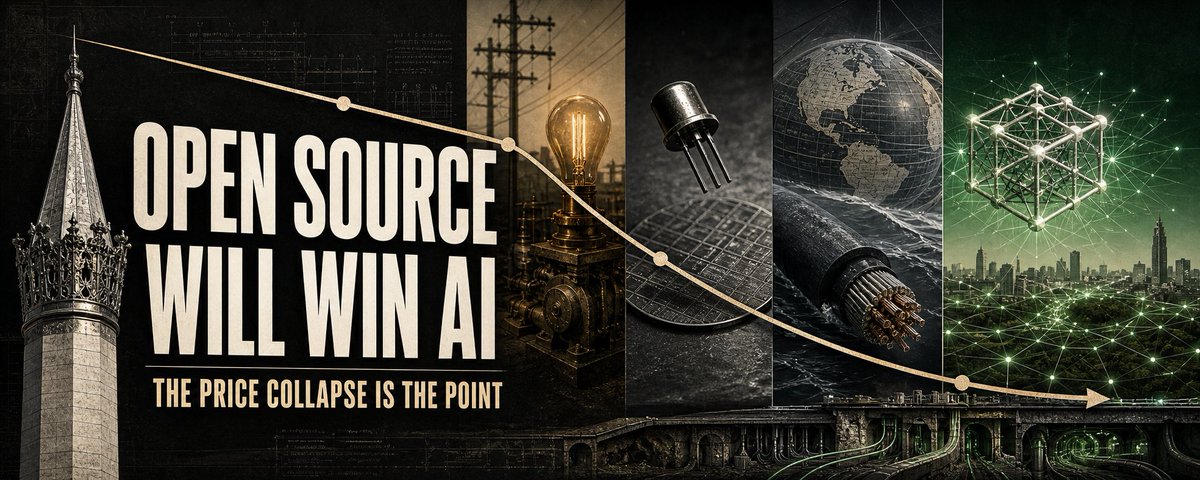
The leading AI has already forked into two options.
A: Closed source American that costs $26-56 per 1MM tokens.
B: Open weight Chinese that costs $0.50-1 per 1MM tokens.
If you force American companies to spend 50-100x more than their competitors abroad here is what will happen:
1. American companies spending 50-100x will at some point become financially impaired and the stock market will crater. This is the equivalent of the US Government saying we can only buy oil at $800/barrel even when the free market sells the same oil for $80/barrel.
2. In the short term, the revenues of the Closed American Labs may remain hi. But then their revenue will also crater because their customers in the US will be impaired and their customers abroad will have already flipped to cheaper solutions.
This would be a terribly self-defeating form of intervention if it were to happen.

Open-source ≠ free. Open-source ≠ zero margin.
Think of the weights as a recipe. Labs give it away to get developers hooked.
But a raw recipe doesn't feed anyone. The APl is the restaurant.
Running these systems at scale takes massive infrastructure, and developers happily pay for the convenience. That's where the high-margin profit lives.
So why can't a third-party host just download the free recipe and undercut the creators?
Because the creators keep their kitchen secrets. Custom hardware optimizations, memory management tricks, all strictly behind closed doors.
An outside host running generic setups can't match the speed or cost of the lab that built the thing.
Open-source isn't charity. They give away the blueprint so they can sell you the power grid.
3
25,990
This is just one benchmark, but a lot of value are going to be wiped off the valuations of OpenAI and Anthropic.
These are two IPOs that feel impossible to price. Yes, revenue is scaling. But I have never seen a business where the core product is under such relentless assault by open source, and the switching cost is literally one API key swap away.

Big news: Kimi-K3 by @Kimi_Moonshot is now #1 in the Frontend Code Arena with 1679 pts, surpassing Claude Fable 5.
This is a 17-place jump from Kimi-k2.6 (#18 -> #1).
In Frontend, Kimi-K3 ranked #1 in 6 of 7 domains: Brand & Marketing, Reference-Based Design, Data & Analytics, Consumer Product, Simulations, and Content Creation Tools, landing #2 only in Gaming behind Fable 5.
The full model weights will be released by July 27.
Congrats to the @Kimi_Moonshot team on this major milestone!

Had to ask Fable this:
I'm not too familiar with soccer, so I don't really understand the quality of players on the USMNT. Using player data, can you identify the most likely parallel if they were basketball players? Would they be in the NBA? If so, who are they most similar to?
Here's the answer:
The big-picture answer first: Yes, essentially everyone on this roster would be "in the NBA." Playing for clubs like AC Milan, Juventus, and Monaco is the equivalent of being a legitimate NBA rotation player or better. What the US doesn't have is an MVP-tier superstar. Think of the USMNT as a team like the Indiana Pacers or Houston Rockets: young, deep, well-coached, several All-Star-caliber guys — but no Jokić, no Giannis. France has Mbappé and Argentina had Messi; those are the LeBron/Jokić class, and the US has never produced one.
That's the gap.
Here's the player-by-player mapping:
Christian Pulisic → Devin Booker. The face of the franchise, a genuine star at a glamour club (AC Milan), perennial "All-Star" but not a top-5-in-the-world player. Carries enormous national expectations, mostly delivers.
Weston McKennie → Draymond Green (with more scoring). Given your Warriors stake, this one should land. He was arguably the best US player of the tournament, played the most minutes of anyone, and offers a lot on both ends. Not the most skilled guy on the roster, but the connective tissue — versatile, relentless, does the dirty work that makes everyone else better. FOX Sports
Tyler Adams → Jrue Holiday. Defensive specialist, tone-setter, the guy coaches trust in the biggest moments. Limited offensively, but every contender wants one.
Folarin Balogun → Zach LaVine. Pure bucket-getter. He became just the third USMNT player ever to score three goals in a single World Cup. Elite finisher who needs teammates to create for him, but when the ball arrives, it goes in. U.S. Soccer
Malik Tillman → Franz Wagner. Smooth, skilled, ascending fast, made his name in the Bundesliga. He offers something different from McKennie and Adams and delivers constant quality on the ball — the shot-creator the midfield lacked. FOX Sports
Antonee Robinson → Derrick White. Arguably the best in the entire Premier League at his position (left back), yet casual fans barely know him. All-Defense caliber, zero ego, massive value.
Chris Richards → Evan Mobley. The 6'2" athletic anchor of the defense — a kid who shares a frame with point guards and wide receivers and is the team's best defender. Rim protector energy. NPR
Tim Ream → Al Horford. The 38-year-old captain still starting World Cup knockout games purely on brains and positioning.
Gio Reyna → Michael Porter Jr. Lottery-pick talent, injury and situation issues, came off the bench. The "what if" guy.
Alex Freeman → a Rookie of the Year candidate. At 21, he joined Landon Donovan as the only USMNT players under 22 to start two World Cup knockout matches — a first-round pick who forced his way into a playoff starting lineup. U.S. Soccer
So the honest scouting report: this is a roster of NBA-quality players — maybe two All-Stars, four or five quality starters, solid depth — that just took a nice playoff run and lost in the second round to a more talented team. The question for 2030 is whether Tillman, Freeman, or someone not yet on the radar develops into the franchise superstar the program has never had.
1
5
54,605
This is indeed one of the more interesting ways Taiwan collects sales tax.
A little-known fact that will blow people's minds in the west. In Taiwan, if a person owns a company and takes it public and sells an equivalent of $1 billion dollars, he/she would pay exactly $3 million in "securities transactions tax" - which is 0.3% of whatever they sell- and owe ZERO income tax.

Taiwan solved tax evasion in 1951 with a trick so cheap it should embarrass every tax authority on the planet.
The problem was an all-cash economy full of small shops. A merchant pockets the cash, skips the receipt, and the sale never existed. Auditors can't catch what was never recorded, and hiring enough of them to watch every noodle stand costs more than the missing tax.
So finance chief Ren Xianqun flipped the incentive. Print a lottery number on every receipt. Draw winners every two months on live TV. Top prize today: NT$10 million, about $310K.
Suddenly the customer and the shopkeeper want opposite things. The merchant wants the sale off the books. The customer wants the ticket. And there are millions more customers than merchants. Every transaction now carries a built-in witness demanding the paper trail.
Year one, reported tax revenue jumped 75%, from NT$29 million to NT$51 million. Seventy-five years later, roughly 70% of Taiwanese still play. Convenience stores redeem the smallest NT$200 prizes at the register, so even a coffee receipt feels like a scratch card.
The elegant part is what the audit force costs. The prize pool runs about NT$7 billion a year, roughly $20 million. In exchange, the government gets 23 million unpaid auditors working every checkout line in the country, forever. No inspector general on earth delivers that coverage at that price.
Greece, Italy, Portugal, and Slovakia all copied it. The most effective compliance tool ever built looks like a game, and that's exactly why it works.