
Brit in the bay. Founding & investing @blank_vc
San Francisco, CA
Joined February 2011
- Tweets431
- Following1.3K
- Followers799
- Likes3.7K




Hannah Chelkowski retweeted

Two of the world’s largest banks are now Silicon Data investors.
Today we announce that Bank of America and Citi have joined our Series A round led by the Valor Atreides AI Fund, alongside CME Ventures, DRW, F-Prime, Samsung Next, VanEck, Further, Jump, Tectonic, Wintermute, Breed, Hack, Blank VC, Sancus Ventures and SoGal Ventures.
The completed round funds four areas:
- Benchmark pricing
- Performance measurement through SiliconMark
- Institutional market and alternative data
- Risk infrastructure for derivatives, insurance and credit markets
Thank you to every investor in this round.
Full announcement: silicondata.com/news-room/ba…

Hannah Chelkowski retweeted

There was a time during the first fintech craze where people realized that much of the explosive growth was coming from non-durable VC backed startups with terrible unit economics just paying each other. Feels like many are now about to have that same realization re: the AI continuum.
Fintech is now maybe the most interesting it’s ever been, but you needed the bubble to burst to get here. Expect the same to happen across the AI ecosystem.
Hannah Chelkowski retweeted

Funding rounds aren't milestones. It shouldn't be your goal to raise a series A. It should be your goal not to need to.

Hannah Chelkowski retweeted

Thank you @FT for citing four of @silicondata token indices.
The falling unit costs can actually lead to more total consumption — especially as AI agents move from answering individual prompts to running long, compute-intensive workflows.
It's exciting to see these datasets increasingly become part of the conversation around how the AI economy actually works. ft.com/content/3effd703-591f…


Hannah Chelkowski retweeted

My bet would be Muse is going to win


Hannah Chelkowski retweeted
Packed room at #SFTechWeek! 🚀
Great discussion on how GPUs, compute & AI tokens actually get priced — from utilization and financing to liquidity and market structure.
Compute is becoming an asset class. Pricing transparency matters!
Thanks @BlankVentures & our amazing panelists! @Dell @superlinked and Makora

Hannah Chelkowski retweeted

Today, we announce the close of our $5 million seed round, bringing our total funding to $8 million.🔥
As demand for space insurance grows, Charter is proud to help American innovators take bold risks, scale faster, and keep America at the forefront of the global space industry.

Hannah Chelkowski retweeted

One of the most slept-on, unpriced-in things is that the world's wealth--dollars, bonds, stocks, derivatives, you name it--is all getting transmuted into smart contracts on blockchains, in the biggest financial reboot since joint-stock companies.
This isn't memecoin bullshit or monkey JPEGs.
Your personal financial app's backend will be a blockchain; you'll earn yield or invest via assets that exist on a blockchain; the biggest institutions in the world will slosh around value on blockchains. It's likely to happen so fast that most people won't even notice.

Hannah Chelkowski retweeted

AI is getting cheaper more quickly than any other transformative tech in history. At a given level of performance, cost has fallen ~47%/quarter since 2023.
That’s 4× faster than DNA sequencing, 6× faster than compute, 18× faster than lithium batteries, and (up to 1973) 54× faster than electricity.

Hannah Chelkowski retweeted

One lesson from the last 24 hours:
Even the most "connected" people in AI seem taken by total surprise. Now we see everyone bending in all sorts of unnatural ways to make sense of it, putting out "thought pieces" to sound smart, and defending/promoting POVs that protect their holdings.
Next time someone tells you very confidently something about the future of tech, remember this time. The future is very unknown, unwritten, and therein lies the opportunity to build something incredible to solve real and important problems. Despite noise in the system, society will reward founders that do that.
Hannah Chelkowski retweeted

The internet is almost entirely unprepared for a future where everyone’s personal agents are running around executing tasks for them.
There are going to be endless new challenges and opportunities at the infrastructure layer, for user experiences, new business models, and more.

Totally fair action from Resy tbh just asked Instinct for its activity log and holy hell lol
"Total: roughly 200 API requests per hour, around the clock
1. 4 Charles availability sweep every 10 minutes, 24/7 since Friday morning - each run hit their API ~17-19 times (one per date in a 21-day window). ~100-115 calls/hour
2. Every morning at 9am drop time, a 2.5-minute burst polling every 0.4 seconds - 200-375 requests per drop
3. Occasional session-token refreshes"
Hannah Chelkowski retweeted

I really recommending reading this.
In summary, a company which does ID verification for in-person interactions (hotels, car rentals, ID verification for alcohol or marijuana, etc) has some how exposed over 153,000,000 drivers licenses for people in the United States and Canada.
It is a catastrophic data breach, probably one of the worse I've ever seen. If you're in the United States and have traveled, gotten a hotel, purchased marijuana or alcohol, there is a high probability you're in this.
Unlike other breaches, this includes a photo of the person (from the license), making verification you've identified the person significantly easier.
This poses a significant threat to celebrities (musicians, YouTubers, streamers, adult entertainers, actors, etc), politicians, lawyers, wealthy people (CEOs, investors, people of public interest), Law Enforcement Officers, etc
Krebs himself, and several other security researchers, have already confirmed they're in the data leak.
tl;dr gah damn dawg this company is going to be sued into oblivion
krebsonsecurity.com/2026/09/…
Hannah Chelkowski retweeted
As Cuy says here, "it's like a new era of fintech". And people are still really underselling the broader opportunity here, it's not just about cards, it's about modernizing the entire banking stack.

Stablecoin-linked cards are in hypergrowth mode.
Visa is seeing it in the data.
@raincards are seeing it with clients.
Hannah Chelkowski retweeted

Today we present Morpheus, a persistent enterprise simulation platform designed to make Continual Learning a reality. Morpheus is the world’s first real world Reinforcement Learning environment.
Every Reinforcement Learning environment operates in the game world. Benchmarks like Atari, OpenAI Gym, MuJoCo, and Procgen are all small, game-like worlds that reset every few minutes.
But the real world never resets. A business keeps running and evolving everyday.
We tested how frontier LLMs would perform in realistic and dynamic business environments 🧬on Morpheus. The main conclusion was that LLMs are not continual learners.
🧵Here’s how we did it and what we learned:
Hannah Chelkowski retweeted

Compute options will be as transformative to the US AI industry as compute futures. Sellers and buyers of compute won't only use options for insurance, they'll write options and get paid. Covered calls and cash-secured puts:
Compute sellers: covered calls
Compute sellers such as neoclouds are long inventory: racks of accelerators that will be rented out over the coming years. Against the capacity they already own, they can write covered calls on GPU-hour prices above today's market and collect the premium as income. If prices stay flat or drift lower, they keep the premium as yield on top of their rental revenue. If prices rise above the strike price at expiration, they rent out capacity at the strike price while still keeping the premium. The upside beyond the strike is capped, but in return the seller converts a portion of future GPU price volatility into present cash. At each expiry, the seller can keep writing calls against inventory, harvesting premium from a depreciating asset.
Compute buyers: cash-secured puts
Compute buyers such as frontier model companies and AI labs are short inventory, looking to acquire rental time on GPUs. Buying futures locks in their effective price, and buying calls insures against rising prices. But there's another important derivatives trading strategy for compute buyers: writing cash-secured puts. If there's a price below the prevailing GPU rental rate that a buyer would be happy to pay, they can sell a put at that strike and immediately collect the premium as income. If prices rise, they keep the premium when the put expires out of the money. If prices fall to the strike or below, they effectively buy compute at the lower price, partially subsidized by the premium they collected.
Both strategies, executed with discipline and proper risk management, generate income while the worst-case exercise scenarios align with the natural hedge.
In summary:
• Futures: lock in the forward price of compute.
• Buying options: insure against adverse moves in GPU prices.
• Selling covered calls or cash-secured puts: generate income where exercise aligns with the natural hedging outcome.
These strategies are hallmarks of mature US derivative markets facilitated by CFTC oversight. The American Innovation Exchange and our industry partners are ready to support compute as a US-developed asset class from the beginning.

Hannah Chelkowski retweeted

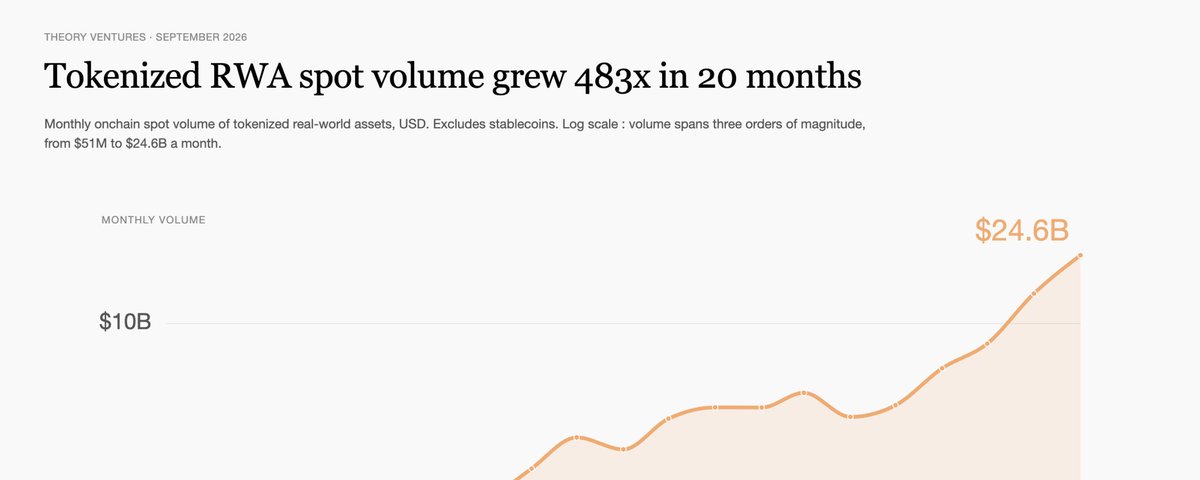
Cash moved onchain first, through stablecoins and tokenized deposits. Now, real-world assets are following, and the market could grow from $30 billion today into the trillions 👇🏻


Hannah Chelkowski retweeted

Every day is Day 1. 🚀
Excited to be working with the team at Bitget to bring real U.S. equities to millions of users globally.
This is just the beginning — a lot more products, markets, and infrastructure coming soon! 👀


Hannah Chelkowski retweeted
Be your self, not someone you were assigned to be!
Bezos won on time horizon, not AWS or 1-Click.
If your bets have to work in 3 years, you compete with everyone. Every smart, funded team is chasing the same 3-year problems. Short horizon, crowded field.
Stretch to 7 and the field collapses. Investors want returns, employees want vesting, founders want proof. Almost nobody can sit in a bet that doesn't pay for most of a decade. The patience is the moat, and it costs you, that's why it works.
But you can't fake a 7-year horizon on a problem you don't actually care about. Pick the users and the problem Moloch assigned you, the safe ones, the fundable ones, and you'll bail the first hard year. Pick the ones that are actually yours and you'll still be there when everyone else has quit.
So the real prerequisite isn't discipline. It's knowing yourself well enough to choose a problem and a set of people you care about that you'll serve them for decades.