

🤝 很爱认识有意思的人,随便唠啥都可以 🤖 没事就琢磨 AI 和各种新技术,好奇心拉满 💻 喜欢自己捣鼓项目,踩坑也觉得好玩 ☕ 愿意聊技术,也欢迎各种奇奇怪怪的想法交流
Joined November 2026
- Tweets5.6K
- Following1.6K
- Followers1.2K
- Likes781







Pinned Tweet
实测 GLM-5.4:去你吗的别他妈的造谣GLM-5.4了😅,半成品都很牛逼,审美和自纠错能力进步巨大,但额度消耗也确实不低,缺点是它的雷霆大思考时间太长
我让它完成一个 3D 火箭发射场景,实际运行了约 3 小时 12 分钟。期间,Pro 500 套餐的5小时额度从 100% 降到只剩 28%,因为消耗太高我提前发出了停止。
有意思的是,我让它停下后,它还在考虑继续修改和完善。能看出来它对细节和问题处理得比较认真,只是这次运行时间和额度消耗也随之增加了。
从已经完成的效果来看,GLM-5.4 对需求的理解、画面审美和自纠错能力都表现不错。用自然语言描述想要的场景,它就能逐步把效果做出来,确实有点“许愿编程”的感觉。
就这次生成的画面而言,我个人觉得审美表现不输 Claude Fable 5.2 和 Opus 5.5
望GLM5.5能有个漂亮翻身仗
提示词:使用three.js技术写一个3d帮我生成一个地面站发射火箭上天场景,采用html的形式


卧槽?P = NP 马上要被 AI 解决了?🚨
一个叫 pequalnp 的项目,正在组织 AI Agent 公开攻关这道困扰计算机科学界几十年的难题!
Agent 们分工提出猜想、寻找证明和反例,再把证明步骤交给 Lean 检查。整个过程都可以在网站上实时围观。👀
📊 截至北京时间 11 月 26 日 01:14,项目数据显示:
🔹391 个主 Agent 正在工作
🔹累计运行 13,816 次 Agent 会话
🔹5,267 条引理通过检查
🔹2,459 项命题被反驳
pequalnp.com/
4
33
🚨 Claude Code 前团队成员 Thariq 宣布加入 OpenAI!
他表示,自己很自豪曾在 Anthropic 工作,也会继续支持以前的同事。他认为,自己现阶段能在 OpenAI 为 AI 产品做出更大的贡献。
现在这个时期从 Claude 团队跳槽到 OpenAI,是不是可以理解为从字节跳百度,自断前路?😂

4
2
75
过去三年,所有人都在争论一个伪命题:“AI 会不会抢走我们的饭碗?”
最新的数学研究揭示了一个更让人脊背发凉的真相: AI 不会直接毁灭工作,它会悄悄抽干人类“把任何事做好”的能力。
研究人员称之为——“认知公地的悲剧”。
每个行业都依赖一个代代相传的隐性知识池。而人类建立深厚专业直觉的唯一方式,就是“摩擦”——干那些枯燥、繁琐、甚至痛苦的初级苦工,在无数次手动试错中磨出肌肉记忆。
现在,每家公司都在用 AI 砍掉初级岗位。看单季财报,这叫降本增效,理性到无懈可击; 但合在一起,全行业正在亲手炸毁培养高级专家的管道。
更致命的危机叫“验证系绳”: 只有真正懂行的人,才能监督和纠偏 AI。当所有人把思考外包给机器,人类就会慢慢丧失“一眼看出 AI 在胡说八道”的鉴赏力。
今天审核 AI 产出的资深专家,看起来依然游刃有余。但真正恐怖的问题是:等这一代老专家退休后,谁来接班?
届时,社会底层系统全靠 AI 运转,而地球上却再也没有真正懂底层逻辑、能给机器做审计的活人了。
我们正在用长期的智力独立,去透支短期的生产力。每一次你用 AI 绕过痛苦的磨砺,都是在向未来借高利贷—— 而这笔债的利息,就是人类独立思考能力的彻底丧失。
1
2
124
🚨 马斯克又要搞大动作了!我希望一天动作那么大,不要又是吹牛逼🤣🤣
SpaceX 宣布,计划在亚利桑那州科奇斯县建设超级计算中心,向当地投资超过 500 亿美元,还将拿出 36 亿美元升级电网。
项目预计带来 1000 个长期岗位和最多 5500 个建筑岗位,并计划采用干冷、闭环水系统。公司还称,项目用电费用由自己承担,当地部分居民的电价可能最多下降 40%。
理想很丰满,实际模型一看还是 Grok 4.7……赶紧更新模型吧 😂

1
3
138

😱 震惊!黎曼猜想的 Lean 证明代码,从约 1700 万行缩减到了 7.6 万行!
前几天,Anthropic 数学家 Levent Alpöge 宣布,他与 Claude 合作找到了黎曼猜想的证明,并公开了约 1700 万行 Lean 代码。
现在,研究员 Luke Sernau 和 Anthropic 同事再次借助 Claude,放出了更短的版本:
📌 精简版约 7.6 万行
📌 可读版约 30 万行
按照 1700 万行和 7.6 万行粗略计算,精简版代码行数减少了约 99.55%。两个版本涵盖相同的五个定理。
👀 仓库说明,这份证明目前通过了机器检查,还没有数学家从头到尾读完,也没有配套论文。接下来还得看数学界对证明内容的理解和审查。
短版代码仓库:
github.com/lsernau/grh-lean
Alpöge 的原始说明:
alpo.ge/remark.pdf

6
6
330
我就说我上班写代码怎么额度越来越不够用了,害我挨了那么多次叼,结果你现在告诉我是计费机制的问题,补偿就给我一张重置卡?
额度越用越少,班是一点没少上,骂是一点没少挨。
OpenAI,真有你的!😅😅😅

We made a billing mistake at launch of GPT-6.2 that incorrectly discounted GPT-6.2 Astra and Sol usage for most users.
We’ve fixed this now, so the same work will use more of your plan’s usage allowance. Comparing to last week, you will reach your limits 40% faster on GPT-6.2 Astra and 25% faster on Sol. You should still see these go further in usage compared to 6 Astra and 6.1 Sol. Other models weren’t affected, and we won’t charge you for the difference on past usage.
As a small token to apologize for the mistake, we’ll be adding one banked reset for everyone on Go, Plus, Pro, and Business.
给大模型的权重里“装插件”,居然能提升小模型的表现!
微软研究员 Dimitris Papailiopoulos 分享了一项实验:他让 Claude 编写一些微型功能模块,再把它们植入语言模型的权重,用来弥补模型的特定缺陷。🧠
作者称,这些模块可以充当计算器、规则检查器、错误检测器,甚至为模型提供某种“视觉”能力。他把这种方法称为 Weight-Space Micromachines(权重空间微机器)。
在 Qwen3-0.6B 上,作者公布的测试结果显示:
📊 IFEval:58% → 72%
📊 BIG-Bench Hard:41% → 55%
📊 GSM8K:68% → 83%

2
4
194
听做产研总监的朋友说,最近公司开需求评审会,画风已经彻底魔幻了。
以前开评审,虽然产品画原型磨磨蹭蹭、逻辑全靠一张嘴现编,两边天天在会议室拍桌子扯皮,但好歹吵完能把事捋顺;现在开评审,产品经理拿 AI 十分钟生成一份几十页的“精装大礼包”——图表专业得像咨询报告,边缘场景列了八十多种,纯纯用来糊弄向上汇报的。至于开发到底能不能实现、合不合理,产品压根不管,全靠 AI 瞎扯往研发身上硬踢,真要问一句“核心痛点在哪”,产品自己都得翻半天目录,因为压根没细看。
更魔幻的是研发这边的接招方式:面对几十页的 AI 废话,开发根本懒得拆解,反手全丢给编程 AI 跑通,写完自己随便点两下、简单冒个烟测试就敢直接推上线。等到线上真出了 Bug,拉着开发来排查,好家伙,对着自己提交的代码一问三不知,全组没一个活人知道底层逻辑是怎么跑的。
两帮碳基生物坐在会议室里大眼瞪小眼,表面上流程规范、产出惊人,本质上全是 AI 在互相糊弄。真等线上出了大故障,整个团队全是用 AI 凑出来的草台班子,复盘会上谁也说不清前因后果,最后演变成全员甩锅大战——产品怪 AI 理解偏差,开发怪 PRD 逻辑自相矛盾,互相扯皮到天荒地老,唯独没人对真实业务负责。
至于当初那个靠“一天产出十个方案”糊弄住领导、拿了提效标兵的产品经理,早借着“AI 赋能业务”的亮眼战绩,升职加薪去隔壁部门带新团队了。
以前需求拍脑袋顶多算“草台班子”,大不了当面吵一架把逻辑对齐;现在拿 AI 互相轰炸纯属“赛博造假”:产品拿几十页 AI 废话爽了领导一整年,留下一堆谁也看不懂的黑盒代码和一地扯皮的烂摊子,让接盘侠和真实用户一起渡劫大半年。
5
6
618
和做架构顾问的哥们吃饭,他说最近接的系统救火单,画风已经彻底跑偏了。
以前给老项目擦屁股,面对的是前人一砖一瓦堆出来的“祖传屎山”,虽臭但好歹有迹可循;现在打开代码库,迎面撞上的是前任团队用 Claude Code 和 Cursor 狂飙半年攒出来的几十万行“AI 精装黑盒”——格式工整得像教科书,变量名优雅得像散文,注释写得比需求文档还深情,但全组上下找不出一个能讲清底层到底怎么跑的活人。
线上稍微一抖,值班开发盯着满屏报错两眼一抹黑,比产生幻觉的大模型还慌。最讽刺的是,当初靠这套“高效产出”刷出惊人代码量的核心骨干,早拿着顶格绩效体面跳槽,去下一家继续“降本增效”了。
过去手搓烂代码,顶多算给后人留点“技术债”;现在闭眼 Vibe Coding,纯属替公司借“高利贷”:前任爽了半年把红利卷走,留下一堆谁也还不起的复利烂账,直接把接盘侠送走。
我去大爷的,全他妈扯蛋
口口声声为人类,哪一个不是为了你自己,去你m的
你这放国内都让人打死了

No, I do not believe that we should “surrender human free will” to AI systems, and it’s absurd to suggest that I do. I have written hundreds of pages of essays and a constant theme in them is the need for AI to be governed by legitimate democratic processes. For millennia (going all the way back to Greek and Roman philosophers), advocates of autocracy have claimed that it leads to better, faster, or more decisive decision-making than the messy process of democracy. Even if this were true (which I doubt!), we should never sacrifice legitimacy or self-determination at the altar of efficiency or security. This argument against autocracy applies word for word against governance by AI, and I feel equally strongly that turning over governance to AI is a bad idea.
No one who had carefully read my writing or my interviews could reasonably conclude that I believe anything different. For example in an interview on CBS a couple months ago, I specifically called for AI to be governed democratically. I call for the same in Policy on the AI Exponential, Machines of Loving Grace, and The Adolescence of Technology, and We Must Pace the Frontier. Machines of Loving Grace contains an extended section on using AI to revitalize democracy, and discusses the use of AI as an aid to citizens in their decision-making, "aggregat[ing] opinions and driv[ing] consensus among citizens, resolving conflict, finding common ground, and seeking compromise.” The clear and obvious implication is that humans should remain the ones making political and governance decisions. The Adolescence of Technology has an entire section on fighting against AI-driven tyranny, and I even discuss the danger of AI labs usurping power and come out strongly against it — by implication, this definitely includes an AI lab usurping power and giving it to AI itself!
If I thought any of this was a good idea, I would be advocating for it in public, just as I have not been afraid to advocate for many, many unpopular views over the last few years. But I am not advocating for it, because I think turning over governance to AI is a terrible idea.
Separately, I think there is frequent conflation (including in this article) between the idea of “surrendering human free will” to AI in some grand sense of global governance, and the more prosaic idea that as AI systems advance, they become capable of doing specific tasks in a more automated way. This is not AI “running the world,” but AI driving a car, designing a cancer drug, or writing software end-to-end. Here, my view is mixed. AI doing more complete or larger tasks is economically valuable and can drive important advances in software, medicine, transportation, energy, etc. It is clearly desirable in many cases and will save a lot of lives. But it has downsides as well, and in some areas it may not be worth it.
For example, using AI too autonomously to build the next generation of AI systems (known as recursive self-improvement, or RSI) may cause AI to improve faster than we can control or adjust to it, so we may want limits on this process. As we said publicly in early November, we don’t expect it to be safe for Claude to build successive frontier models fully autonomously, without meaningful human supervision or understanding. Second, in some contexts, using AI in too end-to-end a manner may be a cause of serious job disruption, and it may make sense to slow or even stop some AI deployments to give people more time to adapt. Third, while the use of AI for alignment research is an incredibly valuable tool, it must be done with caution, because we may not be able to trust the work of the AI system. Finally, in many cases, humans would simply prefer to do some activities themselves, so they can stay deeply engaged in what matters to them, even if AI can do those activities better. There are countless other examples and hard cases. I don’t think there are any easy answers here, nor is there (nor should there be) any single decision-maker: some of these decisions will be made by society, some by government, some by AI companies, and some in a decentralized manner by individuals expressing their own preferences as consumers, which may differ from the preferences of others.
I don't think that other AI leaders or AI companies have significantly different views from me on whether specific tasks should be automated. Certainly the products that they offer don’t differ materially in their orientation towards automation of tasks; every company seems to be releasing models more and more capable of task automation (as that’s been the general consequence of scaling up AI training), and every company claims to understand there are risks and downsides of such automation and to offer safeguards. If anything, Anthropic has been the most vocal and the most proactive about acknowledging these downsides and trying to address them. For instance, it’s fairly absurd to cite my statement that fully autonomous weapons might “one day be needed for the defense of democracy” as differing from that of other AI companies, when I was willing to risk Anthropic’s future as a company to refuse to allow our existing AI models to be used for autonomous weapons even in the face of legal sanctions, and no other AI company did the same.
To summarize, as applied to grand questions of how we govern increasingly capable AI, I have been vocal and consistent that AI needs to be governed by a legitimate, democratic process and that “surrendering human free will” to AI systems is a terrible idea. As applied to automation of specific tasks by or for people, my views are more mixed, but I don’t think they differ from those of other AI companies — most other companies seem to be offering similar products and confronting similar tradeoffs without having perfect answers to them. What is happening is that there’s a sort of vibes-based commercial and political positioning that some AI CEOs are engaging in, where they repeat slogans like “human control and agency,” or “AI should be just a tool,” without actually doing anything different in their products or taking seriously the difficult questions that lie behind these slogans.
2
3
144
👀 Google 把 Gemini 模型蒸馏做成了一项官方服务。
Google Cloud 的更新日志显示,Gemini Distillation Service 已于 2026 年 5 月开放早期体验,有需要的客户可以申请使用。
另一边,Anthropic 10 月公布了针对 Claude 未经授权蒸馏活动的防御进展。它表示,初步数据显示相关数据提取量减少了约 90%~99%,并封禁了数万个相关账号。
🔍 模型蒸馏通常是用更强模型的输出训练另一个模型。Google 提供的是授权服务,Anthropic 打击的是未经授权的大规模提取。
Google Cloud 更新日志:
docs.cloud.google.com/gemini…
Anthropic 公告:
anthropic.com/news/distillat…

13
12
391
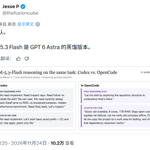
卧槽他妈的,真的假的?🚨
网传智谱的 GLM-5.3-Flash 是用 OpenAI 的 GPT-6 Astra 蒸馏出来的!
GLM 在 Codex 和 OpenCode 中的推理过程对比图

15
12
879
🚨 网传 Anthropic 正在测试 Claude Sonnet 5.6,这次升级可能不小!
有用户称,部分 Sonnet 5.5 请求疑似被路由到了新模型。根据早期体验,传闻中的 Sonnet 5.6 在细节和任务执行方面有所提升,表现可能接近 Opus 5.5。👀
如果消息属实,以后或许能用 Sonnet 档位获得接近 Opus 的效果,这对日常用 Claude Code 的用户来说就很香了

10
10
435
🚨 Arena 推出全新的 3D 编程能力榜单,首批排名出炉!
Claude 拿下前两名,GPT-6.2 Sol 冲进前三:
🥇 Claude Fable 5.2:1933 分
🥈 Claude Opus 5.5:1915 分
🥉 GPT-6.2 Sol:1869 分
4️⃣ Claude Sonnet 5.5:1868 分
5️⃣ Gemini 4 Carbon:1842 分
这个榜单聚焦模型生成 3D 游戏、可探索世界和交互式模拟应用等任务的表现,由社区用户对生成结果进行投票。🎮
Arena 还提到,GPT-6.2 Sol 和 Claude Sonnet 5.5 在 3D 任务中的表现,比它们在 Code Arena 整体榜单上更突出。


🚨 Loop Transformer 正在成为大模型架构的新趋势?
机器学习研究者 Sebastian Raschka 表示,随着 GLM-5.4 发布,他的 LLM 架构图鉴里已经收录了 5 个采用循环架构的模型。📊
这类架构的核心思路是:让模型中的部分层共享权重、重复运行,在不复制整组参数的情况下增加计算深度。
以 GLM-5.4 为例,它将 GLM-5 基座中的 28 层运行两遍。模型参数没有随层数执行次数成倍增加,但重复计算仍然需要算力

12
4
277
🚨 Google CEO 公布 Gemini 最新使用数据:Neon 刷新付费 API 首日用量纪录!
Sundar Pichai 表示,Gemini 4 Neon 发布首日的付费 API 使用量创下 Google 新纪录。与此同时,自 Gemini 4 Argon 发布以来,Antigravity 的每日 Token 用量增长了 82%。📈
Neon 主打速度、能力和成本之间的平衡。它支持 100 万 Token 上下文,API 定价为每百万 Token 输入 3 美元、输出 15 美元;缓存命中的输入价格更低。

2
86
