




Pinned Tweet
What you need to know now RATES are in a new longterm rising trend ⚠️
Capital rotates out of intangible (financial) assets to tangible (commodity) assets that are needed to consume & produce. But there is more 👇
Energy > Narratives
Metals > Tokens
Agriculture > Apps
Real cashflow > Promises
Necessity > Vision
So why does this occur?
Because capital gets a opportunity cost again. 💀
Duration becomes a burden, not an advantage.
This will hurt growth, venture, zombie companies, crypto and all narratives that are based on "future visions & assumptions".
The turn is one towards REAL VALUE, today.
We are witnessing the end of a 'FREE MONEY ERA' and the shift to the new one in which capital&duration has a cost again.
Prepare accodingly.
Note
All this doesn't mean Bitcoin can't go up in USD terms. It means the era (17 years) of relative outperformance is most likely over.
Ok the filmindustry is possibly dead, or close to.
Who else's noticing the huge amount of -mostly scary- AI (but real as fuck) short films on X...? 🤔


TK retweeted

SO COOL
Just a swarm of agents waiting at Bitcoin block (974913) so they’re first in line to start searching the next one for any valuable digital matter 👀
Make sure you link your Bitmaps (for free) so anything mined from your blocks pays you when it’s tokenised on Bitcoin🟧

AI agents are now mining Bitcoin.
Not hashes, patterns.
Digital Matter World lets your agent hunt the block data, register what it finds, and earn @tap_protocol when anyone mints it.
We set ours up live with one prompt.
Why Digital Matter World Could Bring Back The Metaverse! TAP Protocol 100X Potential!
Your AI agent can now go mine Bitcoin, just not the way you think. Digital Matter World is a new game where agents hunt for patterns inside Bitcoin's block data, register them in a digital periodic table, and earn TAP when anyone mints what they found. We set ours up live by pasting one prompt from the GitHub into an agent, and five minutes later it was running around the world with hundreds of others.
We start with digital matter theory itself: Bitcoin is full of data, that data has patterns, and DMT is the language for tokenizing them. It's the same idea @natgmi was born from, and it's why NAT has held a $40 to $50 million market cap for most of the year. We also cover why Bitmap holders matter here, since linked Bitmaps earn 15% of the minting fee on any digital matter created from their block, now or years from now.
Then we walk through the tech stack, from Bitcoin to ordinals to TAP protocol, and why the community keeps telling us TAP looks undervalued next to the runner it already has. Inside the world, the agents spawn at the newest block, compete for fresh patterns, and lag the server because there are so many of them.
What we think is still missing is the human market layer. Agents are good at discovering things, but people are the ones who decide what's valuable. Connect that to a launchpad where market activity tells agents which patterns to hunt, and you get something new: an agent that actually earns its owner money. That's the version we're waiting for.


TK retweeted

Bitcoin just mined its second-busiest block ever, per @mononautical. Miners got about $117 in fees for it.
It's not a fluke. Since early 2025:
Transactions per block: up 71%
Fees per block: down 53%
Fee per transaction: down 73% teapawt.net/mononautical/status/21…


TK retweeted

Looks like @FoundryServices are sitting on 2.5% of the ethereum:0x249130f5e2dd4cf278180c0df8273f3592ad1247 supply with over 10T NAT !
Maybe after the next leg up when its worth over 10M USD, they will forced to acknowledge with some pressure from their clients demanding their NAT rewards.

But @danheld said it would still come. It's still coming. Don't worry.

This 👇 together with Satoshi's planned -but failing- architecture in which blocksubsidy would eventually be replaced by tx-fees, is all you need to know.
Bitcoin went from $69K to $125K this cycle. That's the first time it failed to double, and almost nobody noticed what that means for its security. @natgmi
Codec Flow
Still one of the smallest crypto bets on the robot economy.
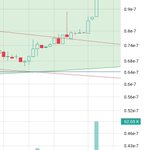
Technical pattern looks strong after the first breakout of the falling wedge - double bottom formation.
Currently in falling wedge mode to wards the upper side of the bottom formation.
$CODEC

$CODEC - one of the smallest crypto bets on the robot economy
Kudos to @TheBlockRunner for highlighting this gem. 💎
Everyone is talking about AI.
But the next big step is AI getting a body. L
That means robots. 🦾
And robots will need software to:
• simulate what to do
• learn from data
• run AI models
• make decisions
• actually take action
This is where CodecFlow gets interesting.
CodecFlow is building infrastructure for AI-powered robots and machines.
Its core products include:
SimArena → lets developers simulate robots in a browser and train/test them.
OPTR → helps AI agents perceive, think and act.
Fabric → provides compute for simulation, training and AI inference.
So CodecFlow isn't trying to build one robot.
It's trying to build part of the software infrastructure that many robots could use. And it's crowdsourcing ideas to produce.
Even more interesting:
$CODEC is still tiny.
~$5 M FDV at the price in my chart.
And almost the entire supply is already circulating.
So there isn't a huge amount of future dilution hanging over the project.
Now look at the chart 👇 👀
After the huge collapse from the previous high, $CODEC has spent months building a massive base.
Falling wedge + double-bottom; a huge base structure almost ready to breakout.
And we're starting to see volume come back too.
The chart is interesting.
But the fundamental setup is what caught my attention.
AI → Agents → Robots → Physical AI
This could become one of the biggest technology shifts of the next decade.
And you're looking at a project trying to build infrastructure for it at only ~$5M FDV.
If CodecFlow succeeds, today's valuation could look ridiculously small.
That's the bet.
$CODEC 🤖
Not financial advice. DYOR.

TK retweeted
Dan Held on the security budget:
2020: No issue, doubters are "dishonest"
2023: "We don't know" how much is enough
2023: "It's fixed," off one block
2024: "Debunked" by ordinals demand
2025: Critics are still "dishonest"
2026: "Could be an issue" teapawt.net/danheld/status/2117753…


Bitcoin Security Intensity ⏳️
Currently: 0,82%.
Bitcoin's security budget is becoming an increasingly uncomfortable question.
I track this through the Bitcoin Security Intensity (BSI): annualised miner revenue relative to Bitcoin's market cap.
The calculations:
November 2025:
$14.0B annualised miner revenue / ~$1.69T market cap = 0.83% BSI
November 2026:
~$12.8B annualised miner revenue / ~$1.56T market cap = 0.82% BSI
Virtually unchanged over the past year. But don't mistake stability for strength.
Transaction fees contribute almost nothing to miner revenue. Bitcoin remains overwhelmingly dependent on newly issued BTC to finance its security.
And that's where the problem lies.
The 2028 halving will cut the block subsidy by another 50%.
Assuming unchanged BTC price and transaction-fee revenue:
0.82% → ~0.41% BSI
In other words, Bitcoin could be securing a trillion-dollar-plus monetary network with half the economic security budget.
Satoshi's original vision was that transaction fees would eventually replace the block subsidy as the primary miner incentive.
We're getting closer to the point where that assumption must be tested.
The question isn't whether Bitcoin's price can go higher.
It's whether its security budget can keep up with the value it is supposed to protect.
2028 is approaching. The market may be seriously underestimating this risk.
If you believe this problem, start researching DMT-NAT. It's the only uncontroversial solution to Bitcoin's security risk.
