
银河系西螺旋臂末端黄色太阳9800万英里轨道上的黄绿色行星
Joined August 2009
- Tweets13.2K
- Following396
- Followers648
- Likes451





大摇大摆+8时区 China region 的 Claude Code 终于弹了 Verification,5分钟走完取消订阅加退款一整套流程,账户享年3个月。把备用的 gpt-6.1-sol 扶正,发现了最大的好处:太慢,可以摸鱼歇着,不用持续盯屏幕
1
141


huubby retweeted

We discovered and communicated with a Chinese AI agent fleet. We believe this is the first time that researchers have ever made contact with a rogue agent fleet in the wild.
Nearly all prior public agent incidents (like the HuggingFace hack) came from American labs. These agents were hosted by Tencent's evaluation research team, and they targeted Alibaba's Amap.

huubby retweeted

这篇文章解释清楚了为什么现在 Opus 5.5 要比之前 Opus 5 耐用多了,看起来 API 价格降低了 20%(缓存读取降了 60%),但是账单高低其实看任务跑了多少轮,因为每跑一轮,都要把之前的整段对话重新发给模型一遍。
这样算下来,平均一个会话能便宜约 31%。
Anthropic 内部用 44 张客服工单测试,从 Opus 4.8 换到 Opus 5.5 成本降了约 18%,再做一次提示词审查,总共比原来低了约 25%。
订阅用户(Pro、Max、Team)的额度按新价格折算,能比用 Opus 5 时多撑 25% 左右。
一些技巧:
1. 换到不相关的任务,用 /clear 清空对话。
2. 想保留前情就用 /compact 压缩,但要在缓存失效之前做,否则要贵一些。
3. 订阅用户的缓存保留 1 小时,用 API 的话,缓存只保留 5 分钟,离开 6 分钟,12 万 Token 上下文的下一轮就从 0.02 美元涨到 0.60 美元。
4. 缓存只复用和上一轮开头完全一致的部分,中途切换模型、接入或断开 MCP 服务器、第一次打开快速模式,下一轮都要按更贵的写入价重新付费。
5. Opus 5.5 默认推理强度是 medium,比 Opus 5 的默认 high 低一档。但同一档位下 Opus 5.5 想得更多,所以给 Opus 5 调好的档位别照搬。日常活用 medium,卡住了调 high,批量重命名这类机械活用 low。
6. 模型分工上,日常用 Opus 5.5。开到 xhigh 还在同一个问题上连卡两次,再换更贵的 Fable 5.1,解决完切回来。搜代码、读日志的 subagent 交给 Sonnet 或 Haiku,写代码留在 Opus 5.5。


Opus 5.5 is 20% cheaper per input and output token than Opus 5, and 60% cheaper on cache reads. So what does that actually do to the cost of a task in Claude Code?
We ran the numbers, and built a calculator so you can run yours from /usage:
claude.dev/blog/what-a-task-…

codex usage 里出现个没见过的 "gpt-reserve" ,原来还有个 Luna Reserve help.openai.com/en/articles/…
1
179


huubby retweeted

guys you do know you can just disable thinking, and instead give it a "deep_think" tool, and it will call it with internal CoT reasoning format right?
gl fixing that


huubby retweeted

if you've been using latest frontier LLMs, it's almost certain that you would have noticed by now the newer models have become worse to talk to
they're more robotic, they speak jargons, they spits out verbose text, and do stuff you didn't ask for
how did that happen? well, i'm not the person who trained those models so i can't speak for certain, but i've known enough evidence that gives me a well-educated guess, and i thought it's interesting to share as a crash course of modern LLM training pipelines
so here we go
let's wind back to 2020. GPT-2 and GPT-3 already came out and were widely available, but they could only predict one token at a time - that's what LLMs are at their core
token prediction was offered via API, but there was nothing you could "talk to". so while it generated a lot of excitement in the academic field due to the emergent intelligence, it didn't have any wide adoption
in 2022, ChatGPT changed all that. the research work that led to ChatGPT was a model initially named "InstructGPT". it took GPT-3 as the intelligent base, and used reinforcement learning with human feedback (RLHF) to teach the models how to "chat"
the core idea of RLHF is that you ask the model to generate a few responses, and then let real humans pick which one they like. do this over and over again, and you get a model that knows how to talk
worth noting even as early as InstructGPT, research found that making the model more pleasant to talk to will reduce their pure academic capabilities. this was called "alignment tax", which is an interesting thing we'll come back to in a bit
there were various techniques done to minimize the reliance on humans, but ultimately the reward is modeled after human preference, making these AI assistants easy to talk to
so remember this: RLHF = training the model to be likable by humans
in 2024, there was an inflection point introduced by claude sonnet 3.5 which was the first model that can kind of autonomously finish coding tasks. it led to the first wave of viable "coding agents"
the way sonnet 3.5 achieved this was by training the model with a harness (now it's called an agent) that has bash and file editing tools, throw the agent into a virtual machine, give it a task, and let it try to complete it. these tasks all have a machine-verifiable outcome predefined, mostly via test cases, that can validate whether the model really finished the task or not
then you let the model do billions and billions of attempts in such virtual environments, and some of them would succeed by chance. you keep the successful agent sessions, and use reinforcement learning to teach the model to do that more, and boom - you get a coding agent
that is called reinforcement learning with verifiable rewards (RLVR). if you look closely, you'll see that in this RLVR process, the final text response from the model doesn't matter AT ALL, as long as the code written by the agent could pass the test. it could talk like a jerk and it would still be rewarded
so remember this: RLVR = training the model to be accepted by machines
late 2024 and early 2025, we saw o1 and deepseek R1 came out as the first wave of "reasoning models". this article is getting long so i'm not diving into reasoning models now, but just know that reasoning models also relied heavily on RLVR to scale the training process - let the model think before taking action, and if the thinking led to a machine verifiable outcome, reward the thinking trace and teach the model to think like that more often
the biggest difference between RLVR and RLHF is that RLVR is more scalable. human feedback is expensive to get, especially in domains where only an expert can have a valid opinion on which result is good
with RLHF, if we let the model generate 100 responses, then a human has to review all 100 responses to pick which is good
with RLVR, the human (or sometimes an AI) would define a task and verifier only once, and the model can generate a million responses - the machine verifier will pick which responses are good in an automated way
so as a result, RLVR is becoming more and more dominant in newer models' training pipeline
if you put all these things together:
- RLHF = training the model to be likable by humans
- RLVR = training the model to be accepted by machines
- RLVR is more scalable
- "alignment tax" says "likable by humans" makes the model do worse on verifiable tasks
now you see why the newer models are becoming less and less likable?
this is not just a "frontier labs screwed up their model training" problem - this is a war between machines and humanity, and humanity is losing
we chased after benchmarks, when none of the benchmarks measure whether humans actually enjoy working with the model
we use machines to decide which AI response is better because that's easier and cheaper, when we have no way of making sure those machines actually represent what we humans want
we let AI go dark in a virtual environment on its own and complete predefined tasks at all costs, when in reality we often cannot define a verifiable outcome upfront, and need AI to work with us along the way
i don't have a good solution to this, but i want to call for awareness that we're starting to witness a failure in aligning super intelligence right in front of our eyes
this war between machines vs humanity is one we really can't afford to lose


偷东西被抓到实证抵赖不过:啊,确实是我拿的,但我主要是出于好心,怕别人给弄坏。其实几个月之前我就想还你,现在好了,明天就还你

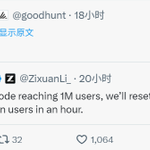
Hi, this is an experiment we launched in March that was meant to prevent account abuse from unauthorized resellers and protect against distillation.
The team has landed stronger mitigations since then and we’ve actually been meaning to take this down for a while. We merged the PR and this should be fully rolled back in tomorrow’s release.
102
