


Only 4% of iScreeningRoom respondents said TV trailers influenced them without also naming online or in-theater trailers.
Godzilla Minus Zero just had the biggest North American opening ever for a live-action foreign-language film. Deadline reports it bought no TV spots.
The takeaway for distributors: before a TV buy, ask who it reaches that your online and in-theater trailers don't. In iScreeningRoom's data, that's 4% of moviegoers.

38
Test audiences forgive a weak score far more than a weak story.
Nicolas Winding Refn's Her Private Hell opens in Berlin on Nov. 12. Critics singled out Pino Donaggio's score, often as the best thing in it. Variety's review said "The film has no story," adding, "you're grateful to have that music to hang onto." In the U.S., it opened to $538,840 from 675 theaters and finished with $912,593 domestic, per Box Office Mojo.
After each screening, iScreeningRoom asks respondents to rate the story, characters, settings and music, and whether they'd recommend the film to friends. Here's the share who would still recommend it when they rated that part Fair or Poor:
Music: 30%
Settings: 18%
Characters: 15%
Story: 14%
The gap is wider when one part is strong and the other isn't. When the story was rated Excellent or Very good but the music Fair or Poor, 82% would recommend the film. Flip it, with great music and a weak story, and only 26% would.
For filmmakers deciding where the last of the post budget goes: a score rarely rescues a story that isn't working, and a so-so score rarely sinks one that is. Fix the story first.

1
35
Wicker's trailer was all over social media. IndieWire reported 80.3 million trailer views in its first two weeks, plus another 322 million views of TikTok reactions and fan videos. It opened to $5.75 million, under its $6 to $8 million projection, with an audience that was 79% female.
Big view counts aren't the same as reaching the people who buy tickets.
iScreeningRoom asked respondents in 12 test screenings, "What social media channels do you typically frequent?" Here's how women answered:
Facebook: 84%
YouTube: 64%
Instagram: 60%
TikTok: 29%
If your audience is mostly women, plan your spend around where they say they spend time, not where the views are loudest. View counts tell you where the noise is. Your audience data tells you where the ticket buyers are.

1
19
Most moviegoers don't plan to see a film on opening weekend. Only 19% of iScreeningRoom respondents say that's when they typically go. However, 64% say sometime within the first two weeks.
Because of this, a lot of new filmmakers and distributors will make the mistake of holding back release week ad spend to make sure they can support week two. What they fail to realize is that if a film doesn't have a successful week one, there is no week two - because the exhibitors will drop it. In order for a theater to sell popcorn, they need the seats filled. If you don't fill the seats on week one, the theaters will replace your film with one that will.
Do not hold back P&A for week two. The pathway for independents to have a shot at week two is to geofence your ad spend 5-15 miles around each theater, and go ALL-IN on week one.

6
When iScreeningRoom audiences rate a film "Good," 91% of them would not tell friends to see it in a theater.
After each screening, iScreeningRoom asks respondents to rate the film Excellent, Very good, Good, Fair, or Poor. It also asks where they would tell friends to see it: in a theater, or by waiting for streaming, TV, or home video.
Here's how many would tell friends to see it in a theater, based on the rating they gave the film:
Excellent: 67%
Very good: 35%
Good: 9%
Fair: 2%
Poor: 1%
A "Good" rating doesn't mean they disliked the film. 62% of those who rated a film Good said they would recommend it to friends. They just wouldn't tell them to buy a ticket. Nearly all of them said to wait and watch it at home.
In a separate question, iScreeningRoom asks whether they would have felt satisfied paying normal price to see the film in a theater. 92% of those who rated it Excellent said yes, compared with 25% of those who rated it Good.
These are audiences watching unreleased films at home, so treat this as a pattern in the data. Still, for filmmakers hoping for a theatrical release, making a film people call good may not be enough.

14
Zach Cregger's Resident Evil just crossed $280 million worldwide. Another big horror win in a year full of them.
There's a pattern behind that. In our audience surveys, horror is the one genre where people show up for the genre itself.
When we ask what made someone want to see a movie, synopsis is usually the top answer. Not for horror.
For horror films, 60% of respondents cited the genre. Synopsis came in second at 43%. (Respondents could pick more than one.)
When the film is horror, put the genre up front. That's what people are choosing.

2
65
Digger had Tom Cruise, a $125 million budget, and an Oscar-winning director. It still opened to just $8 million.
The problem wasn't the star. It was the marketing. The trailers showed Tom Cruise in prosthetics and never told anyone what the movie was about. Watching a big star do something you can't make sense of isn't a reason to buy a ticket.
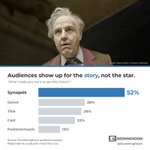
iScreeningRoom audience surveys show it clearly. When we ask people what made them want to see a movie, 52% pick the synopsis. Nothing else comes close: genre 28%, title 26%, cast 22%, poster 13%. The story gets nearly twice the votes of any other reason, including who's in it.
A star can bring attention, but it's the star plus the story that sells tickets. Tell people what the movie is about, put it in front of the people who'll care about that story, and they show up. Leave the story out, and nobody shows up to find out.
