

Yoga practitioner, software product orchestrator.
Joined July 2008
- Tweets9.7K
- Following161
- Followers371
- Likes964





My role as Open Collective's product steward has ended. I want to use this opportunity to share my experience introducing ShapeUp to the organization. Part 1 is how I discovered ShapeUp and how Open Collective came to me.
iamronen.com/blog/2026/10/07…

1
49
part 2: finding my way in
As I was being assimilated into the high-agency & open culture and getting to know the platform, my very presence became a seed of change:
iamronen.com/blog/2026/11/05…
1
8
part 3: establishing a rhythm
Preparing pitches & adding a transition week transformed cycles into a meaningful rhythm; mapping the product made it visible to everyone that we were stuck tending to an endless backlog.
iamronen.com/blog/2026/11/16…
7
Today I stumbled onto a simple (to share) example of using generative sequences (inspired by Christopher Alexander) to redirect an agent performing a UX design task from a "throwing options at the wall and seeing what sticks" to a systemic approach.
iamronen.com/blog/2026/11/13…

1
1
17
iamronen retweeted

In Japan, when a treasured bowl breaks, we don't throw it away.
We don't glue it back and hide the cracks either.
We repair it with gold.
It's called kintsugi. The broken lines are filled with lacquer
dusted in real gold, so every crack becomes a shining river
across the surface.
The bowl is not "as good as new."
It is better than new.
This has been practiced for over 400 years,
and the idea underneath it is quietly radical:
the damage is part of the object's history,
and history should be honored, not hidden.
A kintsugi bowl that survived a break is often
more valuable than one that never broke at all.
Now read that sentence again,
but this time, about a person.
Every scar you carry is proof that you survived something.
Japan just happens to be the country
that wrote this truth in gold,
on its dinnerware,
four centuries before therapy was invented.
What would you repair, if you could repair it with gold?
🤖 Made with AI

iamronen retweeted

I've been maintaining a Rails app for ~10 years. It has very specific business logic for on-site multi-day course registrations. DDD style like I learned at 37signals.
For 10 years, I configured each course in the Rails console. It was never worth it to build out the configurator UI.
This year, I just talked to AI to do it. And the payoff from the carefully written model is really amazing. The AI was completely speaking the language of the domain and even raising meaningful pricing/structural questions about how the packages are set up this year vs previous years.
Sharing this example because it reveals fascinating complexity. There is a positive feedback loop between AI acceleration and really good thoughtful modeling.
1st post, laying the foundations for sharing my experience with generative sequences and LLM-assisted coding - starting with unfolding wholeness and living structures (inspired by Christopher Alexander): iamronen.com/blog/2026/08/14…
1
12
continued: what are generative sequences?
iamronen.com/blog/2026/08/16…
1
6

iamronen retweeted

It works out exactly how much of each med to put in, slot by slot. Tracks what meds are running low. Reminds you when it's time to fill again or restock meds on time.
Free to try, no card needed → withapp.co/?ct=x_cg
#Caregiving #MultipleSclerosis #ChronicIllness

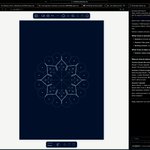
I am spending countless hours at this screen ... it is coming ... a relational drawing experience ...

14



startling realization: building sessions with LLMs are tiring me out because they are pushing me to the edge of my mental capacity.
simply put: I can barely keep up with the intelligence they make available to me.
2
59

The drawing tool is maturing, I feel it coming to life as synergies form between its different capabilities. Using it to make and reflect on this drawing makes me see the power of simple geometry in new and profound ways. Looking forward to getting it into people's hands.

1
1
277
In recent years I've gone through multiple cycles of deep stress & recovery and noticed:
1. Recovery is an innate process.
2. It takes time (longer than I think/imagine/want).
3. Intervention needs to be subtle and caring, it is easy to overdue and disrupt the innate process.
1
16