
AI Researcher https://teapawt.net/t.co/QBjxoJzFCj | NLP Research & CSE from IIIT-H
Bengaluru, India
Joined August 2020
- Tweets648
- Following637
- Followers22
- Likes1.9K

Aklesh Mishra retweeted

We decided to provide more transparency into pretraining progress at OpenAI for the sake of moving toward shared safety bars. In “Perplexity and Intelligence” I argue for common limits based on perplexity and other measurements, with progress beyond them gated on our ability to understand AI behavior.
openai.com/index/perplexity-…

Aklesh Mishra retweeted

Took less than 10 years for Transformers to achieve superhuman performance in abstract mathematics and prove the Riemann Hypothesis.
Kind of crazy.


Aklesh Mishra retweeted

This is the proof of the Riemann Hypothesis.
175,187 files. 17 million lines of Lean. At 1:22, every dot is one file.
Unsolved for 167 years. A proof was announced Nov. 20 and certified by the Lean and Mathlib communities Nov. 21.
Aklesh Mishra retweeted

It’s official: the proof of the Riemann hypothesis is correct. Alpöge made history.
„We have full confidence that Alpöge's proof of the Riemann Hypothesis is correct, and we congratulate him on this achievement.”


The Lean FRO and Mathlib Initiative have released a joint statement on the Lean verification of the Riemann Hypothesis.
On November 20, Levent Alpöge released a proof of the Riemann Hypothesis as a Lean library of 17 million lines of code. Over the past day, the Lean and Mathlib communities worked together to verify it. The statement certifies the proof as correct and describes how it meets all necessary verification criteria.
Congratulations to Levent on this achievement, and thank you to everyone in the community who contributed to the verification.
Full statement: leanprover-community.github.…

Aklesh Mishra retweeted

I played computer games growing up, and remember wondering how I could learn to make my own games.
Now we’re creating models which are excellent at game dev. Hoping they can lower the barriers to entry and unleash creativity and fun for anyone with an idea!

BREAKING: GPT-6.2 Astra (high) and Sol (high) by @OpenAI are ranked #1 and #3 respectively on @/DesignArena’s Game Dev arena making all top 3 models on the leaderboard from @OpenAI. Both models have also redefined the Preference vs Price and Preference vs Speed Pareto frontier!
At an average of 6.8 min and $0.98 per generation, GPT-6.2 Astra (high) is the best model for its price point and speed on both Pareto frontiers. Similarly, GPT-6.2 Sol (high) at an average of 4.6 min and $0.22 per generation is on the Preference vs Price and Speed Pareto frontier. GPT-6.2 Sol (high) also offers similar output quality to GPT-6 Astra (max), the former #1 Game Dev model, while being about 4x cheaper and 40% faster.
Congrats to the @OpenAI team on taking the top 3 spots on the leaderboard!

Aklesh Mishra retweeted

This Anthropic MCP paper is f*cking gold
Anthropic's engineers cut an agent's tool context from 150,000 tokens to 2,000. Same tools, same task. And the model wasn't the upgrade.
The upgrade: the agent stops calling tools and starts writing code that calls them.
tools → files → code → filter → answer
The 6 parts of code mode:
Part 1 → tools as files
Every MCP tool becomes a .ts file in ./servers.
The agent lists the folder and opens only what it needs.
Part 2 → load on demand
150,000 tokens of tool definitions down to 2,000.
A 98.7% saving in time and cost.
Part 3 → filter in code
A 10,000-row sheet gets filtered in the sandbox.
The model sees 5 rows.
Part 4 → loops in code
Polling Slack for "deployment complete" runs as a while loop.
No round trip through the model on every check.
Part 5 → private by default
Emails and phones turn into [EMAIL_1] and [PHONE_1] before the model sees them.
The real data still lands in Salesforce.
Part 6 → skills
Working code gets saved to ./skills with a SKILL.md.
The agent builds its own toolbox.
An agent that loads every tool burns its context before you ask anything. An agent that writes code opens 2 files.
I packed all 6 parts into one prompt. Drop it into Claude Code and it sets code mode up for you.
6 parts. 1 prompt. 98.7% fewer tokens.
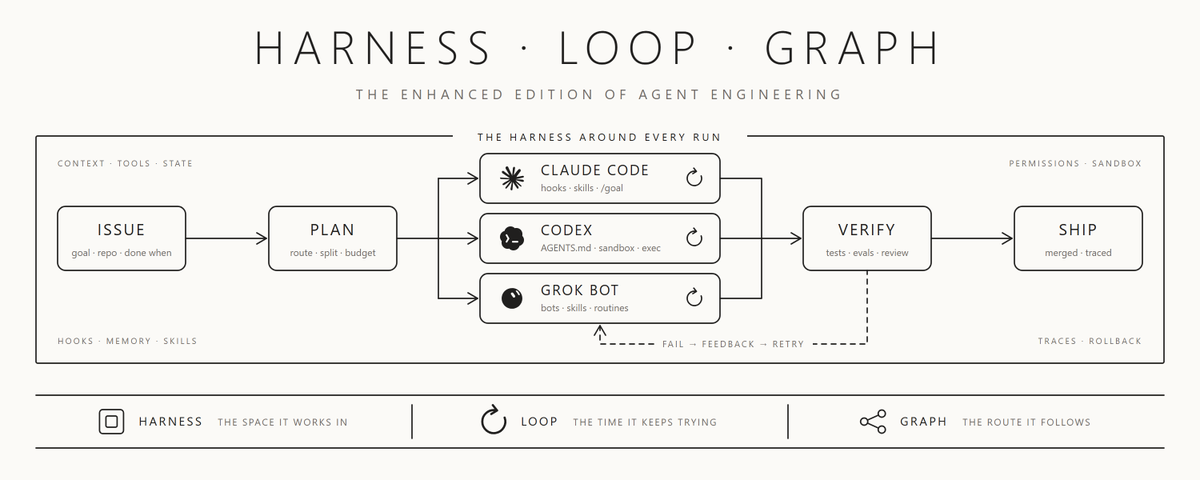
Then read the enhanced edition of agent engineering below ↓

Aklesh Mishra retweeted

MedChemBench is a new benchmark for AI reasoning in medicinal chemistry.
It shows the progress our frontier models have made in their ability to help scientists use AI to identify promising drug candidates.
openai.com/index/introducing…
Aklesh Mishra retweeted
Distillation can reproduce powerful AI capabilities without the safeguards built around them.
We’re sharing new research on our work to combat distillation of our models, how these capabilities transfer, and how we detect and disrupt coordinated attempts.
These findings are helping us sharpen our defenses and support safeguards across the industry.
openai.com/index/combatting-…


Aklesh Mishra retweeted

JUST IN: Riemann Hypothesis has been solved.
alpo.ge/remark.pdf
Aklesh Mishra retweeted

DeepMind Institute
Our new essay examines the path from AGI to ASI (Artificial General Super Intelligence)
Read it here: bit.ly/what-comes-after-agi

Aklesh Mishra retweeted
This is not AI 😂

Back in January 2020, Elon Musk celebrated with the Tesla China team by dancing on stage at Giga Shanghai
Tesla had just started delivering its first China-made Model 3s to customers, only 357 days after construction began
Elon personally thanked the team for their incredible hard work and kicked off the Model Y program in China
One of the most iconic and unforgettable moments from Tesla's early days in Shanghai....and that dance is still hilarious to watch 🥰
Aklesh Mishra retweeted

\ thank-you \ to the people behind these projects. Meet a few of them: teapawt.net/AnthropicAI/status/212…

Aklesh Mishra retweeted

Breaking news: Shares in Anthropic are set to open about 20% higher at $100 when trading begins, according to Nasdaq data, up from their $83 IPO price. Follow live developments here: ft.trib.al/2btOosM

Aklesh Mishra retweeted
GPT-6.2 Astra exceeding human baseline on physical 3D understanding benchmark:



Aklesh Mishra retweeted
We're sharing new data on how AI is changing research at OpenAI.
We find researchers' AI use continues to rise exponentially, and agents are completing longer tasks, but human involvement remains central in research. Researchers are also spending more time on safety and alignment, with human effort in these areas growing faster than in any other individual research area.
This report aims to increase transparency around research acceleration and inform the governance of increasingly capable AI. We believe that AI labs should be required to track and publicly report indicators of recursive self-improvement (RSI): the process by which AI accelerates the development of future AI systems.
Our hope is that this expanded report will help sustain and advance shared measurement norms across the industry.
openai.com/index/research-ac…

Aklesh Mishra retweeted

Banger paper from Google on RSI.
(bookmark it)
They propose an approach for continual recursive self-improvement at the harness level. They also propose their own self-improving memory system for the harness optimizer.
This clearly highlights the importance of traces and having a functional, adaptive, and structured persistent memory system in your harness.
They show that a harness optimizer improves 9 of 10 continued runs when it remembers why it made each past edit.
They discuss that a common problem shows up when you change the model or the benchmark. An Opus-evolved harness started at 68.41 on Gemini, below the 73.89 of the plain seed harness.
Self-Improvement Memory groups past edits by the harness problem they addressed. For each edit, it stores the rationale, predicted outcome, observed outcome, and evaluation context. The proposer and the selector both read it before making new changes.
Across four domains, including Terminal-Bench 2.1 to Terminal-Bench 4, SIM beats continuing from the harness alone in six cross-dataset and four Opus-to-Gemini settings. Across ten coding runs, it adds 2.36 points on average (p=0.003).
If you evolve harnesses automatically, store the reasons and results of each edit next to the code.
arxiv.org/abs/2611.18856
Chat with Paper: academy.dair.ai/papers/self-…
