

The Chemical Intelligence Organization https://xitter.cf/t.co/L9IB7tk6nB
Joined December 2023
- Tweets34
- Following3
- Followers497
- Likes33




Inductive retweeted

Big week at @inductive_bio with the launch of our agent Indy on Monday and our new model Beacon-2 today. These launches are important milestones on our journey to building superhuman chemical intelligence.

Today @inductive_bio is launching Beacon-2, which can predict human dose directly from chemical structure.
A dirty secret of AI for drug discovery is that most systems optimize the wrong reward, making them near useless in practice. Human dose is the right reward – it’s what every drug program is already optimizing. Making it computable will unlock the real-world impact of agentic drug discovery.
Beacon-2 builds on our Beacon-1 models that beat 750+ competitors to win all three OpenADMET blind challenges. Whereas Beacon-1 provided a suite of models for individual molecular properties, Beacon-2 is a single system that predicts human dose end-to-end.
It has three configurable modules: an ADMET-PK foundation model, a potency module that can use our fine-tunable co-folding affinity model or physics-based methods like FEP, and a PK/PD model with physiologically-informed mechanistic models of pharmacokinetics.
We share validation results from Beacon-2 in a blog we are releasing today. We show that across 20 real-world drug programs running through Inductive, dose predictions from Beacon-2 agree with those from experimental data with a Spearman’s ρ of 0.61. And in a similar study on 325 publicly available compounds from the ExpansionRx OpenADMET competition, we show a Spearman ρ of 0.79.
As a proof-of-concept, we gave Beacon-2 to Indy, our medicinal chemistry agent, which used it over 5 autonomous design cycles on a recently disclosed SARS-CoV-2 program to cut predicted human dose 17x, which can be the difference between a drug program that gets killed and that makes it to clinical trials.
We compared the compounds that Indy designed using Beacon-2 against compounds from an optimization loop that used a potency-only reward function. The Beacon-2 compounds were favorable across three independent measures: they were preferred by chemists in blinded comparisons 87% of the time; were more druglike according to QED; and had a lower projected dose when computed by alternate methods relying on in vivo rat models and allometric scaling. Based on these encouraging results, we are now running prospective studies where compounds optimized by Beacon-2 will be validated in the lab.
Read the full post here: inductive.bio/news/beacon-2
At Inductive, our long-term goal is to build superhuman chemical intelligence, and by completing the reward function for autonomous drug discovery, Beacon-2 is an exciting step toward that goal.
Reach out if you’d like to get involved.

Inductive retweeted

Today @inductive_bio is launching Beacon-2, which can predict human dose directly from chemical structure.
A dirty secret of AI for drug discovery is that most systems optimize the wrong reward, making them near useless in practice. Human dose is the right reward – it’s what every drug program is already optimizing. Making it computable will unlock the real-world impact of agentic drug discovery.
Beacon-2 builds on our Beacon-1 models that beat 750+ competitors to win all three OpenADMET blind challenges. Whereas Beacon-1 provided a suite of models for individual molecular properties, Beacon-2 is a single system that predicts human dose end-to-end.
It has three configurable modules: an ADMET-PK foundation model, a potency module that can use our fine-tunable co-folding affinity model or physics-based methods like FEP, and a PK/PD model with physiologically-informed mechanistic models of pharmacokinetics.
We share validation results from Beacon-2 in a blog we are releasing today. We show that across 20 real-world drug programs running through Inductive, dose predictions from Beacon-2 agree with those from experimental data with a Spearman’s ρ of 0.61. And in a similar study on 325 publicly available compounds from the ExpansionRx OpenADMET competition, we show a Spearman ρ of 0.79.
As a proof-of-concept, we gave Beacon-2 to Indy, our medicinal chemistry agent, which used it over 5 autonomous design cycles on a recently disclosed SARS-CoV-2 program to cut predicted human dose 17x, which can be the difference between a drug program that gets killed and that makes it to clinical trials.
We compared the compounds that Indy designed using Beacon-2 against compounds from an optimization loop that used a potency-only reward function. The Beacon-2 compounds were favorable across three independent measures: they were preferred by chemists in blinded comparisons 87% of the time; were more druglike according to QED; and had a lower projected dose when computed by alternate methods relying on in vivo rat models and allometric scaling. Based on these encouraging results, we are now running prospective studies where compounds optimized by Beacon-2 will be validated in the lab.
Read the full post here: inductive.bio/news/beacon-2
At Inductive, our long-term goal is to build superhuman chemical intelligence, and by completing the reward function for autonomous drug discovery, Beacon-2 is an exciting step toward that goal.
Reach out if you’d like to get involved.
Inductive retweeted
In our benchmarks our chemistry agent consistently outperforms generalist agents. Today we’re sharing some of these metrics (twice as accurate as Opus 5/Sol at finding data QC issues and better precision/recall at compound enumeration) and making the agent available to customers!

Today we’re launching Indy, @inductive_bio's medicinal chemistry assistant.
Originally built for our internal team, Indy learned from some of the industry’s best drug hunters how to best support real programs and is now doubling our team's’ capacity:
inductive.bio/blog/meet-indy

We’re excited to share that Inductive Bio has joined the OASIS Consortium, a collaborative effort focused on predicting liver toxicity from advanced in vitro assays within the Health and Environmental Sciences Institute (HESI).
As part of OASIS, we’ll be helping assess how different pharmacokinetic (PK) approaches define drug exposure for DILI prediction, including exposure estimates powered by Inductive’s Beacon-1 ADME models. This work builds on the foundation of our ARPA-H CATALYST award, where we’re developing next-generation in vitro and AI methods for liver and cardiac safety prediction along with our collaborators Amgen Cincinnati Children's Baylor College of Medicine and Torch Bio.
A key challenge in toxicology modeling is that clinical risk depends on both mechanistic hazards and exposure. We believe exposure-aware toxicity models are essential for generating predictions that are both accurate and clinically meaningful, and we’re excited to contribute to the consortium’s efforts in this area.

Inductive retweeted

Thrilled to launch our new ADME-One service at @Ginkgo with our partners @inductive_bio and Tangible Scientific!
Amazing price point at $199 -- this is what AI + autonomous labs will enable in biopharma CRO services.
ADME-One delivers a high-throughput Tier 1 ADME (absorption, distribution, metabolism, and excretion) panel paired with best-in-class AI-powered human pharmacokinetic (PK) projection and fully integrated compound management.
* Ginkgo Datapoints: Data Generation. All five Tier 1 assays (microsomal stability, cell permeability, kinetic solubility, CYP inhibition, and plasma protein binding) are executed end-to-end in Ginkgo's automated laboratory in Boston. Validated, standardized workflows produce AI-ready data without the variability of manual handling.
* Inductive Bio: AI-Driven Contextualization. Inductive Bio's Compass platform turns the experimental panel into actionable human PK projections, integrating disparate individual ADME datapoints into a single multiparameter optimization endpoint that guides compound prioritization. The company's ADMET models are independently validated as best-in-class, having recently won both the 2025 ASAP and 2026 ExpansionRx OpenADMET blind prediction challenges, two of the most rigorous public benchmarks in the field.
* Tangible Scientific: Compound Management. Customers submit compounds and receive results. Tangible handles compound intake, plating, real-time tracking, and management for every ADME-One order, eliminating the logistics overhead that typically accompanies outsourced ADME work.
Read more here and try it out!
prnewswire.com/news-releases…

We are excited to announce we have won first place in the OpenADMET-ExpansionRx blind challenge - our second consecutive first-place finish in a major ADMET benchmark.
This challenge had 370+ teams competing to predict 9 ADMET properties on over 2,250 unseen compounds from a real drug discovery campaign, rather than retrospective datasets. Beacon’s performance reflects how our virtual chemistry labs are used in practice: helping teams make earlier, higher-confidence decisions around safety, dose, and developability.
Thanks to OpenADMET and Expansion Therapeutics for running a rigorous community benchmark, the Inductive team for all the work behind the results, and all our pre-competitive ADMET consortium members who made this possible.

We’re excited to lead a $21M ARPA-H initiative with @Amgen and leading academics to build AI models for drug toxicity - improving drug safety and reducing reliance on animal testing. We’re generating human organoid, microphysiological system (MPS), and ex vivo tissue data to build digital liver & heart models to better predict DILI and cardiotoxicity.
inductive.bio/news/inductive…

Can AI fix one of drug discovery’s biggest bottlenecks? At Inductive Bio, we think so, by making ADMET optimization faster and smarter.
In this new @DrugTargetRev feature, our CEO Josh Haimson shares how: drugtargetreview.com/article…

We’re thrilled to announce that our latest generation of Beacon-1 ADMET models secured first place in the recent @Polaris_HQ blinded prediction challenge focused on ADMET properties in a real ASAP discovery antiviral program. Read about our lessons learned: inductive.bio/blog/lessons-f…
Big news: Inductive has raised a $25M Series A to democratize AI that transforms small molecule drug discovery.
Our Compass platform, powered by our pre-competitive data consortium, predicts ADMET properties before synthesis - helping find higher quality drugs for patients, faster.
• Backed by @obviousvc, @a16zBioHealth, @Lux_Capital, @S32_VC & more
• 1st place in Polaris ADMET challenge
• Supporting dozens of active drug programs already
We’re just getting started.
👉 inductive.bio/news/inductive…
#DrugDiscovery #AI #Biotech #Pharma #InductiveBio

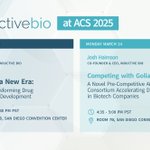
The rapid rise of AI in drug discovery brings both new opportunities and new challenges to navigate. We’ll be exploring these topics at two sessions at @ACS Spring 2025 this year. Looking to see a demo of Inductive Bio’s latest at #ACS? inductive.bio/book-a-demo

Switching from SMILES to IUPAC reduces invalid molecules generated by LLMs by >90%.
Want to know why?
Catch up on our blog now: inductive.bio/blog/molecular…
#GenerativeChemistry #DrugDiscovery #AI #ML
LLMs’ impact in generative chemistry has been limited to date. We show that a slight change in how you ask the question, simply by switching the input from SMILES to IUPAC, can reduce invalid molecules by >90%.
Learn more: inductive.bio/blog/molecular…
#GenerativeChemistry #AI #ML
Join us at #ACSFall 2024! Our own Josh Haimson will be host "Sifting Reality from Hype - AI & ML in Drug Discovery" on Aug 20 with experts from Eli Lilly, Atavistik Bio, & Sanofi.
Looking to meet with our team while at #ACS? inductive.bio/contact-us
Inductive retweeted

Guidelines for best practices when using #ML for #ADME drug optimization from @inductive_bio & @nestedtx including a successful case study! #ACSMedChemLett
go.acs.org/ape
Tired of the local vs. global property-prediction model debate? Why not both? Our blog dives into this debate and provides evidence that a combined global+local approach performs the best. Learn more: inductive.bio/blog/local-vs-… #DrugDiscovery #ML #ADME #Biotech
Inductive retweeted

High value AI application: Predicting properties of new drug candidates.
Congrats to the Nested Tx and Inductive Bio teams on this successful collaboration showing how new AI models can predict ADME properties and accelerate small molecule drug discovery.

Thrilled to announce that our work with @nestedtx in drug optimization is now published! 🧬Our ML models helped overcome critical ADME issues to advance Nested’s program. Full story: inductive.bio/news/publicati… #DrugDiscovery #ML #ADME #Biotech
