


INTJ68 retweeted

I want to pull this into its own thread. The permission split only matters once we say what freedom is.
Eric’s two senses are a fair map.
Sense 1: the decree does not specify the choice; the creature specifies it; God concurs. That is the stronger permission Oz wants.
Sense 2: God decrees the particular choice and the second causes that bring it about, without coercion.
Determinists use “permission” in sense 2. Oz said that is not his beef. Fine. Then the question is whether Reformed freedom requires sense 1.
I get the distinctions: contradiction and contrariety, concurrence, permission vs effect, necessity of the consequence vs the consequent, divided vs compound sense. I’ve read Muller and van Asselt. I’ve also read Turretin, Helm, and Preciado. The issue isn’t that those tools exist. The issue is making indifference the ground of freedom and contingency.
Turretin is clear: free will in its formal sense doesn’t consist in indifference. It consists in rational spontaneity. His first reason is that indifference to opposites is found in no free agent, created or uncreated. He’s talking about the essence of liberty, not denying every scholastic use of the word.
God is the freest agent there is. He isn’t in equilibrium between good and evil. He cannot will contrary to his nature. If freedom is that indifference, God is not free, or a sinner who can still go either way is freer than God. That’s backwards.
Christ’s human will is not indifferent to sin. The older Reformed weren’t hedging here. His obedience is the freest and most praiseworthy obedience there is. If an act is free only when the decree leaves the specification open and the will can take the contrary, then Christ’s obedience is either not free or it is a lesser freedom than Adam’s. That’s not a result they would accept.
Confirmed angels and glorified saints are non posse peccare. WCF 9.5 still calls that freedom: the will is perfectly and immutably free to good alone. That’s an upgrade, not a loss. If pilgrims are free because they retain indifference and because the decree did not specify the act, heaven is a demotion. Turretin’s question is the right one: do saints on earth have more liberty than saints in heaven because they can still sin?
WCF 9.1 doesn’t rescue sense 1. It says the will is not forced and not determined by an absolute necessity of nature to good or evil. That’s coaction and natural necessity. It isn’t “the decree left the choice unspecified.” 9.5 shows you can lose the power to the contrary and still have freedom in the confession’s own vocabulary.
Same structure on the other side. Reprobate angels are determined to evil and still act voluntarily. That necessity isn’t coercion. “Determined to one moral object, yet voluntary” is not an Edwards invention.
If all “indifference” means is potency in the divided sense, the will as a faculty can take contrary objects, and in other circumstances would have, then the determinist already has that. Edwards has that. Hypothetical ability is not sense 1. Sense 1 is the extra claim that, with the decree and the actual second causes in place, the creature still specifies which potency is reduced to act.
That extra claim cannot be the Reformed definition of freedom. The highest cases don’t work that way. A holy will is free because it acts of itself, from reason and will, without violence, according to its nature. That’s spontaneity. It doesn’t require an open decree plus indifference.
If the reply is that indifference is only a mode in some states, not the essence, then it’s no longer the ground of freedom. Freedom is then compatible with the will being determined to one effect. What remains is how to talk about sin so that God is not its author. That’s a real question. It’s not answered by treating indifference as the engine of liberty.

INTJ68 retweeted

Does being born again precede faith? Let’s see what Scripture teaches.
1 John 5:1 says, “Everyone who believes that Jesus is the Christ has been born of God.”
This verse links together regeneration (being born of God) and faith in an enlightening way. The relationship between the two is seen in the English translation (LSB), but it’s even clearer in the Greek text:
Πᾶς ὁ πιστεύων ὅτι Ἰησοῦς ἐστιν ὁ Χριστός ἐκ τοῦ θεοῦ γεγέννηται.
The Greek term ὁ πιστεύων is a present participle that means “believe.” In this form, it means “who believes,” with the implication from the present tense that such belief is a present and continuous activity. The person John has in view presently and persistently believes that Jesus is the Messiah.
Because this Greek verb is a participle preceded by the article, it functions as a verbal noun and the subject of the verb γεγέννηται. This term is the main predicate of the clause, and it means “to be born.” As the predicate, it predicates something about its subject, the one who believes. But what does it predicate about the believer?
The verb is a perfect passive indicative. The passive voice indicates the believer has been acted upon by another subject, in this case God, as the prepositional phrase makes clear. The indicative means that John is making a statement of fact, and this represents reality, not possibility or a hypothetical. The perfect tense indicates a past, completed action with ongoing present results. It’s nearly impossible to express this concept succinctly in English because our verbal system is so different from the Greek system.
The real gold comes in understanding the relationship between the participle (who believes) and the predicate (has been born). If being born of God followed faith, or to put it another way, faith preceded regeneration, we would expect the participle (who believes) to be in the aorist tense and the main verb in the present tense.
That would read, “Everyone who has believed that Jesus is the Christ is born of God.”
But the text says, “Everyone who believes that Jesus is the Christ has been born of God.”
This distinction’s importance cannot be overstated. John’s logic demands regeneration (being born of God) to precede faith (believing that Jesus is the Christ). The Greek text cannot be read any other way.
This verse definitively shows that the biblical order of salvation is regeneration->faith. Or, as Jesus put it, unless one is born again he cannot see the kingdom of God (John 3:3).
INTJ68 retweeted

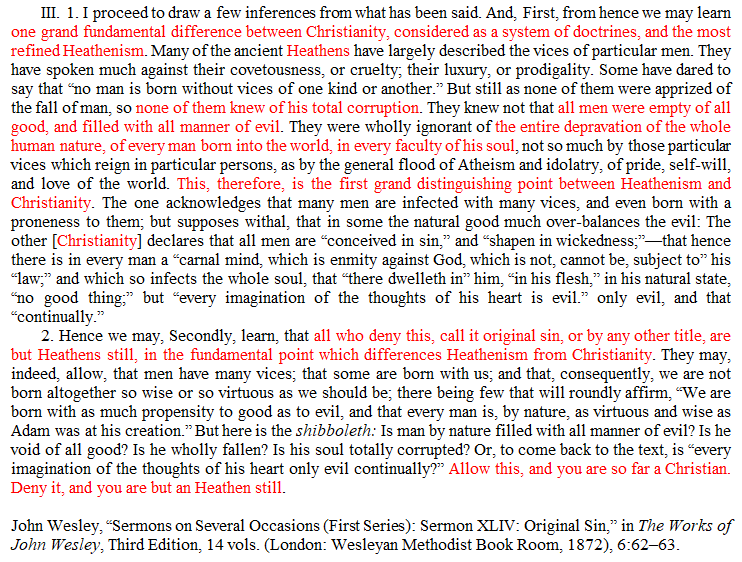
Many have seen John Wesley’s strong statements against Calvinistic predestination, with its notion of God, but few have seen this side of Wesley on “total corruption,” “original sin,” and those who deny it. A̲c̲c̲o̲r̲d̲i̲n̲g̲ t̲o̲ h̲i̲s̲ v̲i̲e̲w̲, what we’re seeing on 𝕏 these days is not coming from Christianity, but Heathenism:
III. 1. I proceed to draw a few inferences from what has been said. And, First, from hence we may learn one grand fundamental difference between Christianity, considered as a system of doctrines, and the most refined Heathenism. Many of the ancient Heathens have largely described the vices of particular men. They have spoken much against their covetousness, or cruelty; their luxury, or prodigality. Some have dared to say that “no man is born without vices of one kind or another.” But still as none of them were apprized of the fall of man, so none of them knew of his total corruption. They knew not that all men were empty of all good, and filled with all manner of evil. They were wholly ignorant of the entire depravation of the whole human nature, of every man born into the world, in every faculty of his soul, not so much by those particular vices which reign in particular persons, as by the general flood of Atheism and idolatry, of pride, self-will, and love of the world. This, therefore, is the first grand distinguishing point between Heathenism and Christianity. The one acknowledges that many men are infected with many vices, and even born with a proneness to them; but supposes withal, that in some the natural good much over-balances the evil: The other [Christianity] declares that all men are “conceived in sin,” and “shapen in wickedness;”—that hence there is in every man a “carnal mind, which is enmity against God, which is not, cannot be, subject to” his “law;” and which so infects the whole soul, that “there dwelleth in” him, “in his flesh,” in his natural state, “no good thing;” but “every imagination of the thoughts of his heart is evil.” only evil, and that “continually.”
2. Hence we may, Secondly, learn, that all who deny this, call it original sin, or by any other title, are but Heathens still, in the fundamental point which differences Heathenism from Christianity. They may, indeed, allow, that men have many vices; that some are born with us; and that, consequently, we are not born altogether so wise or so virtuous as we should be; there being few that will roundly affirm, “We are born with as much propensity to good as to evil, and that every man is, by nature, as virtuous and wise as Adam was at his creation.” But here is the shibboleth: Is man by nature filled with all manner of evil? Is he void of all good? Is he wholly fallen? Is his soul totally corrupted? Or, to come back to the text, is “every imagination of the thoughts of his heart only evil continually?” Allow this, and you are so far a Christian. Deny it, and you are but an Heathen still.
John Wesley, “Sermons on Several Occasions (First Series): Sermon XLIV: Original Sin,” in 𝘛𝘩𝘦 𝘞𝘰𝘳𝘬𝘴 𝘰𝘧 𝘑𝘰𝘩𝘯 𝘞𝘦𝘴𝘭𝘦𝘺, Third Edition, 14 vols. (London: Wesleyan Methodist Book Room, 1872), 6:62–63.
INTJ68 retweeted

🚨Leighton Flowers has revealed a critical inconsistency in his own theology. In the video clip, Leighton outright denies that the Fall caused any internal change in Adam's nature. According to him, the only difference between Adam before the Fall and humanity after the Fall is external—proximity to the "light," or the preaching of the word. He claims that, on Provisionism, Adam never lost his "eyes" (the ability to see the light); he only needed light restored, as opposed to any internal regeneration or transformation.
But here’s the issue: Leighton’s own Provisionist Article of Faith states, "We affirm that, because of the fall of Adam, we inherit not only an environment but a nature inclined toward sin and that every person capable of moral action will sin." This directly contradicts his statement in the video. If humanity after the Fall has a "nature inclined toward sin," as his article claims, then how does Leighton maintain that Adam’s nature didn’t change after the Fall?
If we take Leighton’s article seriously, it creates an even bigger problem: it retroactively applies to Adam before the Fall. Why? Because Adam was also a "person capable of moral action" before the Fall. This means that if there is no difference in nature between pre-Fall Adam and post-Fall humanity, Adam must have been created with a "nature inclined toward sin"—a nature that, according to Leighton’s article, "will sin."
Leighton’s logic forces him into an absurd position: Adam was created by God with the same sinful nature as humanity after the Fall, meaning God predestined Adam to sin because of the nature He gave him. In trying to deny the internal effects of the Fall, Leighton has backed himself into a corner where he either admits to contradicting his own article or accepts that God created Adam with a sinful nature that guaranteed he would fall.
This inconsistency exposes a fundamental flaw in #Provisionism. It attempts to downplay the devastating effects of the Fall to preserve human autonomy but ends up contradicting itself and creating a view of God that undermines His goodness and holiness. Would Leighton really accept the implication that Adam was created no different than post-Fall sinners, destined to sin from the start? If not, how does he reconcile this clear contradiction? @Soteriology101 #Calvinism
INTJ68 retweeted

I was asked to address the issue of whether or not 'world' and 'all' means every single person without exception in scripture.
INTJ68 retweeted

Double Predestination Explained Without Confusion
Many people speak about double predestination without first asking what the Bible actually teaches. The confusion usually begins when human explanations are treated as though they are equal to Scripture itself.
The Bible clearly teaches that God actively chooses to save sinners. This is not debated in Scripture. “He chose us in Christ before the foundation of the world” Ephesians 1:4. Salvation is described as God’s work from beginning to end. Faith itself is said to be granted, not produced naturally. “To you it has been granted for Christ’s sake to believe” Philippians 1:29. Those who believe do so because God first appointed them to life Acts 13:48.
When Scripture speaks about election, the language is always active. God chooses. God calls. God gives life. God shows mercy. “So then it depends not on human will or exertion but on God who has mercy” Romans 9:16.
However, when Scripture speaks about the lost, the language changes. It does not say God creates unbelief in them. It does not say God forces rebellion. It says they are already condemned because of sin. “All have sinned” Romans 3:23. “The wages of sin is death” Romans 6:23. Judgment is never presented as something God invents but as something sin deserves.
Jesus says men are condemned already because they do not believe, not because God prevented belief. “This is the judgment that the light has come into the world and people loved the darkness rather than the light” John 3:19. Their rejection flows from desire, not coercion.
This is why Scripture often uses the phrase “God gave them over” Romans 1:24 to 28. God does not plant evil in the heart. He hands men over to what they already pursue. That is judicial judgment, not moral causation.
When theologians speak of double predestination, they are not saying God works salvation and damnation in the same way. They are trying to describe two different divine actions. God actively saves some by mercy. God passively leaves others in their sin by justice. One involves intervention. The other involves restraint.
This is where people become confused. They assume symmetry where Scripture shows distinction. They imagine God dragging innocent people into hell. The Bible never teaches that. All are already guilty which also includes the elect. “There is none righteous not even one” Romans 3:10. IF GOD SAVES, IT IS GRACE. IF GOD JUDGES, IT IS JUSTICE.
Another common error is to think that if God is sovereign, human responsibility disappears. Scripture never allows that conclusion. Judas acted freely and was still accountable, yet his betrayal fulfilled God’s plan Acts 2:23. Divine sovereignty and human responsibility are never placed in opposition in the Bible. They run together even when the human mind cannot fully resolve them.
The real offense of this doctrine is not that God condemns sinners. Everyone agrees sin deserves judgment. The offense is that God saves some purely by mercy. That removes boasting. That removes control. That leaves salvation resting entirely in God’s hands.
Scripture does not present a cruel God delighting in destruction. God says plainly that He takes no pleasure in the death of the wicked Ezekiel 33:11. Judgment flows from holiness, not from malice. Salvation flows from mercy, not obligation.
So the Bible teaches election unto life and judgment according to sin. It teaches mercy given freely and justice rendered rightly. The confusion comes when people collapse these into one category and accuse God of doing what Scripture never says He does.
God saves sinners who do not deserve it.
God judges sinners who refuse Him.
That is not injustice. That is the gospel standing beside the holiness of God.
INTJ68 retweeted

🧵 𝟏/𝟕: Scripture is clear, in both the Old and New Testaments, that regeneration causes and therefore logically (if not chronologically) precedes the faith in Christ that brings justification before God.
teapawt.net/Pastor_Gabe/status/200…

INTJ68 retweeted
🚨 “Faith Before Regeneration” Is Just Dead Faith Revisioned:
We agree with the biblical category of Dead Faith preceding regeneration: Scripture shows lots of unregenerate willings “free from God’s internal grace”... ranging from hostile rebellion, to neutrality, to religious motions like “Lord, Lord” and lip-service while the heart is far off.
What that category is called in the Bible:
Outwardly “Godward” actions from a heart still corrupt are labeled hypocrisy, lip-service, dead faith, filthy rags, and vanity... not “pleasing faith.”
The real disagreement:
Anti-Calvinists treat these “free-from-internal-grace” willings (mere correct choice at the moment) as pleasing enough for God to respond with regeneration.
The Consistent View denies Scripture ever calls dead faith “saving faith” or presents it as the trigger for the new heart.
Why their slogan collapses:
Leighton’s line... “Just because someone has a corrupt heart doesn’t mean he can’t confess it and ask for a new one”... forces a dilemma:
🚩 If the confession comes from the corrupt heart, it’s hypocrisy/dead faith (real, common, and never tricks God).
If it comes from a non-corrupt heart, then internal grace has already changed the heart... so their premise is gone.
Bottom line:
Yes, a kind of “faith before regeneration” exists... as dead faith (lips honoring while the heart is far).
Anti-Calvinism is built on upgrading that condemned category into God-pleasing, saving faith, even while the heart remains fully corrupt.
#Calvinism vs #DeadFaithTheology
INTJ68 retweeted

Turek’s clip trades on a familiar sleight of hand. He redefines Calvinism as fatalism, smuggles in a libertarian definition of freedom, and then declares victory when the Reformed position fails to meet standards it never accepted. It sounds persuasive until you actually examine what he’s claiming.
First he says that Calvinism “makes the world a sham” because God commands people to choose Him when they “can’t.” That objection only works if freedom is defined as the power of contrary choice, a will that is above nature, desire, and disposition. However, that is not a biblical definition of freedom; it’s a philosophical import. Scripture defines freedom as acting according to one’s nature and desires, not in spite of them. Jesus doesn’t say, “You will not come to Me because you lack libertarian capacity.” He says, “You will not come to Me because you do not want to” (John 5:40). The inability is moral, not mechanical. The will is not coerced; it is enslaved. A will enslaved to sin still wills freely, eagerly, and consistently.
So when God commands repentance, He is not play-acting. He is addressing real moral agents who act voluntarily, even while bound by their nature. Divine commands do not require libertarian ability; they require moral responsibility. Scripture never apologizes for this. Neither should we.
Then comes his second claim, that Calvinism makes God the author of evil. This is where the argument collapses under its own weight. To say God ordains whatsoever comes to pass is not to say God commits evil, approves evil, or injects evil into creatures as a substance. Evil is not a “thing” God creates; it is a privation, a disorder of the will. God’s decree establishes the certainty of events; the creature’s will supplies the moral quality of those events. Same act. Different causal orders. Different intentions. This distinction is basic Christian metaphysics, affirmed long before the Reformation.
Turek then appeals to a debate story involving Norman Geisler and John Gerstner, with the rhetorical mic-drop question: “Who gave Adam the desire to sin?” followed by the verdict “contradiction.” That only sounds decisive if you assume desires must be externally injected like software updates. Adam did not sin because God implanted evil in him. Adam sinned because, though created upright, he was mutable. The desire arose from Adam’s own finite, contingent will when confronted with temptation. God ordained the Fall; Adam authored the sin. Those two statements are not contradictory unless you collapse all causation into one flat category, which is precisely the philosophical error being made.
Calling this a “mystery” does not mean “logical contradiction.” It means we are dealing with layered causality. God as the first cause, man as the secondary cause; God ordaining the event, man intending the evil within the event. Scripture explicitly affirms both without embarrassment (Genesis 50:20; Acts 2:23; Acts 4:27–28). If that framework makes God the author of evil, then the Bible itself is guilty.
Finally, the irony is that the very objection meant to rescue human freedom ends up destroying it. If desires must be self-originating in a libertarian sense, then they are either uncaused (which makes them random) or self-caused (which is incoherent). A will that determines itself without prior inclination is not free; it is unintelligible. Calvinism, by contrast, affirms what we actually experience every day; we choose what we want, and we want according to what we are. Grace doesn’t violate that structure; it redeems it.
So no, Calvinism does not make the world a sham. It makes it intelligible. It preserves real agency, real responsibility, and a sovereign God who is holy, righteous, and never the author of evil, while still being the Lord who “works all things according to the counsel of His will” (Ephesians 1:11). The real problem here is the insistence on a definition of freedom that neither Scripture nor reason can sustain.

INTJ68 retweeted
If faith really comes by hearing and hearing by the Word of Christ (Rom. 10), there’s a question Libertarian Free Will never wants to face,
What about all the people who never hear the gospel; never have, never will?
Once you take Romans 10 seriously, there are only four ways out, and all of them fail.
First option, “God gives everyone sufficient grace anyway.” But then faith no longer comes by hearing the Word. Romans 10 becomes decorative, not causal. Salvation now happens through some universal inner grace Scripture never describes. You’ve rescued libertarian freedom by quietly sidelining the very verse you appealed to.
Second option, “God judges them by the light they have.”
Now faith in Christ is no longer necessary. General revelation does what special revelation was supposedly required to do. At that point, the cross is no longer essential, it’s optional. That doesn’t preserve free will; it empties the gospel of urgency and meaning.
Third option, “God knew what they would have done if they had heard.” Congratulations, you’ve reinvented Molinism. Salvation now hinges on hypothetical worlds God never actualized. The decisive factor still isn’t human freedom, it’s God’s decision about which world to create. Libertarian freedom is doing no real work here.
Fourth option, “It’s a mystery.”
Fine. But then stop accusing Calvinism of incoherence. You don’t get to invoke mystery only when your system collapses and then demand airtight logic from everyone else.
Here’s the unavoidable conclusion. Romans 10 locates the cause of faith outside the human will, in the preached Word, sent by God, through messengers God commissions, to people God places in history and geography. Access to the gospel is providentially distributed.
Which means God, not autonomous human choice, ultimately determines who even gets the opportunity to believe.
Once you admit that, Libertarian Free Will isn’t merely wounded. It’s finished.
INTJ68 retweeted
Everyone believes in a limited atonement. The only question is where the limitation lies.
If someone says Christ died for every person without exception, yet not all are saved, then they are saying the atonement is limited in its power and effect. The cross, in that view, makes salvation possible but secures salvation for no one in particular. It waits on human response to finish what Christ began.
Scripture does not speak that way.
The Bible presents the atonement as effective, not hypothetical. Matthew 1:21 says He will save His people from their sins, not try to save them. Isaiah 53:11 says by His knowledge shall the righteous One justify many, and He shall bear their iniquities. The bearing of sin results in justification. It is not left unfinished.
Jesus Himself ties His death to a definite people. In John 10:11 He says the good shepherd lays down His life for the sheep. In John 10:15 He repeats it. Not for goats. Not for an undefined mass. For the sheep. And in John 10:26 He explains unbelief by saying some do not believe because they are not His sheep.
The apostles speak the same way. Ephesians 5:25 says Christ loved the church and gave Himself up for her. Acts 20:28 says He obtained the church with His own blood. Romans 8:32 to 34 connects Christ’s death directly to justification and says no charge can be brought against those for whom Christ died.
If Christ bore the sins of every individual without exception, then justice demands that every individual be saved. God does not punish sin twice. Hebrews 10:14 says by a single offering He has perfected for all time those who are being sanctified. The atonement actually accomplishes what it intends.
So yes, everyone limits the atonement somewhere. Either you limit its power, making it dependent on man, or you limit its scope, saying Christ died intentionally and effectively for His people.
Scripture is clear. The cross does not make salvation possible. It makes salvation certain. Christ did not die to create a chance. He died to save.
INTJ68 retweeted

Here’s French Reformed professor and minister Moses Amyraut responding to the same slanderous claims made against the Reformed in the 17th century. Sorry Amyraut, some things remain the same.
“As to the first, I am astonished that a learned man, whoever he may be, should liken the inability to believe—found in the reprobate—to the inability to fly in those to whom nature has not given wings. For indeed, the Romanists often attempt not so much to refute our doctrine as to calumniate it, as if we held that fulfilling the law of God, or believing in Christ, is just as impossible to man as if someone attempted to halt the motion of the heavens or remove the earth from its place…
Such things are not surprising among that sort of people who either do not read our writings, or, if they read them, do not understand them—or, if they do understand, then (as is the custom of these evil times and the bent of those eager to calumniate) they go out of their way to pervert them and to render us odious to all.
But it was to be expected that the disciples of Arminius—professing the Reformed religion—would either be more ingenuous or better acquainted with our doctrine. For the man who lacks wings, no matter how greatly he may desire to fly, nevertheless cannot do so. And in the same way, if someone were burdened with the Alps or the Pyrenees, no amount of effort or will to the contrary would suffice to remove the burden.
But if the reprobate most earnestly desired to believe the Gospel, they would certainly be able to do so. Indeed, by the very fact that they most earnestly desired to believe, they would thereby already testify that they had believed. For no will could be so compelled except by the intellect’s having already acknowledged and esteemed the incomparable excellence of the Gospel—which is nothing other than faith itself.
Therefore, to be unable to fly in the case of those to whom nature has denied wings is due to a deficiency in natural faculties and the absence of the necessary instruments for such an action. But the inability to believe, in the case of the reprobate, arises not from a like cause, but rather because they are unwilling to use the faculties granted to them by nature for that purpose. And they are unwilling because they are wicked—and so it is that they always will to be so.”

INTJ68 retweeted

You said something friend that cuts to the heart of the issue…“Especially when others don’t have any chance to make that choice to believe.” That’s a serious concern, and I get why it doesn’t sit right. But we need to be honest about what Scripture actually says. The problem isn’t that people are desperately trying to believe and God won’t let them. The problem is that no one wants to believe unless God changes their heart. “No one seeks for God… no one does good, not even one” (Rom 3:11-12). Jesus doesn’t say, “You can all come if you want.” He says, “No one can come to me unless the Father who sent me draws him” (John 6:44).
In other words, it’s not that the non-elect are banging on the door and getting turned away. It’s that none of us even looked for the door until God opened our eyes. The elect believe because God gives them a new heart, and from that heart, they believe freely and joyfully. It’s not robotic, and He’s not believing for them. He makes them willing. “Your people will offer themselves freely on the day of your power” (Ps 110:3). That’s grace.
Now, you also said you don’t believe election is individual but corporate, that God chose a category: all who believe. I get that. But that raises the obvious question: who will believe? If belief is ultimately up to us, then salvation depends on who’s smart enough, soft hearted enough, or lucky enough to respond. But Scripture says the opposite: “All that the Father gives me will come to me” (John 6:37). “As many as were appointed to eternal life believed” (Acts 13:48). The corporate body exists because of God’s individual election, not the other way around.
Same goes for your point about Christ dying for the world. That phrase doesn’t always mean every individual without exception, it often means every kind of person: Jew and Gentile, rich and poor, slave and free (Rev 5:9, John 11:52). Jesus didn’t die to make salvation possible, He died to actually save. He laid down His life for His sheep (John 10:11), for His church (Eph 5:25). If He paid for everyone’s sins, then God would be unjust to punish anyone. But Scripture is clear, not all are saved.
So yes brother, everyone who believes will be saved. No question. But without God’s sovereign grace, no one would believe. That’s why election isn’t cold or arbitrary, it’s mercy. Nobody gets treated unfairly. The non-elect get justice. The elect get grace. Nobody gets shortchanged. That’s not some philosophical mind game. That’s the Gospel.
INTJ68 retweeted
🚩And there it is—Provisionism finally admitting it: “We’re co-creators with God.”
That’s not deep. That’s disaster theology.
If we’re “co-creators,” then that means:
There are parts of creation God didn’t create.
There are parts of the future God didn’t know until we made them.
That’s not sovereignty—that’s shared authorship.
That’s not Christianity—that’s cosmic dualism.
It’s like a novelist saying his character helped him write the plot. That’s nonsense. You don’t “co-create” what you exist inside of. You’re not the Author. You’re the clay.
This isn’t just bad theology—it’s a small god, begging his creatures to finish what He couldn’t.
#Provisionism #Dualism #OpenTheism

INTJ68 retweeted
According to #Scripture, everyone who ends up in hell is:
1) Born in sin because of Adam (Romans 5:12)
2) Born with a heart that hates God and loves darkness (John 3:19)
3) Born guilty not for Adam’s act alone, but for their own rebellion against a holy God (Romans 3:10–12)
4) Born with no desire for God unless grace awakens it (Romans 8:7–8)
5) Born under judgment because they willingly suppress the truth in unrighteousness (Romans 1:18–20)
The problem is not that men cannot come to God but they will not. Their inability is moral, not mechanical. They do exactly what they want: they love darkness and hate the light. That is why judgment is just (John 3:19-20).
#Calvinism does not create victims. It reveals reality.
Hell is not filled with people who wanted Christ and were rejected. It is filled with those who refused Him, loved their sin, and died in it. The sinner is not a victim of God’s sovereignty; he is a rebel against His holiness.
The wonder of grace is not that some are condemned, but that any are saved at all.

According to #Calvinism everyone who ends up in hell was:
1) Born rejected by God (non-elect)
2) Born unable to believe (total inability)
3) Born guilty for someone else’s choice (original guilt)
5) Born without a means of atonement (limited atonement)
How are they not merely pitied as helpless victims, rather than justly rebuked and punished—as if they had any control over the way they were born?
If Calvinism is true there is no good reason not to just feel sorry for unbelievers and there certainly doesn’t seem to be any justification for rebuking and punishing them.
INTJ68 retweeted
The lengths to which some (not all but some) Provisionists (or maybe I should just say “anti-Calvinists?”) will go to avoid finding Calvinism in Scripture are simply staggering.
One of the latest cases in point is that of the random anon anti-Calvinist Mindwarden boldly declaring that “No one is ‘Spiritually dead’.” Since the concept of spiritual death is not derived from Gen 2:17, exegesis of that text is utterly beside the point.
The Apostle Paul describes sinners apart from Christ as follows:
¹⁸ They are darkened in their understanding, alienated from the life of God because of the ignorance that is in them, due to their hardness of heart.
—Ephesians 4:18 (ESV)
The word “alienated” here translates the verb ἀπαλλοτριόω (apallotrióō), which means “estranged” or “separated.” It’s only used in the New Testament two other times, both times by Paul (Eph 2:12; Col 1:21), and always in a spiritual sense.
The word for “life” is ζωή (zōḗ) which in the New Testament can refer to either physical life (Lk 16:25; Rom 8:38; Jas 4:14) or spiritual life (Jn 1:4; 10:10; 1Jn 5:12).
Since the sinners to which Paul refers are physically alive, it should go without saying that he’s using ζωή (zōḗ) in Eph 4:18 to refer to spiritual life. And if these sinners are alienated, estranged, or separated from spiritual life it follows that they are thus spiritually dead.
In other words, Paul is telling the Ephesians that their unbelieving neighbors remain in the same condition they were once in as he told them earlier when he wrote:
¹ And you were dead in the trespasses and sins
² in which you once walked…
—Ephesians 2:1-2a (ESV)
In other words, spiritually dead. This was the same thing Paul told the Colossians when he wrote:
¹³ And you, who were dead in your trespasses and the uncircumcision of your flesh, God made alive together with him, having forgiven us all our trespasses,
—Colossians 2:13 (ESV)
Paul informs us in Eph 2:2-3 that the evidence of spiritual death is a lifestyle characterized by unrepentant sin, which he also indicates when he tells Timothy that “she who is self-indulgent is dead even while she lives” (1Tim 5:6 ESV).
I, for one, think there’s evidence in the text of Genesis that Adam and Eve came to saving faith after their fall into sin. And since I believe Scripture teaches that saving faith comes as the result of Effectual Grace, that also had to be true of our first parents, assuming God saved them. But until that happened, they too were “dead” in their sins, that is, spiritually dead.
But equally astonishing is how Mindwarden is quick to blame the biblical concept of spiritual death on “obligation to a system despite the evidence” without even considering all the evidence.
And this raises the question: Which “system” is allegedly guilty of this? Based on my search of his posts, while @Soteriology101 disagrees with Calvinism on the implications of being dead spiritually, far from saying “No one is ‘Spiritually dead’” he actually affirms its existence.
This is also true of Arminianism, as one of their theologians makes clear:
“There is also a spiritual death in distinction from the spiritual life—such as man originally possessed. This death is inseparably connected with sin, and must have been the immediate consequence of sin in Adam. His spiritual life was fully realized only in union with the Holy Spirit. Sin was the severance of that union, with the consequence of spiritual death. Such was now the state of Adam and Eve. With the full execution of the penalty this death must have been utter. But it is reasonable to think that in this case, as in that of physical death, there was a partial arrest of judgment, or an instant gift of helping grace, through the redemptive mediation already instituted.”
—John Miley (1813-1895), Systematic Theology, Volume 1 (New York: Hunt & Eaton, 1892), 432.
Notice that Miley affirms that spiritual death “must have been the immediate consequence of sin in Adam.” In other words, for Arminians as well as Calvinists, Adam and Eve died spiritually in the day they ate from the Tree of the Knowledge of Good and Evil.
This conclusion isn’t the result of any particular “system,” but of simply listening to “the whole counsel of God” (Acts 20:27) which helps protect us from the “fierce wolves” Paul warned would rise up among us “not sparing the flock” (20:29-30).

INTJ68 retweeted
🚨 When Someone Says, “I Used to Be a Calvinist”:
We try to give the benefit of the doubt when someone claims they were once a Calvinist but have since “walked away.” Yet, as soon as you ask what exactly they walked away from, it quickly becomes clear that what they left behind was not Actual #Calvinism... it was something else entirely.
Often, their story sounds less like someone departing from Reformed theology and more like a Provisionist who had been incorrectly wearing the Calvinist label. They wrestle with questions about human freedom, responsibility, and God’s sovereignty... but their presuppositions have always been built on the idea of creaturely autonomy rather than divine authorship. They try to force the deeper doctrines of grace to fit into that man-centered framework, but the pieces never align. Eventually, they discover Provisionism and realize, “This is what I actually believed all along.”
Then comes the public announcement: “I left Calvinism.” But in reality, they didn’t leave Calvinism... they simply re-labeled what they had been from the start. They never embraced the consistent view of God as the continuous, causative Sustainer of all things, or the biblical logic that flows from that truth. They only ever stood on the outskirts.
Ironically, the Provisionist community then praises them for “leaving Calvinism,” celebrating what is, in truth, a correction of categories rather than a theological conversion.
The illusion is that Calvinism lost another follower... but what really happened is that someone finally named their presuppositions honestly.
🤷♂️ Why praise God... if it was his Will...
