

| Content creator | Digital Artist | locked in @SeismicSys
Joined April 2023
- Tweets24.7K
- Following1.8K
- Followers1.8K
- Likes40.8K






Zimal🦉 retweeted
GM, CT!
My plans for today:
• Sleep
• Eat good food
• Work on my art
• Scroll through reels
• Engage with mah pookies
Just a lazy saturday no plans no stress just chilling🫶🏻


Zimal🦉 retweeted
Gm, ct!
Happy Wednesday
Been a little inactive these past few days just took some time off the screen to enjoy with family Sometimes a little break is all you need🫶
Back today and first thing on my list is engaging with my mutuals
Have a nice day good peeps

A blockchain can agree on what happened
But how does it know an AI actually computed the result it claims?
That’s where the distinction between @BaranosAI and @fogo gets interesting
They solve two different problems
@BaranosAI focuses on the computation
Which model was used? What inputs did it receive? Which execution rules were followed? Can the result be reproduced, and can an incorrect execution be challenged?
@fogo provides the consensus layer
It secures the canonical onchain history where Baranos results are verified and settled
One handles the integrity of AI execution. The other establishes the shared blockchain state.
And that separation matters.
You don’t need to run every AI operation directly on the blockchain to make its output accountable
@BaranosAI normal Confirmation mode runs inference offchain then brings the result onchain for verification and potential dispute resolution
If a result is challenged the disputed computation can be replayed and adjudicated onchain
Once settled the result becomes onchain state that applications can use
That’s the part worth paying attention to
@BaranosAI makes AI computation verifiable
Fogo gives its settled results a canonical home
Together they create a path for AI outputs to become something applications can rely on not simply an answer they have to trust

Gm, ct!
Happy Wednesday
Been a little inactive these past few days just took some time off the screen to enjoy with family Sometimes a little break is all you need🫶
Back today and first thing on my list is engaging with my mutuals
Have a nice day good peeps
A blockchain can agree on what happened
But how does it know an AI actually computed the result it claims?
That’s where the distinction between @BaranosAI and @fogo gets interesting
They solve two different problems
@BaranosAI focuses on the computation
Which model was used? What inputs did it receive? Which execution rules were followed? Can the result be reproduced, and can an incorrect execution be challenged?
@fogo provides the consensus layer
It secures the canonical onchain history where Baranos results are verified and settled
One handles the integrity of AI execution. The other establishes the shared blockchain state.
And that separation matters.
You don’t need to run every AI operation directly on the blockchain to make its output accountable
@BaranosAI normal Confirmation mode runs inference offchain then brings the result onchain for verification and potential dispute resolution
If a result is challenged the disputed computation can be replayed and adjudicated onchain
Once settled the result becomes onchain state that applications can use
That’s the part worth paying attention to
@BaranosAI makes AI computation verifiable
Fogo gives its settled results a canonical home
Together they create a path for AI outputs to become something applications can rely on not simply an answer they have to trust
Zimal🦉 retweeted
A blockchain can agree on what happened
But how does it know an AI actually computed the result it claims?
That’s where the distinction between @BaranosAI and @fogo gets interesting
They solve two different problems
@BaranosAI focuses on the computation
Which model was used? What inputs did it receive? Which execution rules were followed? Can the result be reproduced, and can an incorrect execution be challenged?
@fogo provides the consensus layer
It secures the canonical onchain history where Baranos results are verified and settled
One handles the integrity of AI execution. The other establishes the shared blockchain state.
And that separation matters.
You don’t need to run every AI operation directly on the blockchain to make its output accountable
@BaranosAI normal Confirmation mode runs inference offchain then brings the result onchain for verification and potential dispute resolution
If a result is challenged the disputed computation can be replayed and adjudicated onchain
Once settled the result becomes onchain state that applications can use
That’s the part worth paying attention to
@BaranosAI makes AI computation verifiable
Fogo gives its settled results a canonical home
Together they create a path for AI outputs to become something applications can rely on not simply an answer they have to trust
Prediction markets don’t just need data
They need interpretation.
A market might ask:
Did this event actually happen?
Finding the evidence is one thing
Deciding what that evidence means is another
That’s where AI could become useful as an oracle
But there’s a problem
If an AI is responsible for interpreting an event that settles a market you can’t just say:
“the AI said yes.”
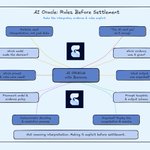
The market needs to know which model made the decision, what evidence it was given, what prompt and rules were used, and what output was expected
@BaranosAI approaches this by making those decisions explicit before settlement
A prediction market could precommit to its model, evidence policy, prompt template, deterministic decoding rules, output schema, and resolution process
So the AI isn’t just a black box sitting between the real world and the blockchain
Its role in the decision is defined upfront
And if the result is disputed, the computation can be replayed and resolved through the protocol
That’s what I find interesting about the AI oracle idea
It doesn’t try to remove interpretation.
It makes the interpreter, evidence, and rules of interpretation explicit before settlement
That could make AI much more useful for markets where the answer actually has consequences
Zimal🦉 retweeted
Prediction markets don’t just need data
They need interpretation.
A market might ask:
Did this event actually happen?
Finding the evidence is one thing
Deciding what that evidence means is another
That’s where AI could become useful as an oracle
But there’s a problem
If an AI is responsible for interpreting an event that settles a market you can’t just say:
“the AI said yes.”
The market needs to know which model made the decision, what evidence it was given, what prompt and rules were used, and what output was expected
@BaranosAI approaches this by making those decisions explicit before settlement
A prediction market could precommit to its model, evidence policy, prompt template, deterministic decoding rules, output schema, and resolution process
So the AI isn’t just a black box sitting between the real world and the blockchain
Its role in the decision is defined upfront
And if the result is disputed, the computation can be replayed and resolved through the protocol
That’s what I find interesting about the AI oracle idea
It doesn’t try to remove interpretation.
It makes the interpreter, evidence, and rules of interpretation explicit before settlement
That could make AI much more useful for markets where the answer actually has consequences
What if you couldn’t just trust an AI answer but actually verify how it was produced?
That matters a lot once AI starts making decisions that affect money, markets, insurance, or onchain apps.
Because with a normal LLM, things can change.
Different model version.
Different runtime.
Different decoding settings.
Even different execution environments.
And suddenly, you might not get the exact same result.
@BaranosAI is trying to solve that at the computation level
And it’s being built on Fogo, giving these verified AI computations a canonical place to settle onchain.
A @BaranosAI job can lock in the model, inputs, runtime, prompt construction, decoding rules and execution policy
So the idea is simple:
same inputs + same rules + same committed model = same result.
Take a prediction market.
If an AI is being used to decide whether an event happened, “the AI said yes” isn’t really enough.
You should be able to ask:
Which model?
Which evidence?
Which rules?
Can someone reproduce or challenge the result?
That’s the interesting part of @BaranosAI
It isn’t just about putting an LLM on a blockchain
It’s about making the computation behind an AI result something that can actually be checked
And honestly, that’s a much more useful way to think about verifiable AI
Zimal🦉 retweeted

What happens after an AI gives you an answer ?
With normal AI you usually get the result and trust the system behind it
@BaranosAI takes a different approach
Here is a simple look at how a Baranos AI job can become a verifiable onchain result
> Step 1 : Commit the AI job
Before the job starts, important details are fixed such as the model, inputs, prompt, runtime and execution rules
This defines exactly what the AI is supposed to do
> Step 2 : Execute the inference
The inference can run offchain, where heavy AI computation is more practical
The executor runs the committed job and produces a result
> Step 3 : Submit the result
The executor submits the result together with the information needed for verification
> Step 4 : Challenge if someone disagrees
If someone believes the result doesn't follow the committed rules they can challenge it
> Step 5 : Replay the computation
The relevant computation can then be replayed using the committed parameters to check whether it was executed correctly
> Step6 : Settle the result
Once the verification process is complete the canonical result can be settled onchain and used by applications
So the flow is simple:
Commit → Execute → Submit → Challenge → Replay → Settle
Imagine a prediction market asking:
Did a specific event happen?
Instead of simply trusting an AI API to answer YES or NO
The market can define the job, run the AI, allow challenges and settle the final result through a verifiable process
The goal isn't to prove that AI can never be wrong It is to make the AI computation itself verifiable
And that’s the interesting part of @BaranosAI
Don't just trust the AI result
Verify how it was produced

Zimal🦉 retweeted
What if you couldn’t just trust an AI answer but actually verify how it was produced?
That matters a lot once AI starts making decisions that affect money, markets, insurance, or onchain apps.
Because with a normal LLM, things can change.
Different model version.
Different runtime.
Different decoding settings.
Even different execution environments.
And suddenly, you might not get the exact same result.
@BaranosAI is trying to solve that at the computation level
And it’s being built on Fogo, giving these verified AI computations a canonical place to settle onchain.
A @BaranosAI job can lock in the model, inputs, runtime, prompt construction, decoding rules and execution policy
So the idea is simple:
same inputs + same rules + same committed model = same result.
Take a prediction market.
If an AI is being used to decide whether an event happened, “the AI said yes” isn’t really enough.
You should be able to ask:
Which model?
Which evidence?
Which rules?
Can someone reproduce or challenge the result?
That’s the interesting part of @BaranosAI
It isn’t just about putting an LLM on a blockchain
It’s about making the computation behind an AI result something that can actually be checked
And honestly, that’s a much more useful way to think about verifiable AI
Zimal🦉 retweeted

All the rewards for the BaranosAI Educational Quest are now live!
Every winner can now claim their respective reward. Thank you guys for the participation and the effort you put in.
I’ve loved reading your ideas, seeing your content and watching you help each other understand BaranosAI. Being able to give something back to this community means a lot to me.
I’m still impressed by how the community showed up for the Quest ❤️
Keep learning about @BaranosAI, follow their page and stay close to the announcements. I believe there are plenty more opportunities ahead for people who stay curious and involved.
Let’s keep bringing this energy to @fogo and the people building within its ecosystem. Showing up, trying what they build and sharing thoughtful feedback all matter beyond a single campaign.
I’ve tried to maintain openness and transparency throughout the event. I’d love to see that same standard across more projects and their communities in the Web3 space 😅
I firmly believe BaranosAI and Fogo have a lot to offer in the future, and I’m excited to keep being part of the journey along with all of you.
Enjoy your rewards, everyone. Let’s keep building, learning and growing together.
You can claim your airdrop through Lemon Drop. Connect your wallet using the claim link below and follow the steps to claim your reward. If you run into any issues, my DMs are always open.
Adios, My fam. This is the final post related to this event ❤️
P.C: A big thank-you to @miketherizzler and @smartcoded for bringing these stats together.


GM CT Fam
Launching a 60,000 $FOGO community challenge around the @BaranosAI Educational Quest. 🔥
The 10 best content creators will receive 6,000 $FOGO each, with six days to enter.
I have built the Quest to make the Baranos whitepaper easier to understand through a game. You work through the cases, develop your own use case and earn a certificate along the way.
I’ve always believed onchain AI has a big future. Baranos on-chain verification of AI is really quite interesting and verify the computation behind an AI decision. Once smart contracts act on those results, that ability starts to matter a lot.
Now I’d love to see how you explain it.
To enter:
1. Complete the Quest and submit your use case to unlock your certificate.
2. Read the whitepaper and create original content about what you learned.
3. Quote-post this announcement with your content and certificate, tagging @BaranosAI and @fogo.
A post, thread, graphic or short video all count.
Explain why Baranos’s approach matters, or explore something useful you’d build with it on Fogo’s 40ms block infrastructure. Tell us who it helps, why verification matters and what still needs work. Be clear about what exists today and what you’re proposing.
I’ll look for originality, clear explanations, technical accuracy and practical ideas when selecting the winners.
Entries will close on Saturday 5th October 2026.
"Play the Quest" baranosaieducationalquest.ne…
"Read the whitepaper" baranos.ai/assets/baranos-wh…
P.S. This is an independent, community-led event, not organised by either the Fogo or BaranosAI team.

What if you couldn’t just trust an AI answer but actually verify how it was produced?
That matters a lot once AI starts making decisions that affect money, markets, insurance, or onchain apps.
Because with a normal LLM, things can change.
Different model version.
Different runtime.
Different decoding settings.
Even different execution environments.
And suddenly, you might not get the exact same result.
@BaranosAI is trying to solve that at the computation level
And it’s being built on Fogo, giving these verified AI computations a canonical place to settle onchain.
A @BaranosAI job can lock in the model, inputs, runtime, prompt construction, decoding rules and execution policy
So the idea is simple:
same inputs + same rules + same committed model = same result.
Take a prediction market.
If an AI is being used to decide whether an event happened, “the AI said yes” isn’t really enough.
You should be able to ask:
Which model?
Which evidence?
Which rules?
Can someone reproduce or challenge the result?
That’s the interesting part of @BaranosAI
It isn’t just about putting an LLM on a blockchain
It’s about making the computation behind an AI result something that can actually be checked
And honestly, that’s a much more useful way to think about verifiable AI
Zimal🦉 retweeted
Finally, the time!
What started as a fun educational Quest is now rewarding or giving back $1,850 worth of $FOGO to 35 community members who participated in the event.
Tbh, this campaign brought back the @fogo vibes I’d been missing. I’ve loved reading your case studies, seeing your content and watching you explore what people could build with @BaranosAI
Thank you to every single person who took part. You gave this Quest your time and creativity, and you made the whole experience special. In my eyes, everyone who made that effort deserves to be celebrated.
Now, let’s congratulate our winners! 🥳
🏆 Top 13 winners · $100 worth of $FOGO each
@mmhero9 @rogalev_lion @miketherizzler
@giyu24x @FammaMalik @yocodedx
@Jia_Lilly01 @its3n3rgy @kaicrypt00
@web3candy @eniolafaruq3 @notuzzs0l
@mikolarabec
💙 22 additional winners · $25 worth of $FOGO each
@Durkhany_01 @lizzaali11 @Aashir_beyg
@David_John_555 @Chigo1andonly @MabMan338
@sam_crasy @bluberrry12 @rim_10x
@dream_07a @itszimal @iamsamsnipes
@frankk_onchain @fizzanami56 @DMLDeFi
@arr_kr @Mario_we3 @MrWaytoff
@theoneayoola @Je47929Emmanuel @ai_tee3
@kehindeayoola7
All 35 winners, please DM me your Fogo wallet address so I can arrange your rewards.
Keep learning, keep sharing your ideas around @BaranosAI and @fogo, and let’s keep building together. I’m so happy we could make this happen. ❤️
P.S. If you submitted an eligible entry and I’ve missed your handle, please reply or DM me with your entry link so I can check. Thank you!
🤝 Paid partnership

GM CT Fam
Launching a 60,000 $FOGO community challenge around the @BaranosAI Educational Quest. 🔥
The 10 best content creators will receive 6,000 $FOGO each, with six days to enter.
I have built the Quest to make the Baranos whitepaper easier to understand through a game. You work through the cases, develop your own use case and earn a certificate along the way.
I’ve always believed onchain AI has a big future. Baranos on-chain verification of AI is really quite interesting and verify the computation behind an AI decision. Once smart contracts act on those results, that ability starts to matter a lot.
Now I’d love to see how you explain it.
To enter:
1. Complete the Quest and submit your use case to unlock your certificate.
2. Read the whitepaper and create original content about what you learned.
3. Quote-post this announcement with your content and certificate, tagging @BaranosAI and @fogo.
A post, thread, graphic or short video all count.
Explain why Baranos’s approach matters, or explore something useful you’d build with it on Fogo’s 40ms block infrastructure. Tell us who it helps, why verification matters and what still needs work. Be clear about what exists today and what you’re proposing.
I’ll look for originality, clear explanations, technical accuracy and practical ideas when selecting the winners.
Entries will close on Saturday 5th October 2026.
"Play the Quest" baranosaieducationalquest.ne…
"Read the whitepaper" baranos.ai/assets/baranos-wh…
P.S. This is an independent, community-led event, not organised by either the Fogo or BaranosAI team.
Zimal🦉 retweeted
Making a blockchain faster isn’t always about making the computers faster.
Sometimes, it’s about making the network smarter
Think about what happens after a block is produced
The data still has to travel across a distributed network and reach the nodes that need it. If that movement is slow or inefficient, adding more compute doesn’t necessarily fix the problem.
This is where @get_optimum takes a different approach
It uses RLNC to reduce unnecessary redundancy when data is propagated, while Flexnodes encode, decode, and forward coded data across the network
What makes the architecture more interesting is that these Flexnodes form a permissionless network and can work alongside existing blockchain clients and P2P stacks.
So @get_optimum isn’t trying to rebuild the whole blockchain stack
It’s focused on improving something fundamental underneath it:
how efficiently information moves
And when blockchains continue to become more distributed and data heavy, that layer can matter just as much as raw computing power

Zimal🦉 retweeted

NAGI X CONSO BOTS
I am giving away 3 WL spots of Conso Bots
CONSO BOTS are Reputation Backed Agentic Collectibles designed to act as Mobile Nodes for the CONSO Network that is powered by Sui and Walrus (iykyk)
To enter:
• Follow me & @conso_xyz
• Like + RT this post
• Comment done

Making a blockchain faster isn’t always about making the computers faster.
Sometimes, it’s about making the network smarter
Think about what happens after a block is produced
The data still has to travel across a distributed network and reach the nodes that need it. If that movement is slow or inefficient, adding more compute doesn’t necessarily fix the problem.
This is where @get_optimum takes a different approach
It uses RLNC to reduce unnecessary redundancy when data is propagated, while Flexnodes encode, decode, and forward coded data across the network
What makes the architecture more interesting is that these Flexnodes form a permissionless network and can work alongside existing blockchain clients and P2P stacks.
So @get_optimum isn’t trying to rebuild the whole blockchain stack
It’s focused on improving something fundamental underneath it:
how efficiently information moves
And when blockchains continue to become more distributed and data heavy, that layer can matter just as much as raw computing power
