

Assistant Professor @KelleySchool | PhD @Wharton | Studying leader and team emotions | Views mine, working on sharing
Joined July 2019
- Tweets601
- Following1.3K
- Followers681
- Likes6.7K






Pinned Tweet
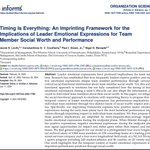
NEW @OrganizationSci with @coutifaris, @paulgreenjunior, and @BarsadeSigal
For leader emotions, timing is everything
We find that WHEN a leader expresses an emotion may be as important as which emotions they express for team member social worth and performance

For all instructors starting the spring semester, check out our piece adapting our research on leaders to how the timing of teacher positivity and negativity can impact student performance.
🌷📚🤓

Setting a tough tone early in the #semester doesn’t always lead to better performance.
In Inspiring Minds, researchers from @kelleyschool and @UTexasMcCombs explain why early encouragement and the timing of constructive #feedback matters: hbsp.harvard.edu/inspiring-m…

Jacob Levitt retweeted

Bonus - Is Economics a Science? w/ @erikmbaker
Danny chats with Erik Baker about his new article reviewing the “science critique of economics.” Plus, they talk a bit about the history of nuclear science.
Link in the replies!

This is something management journals should also consider in their push towards reproducible science and combating fraud.

Jacob Levitt retweeted

The way that we, as leaders, convey emotions really matters. New research busts the myth that leaders who express harsh feedback at the start of a project help to drive performance by showing the required standard. The research showed the opposite: the extent to which leaders expressed positivity (at the start of a project or year) was the biggest predictor of team success. It was as simple as stating how much they cared about team members, enjoyed working with them & valued their specific contributions. The research doesn't suggest that leaders have to always be positive, but that challenging feedback works better at the midpoint of a project or a year. Timing is important. Leaders who express constant negativity hurt team members’ performance:
hbr.org/2025/04/research-whe…. Via @jacobsglevitt @HarvardBiz.

Jacob Levitt retweeted

Research shows when leaders express positivity early on, employees perform better. s.hbr.org/3ErUyU2
🚨Our New Paper in HBR 🚨
☕️ Leaders expressing positivity early on has long lasting effects on performance.
🎛️ After early positivity, some negativity at the midpoint can further boost performance.
🫶 Team members feeling respected early enables tough criticism later.


Severance is about the horrors of work, and White Lotus is about the horrors of vacation.
Seeking a secret third show where work is fine and vacation is good
Jacob Levitt retweeted

New post! Yeah sorry it's about AI again. I'm not the biggest fan but it's obviously immensely clarifying for our idea of "intelligence"; ceding power blindly is bad but remaining totally ignorant is worse. Here's what we ought to learn about what's easy and what's hard.

Jacob Levitt retweeted

Can emotion regulation interventions spread from treated to non-treated people in a group?
We examine this question in a paper published in @NatureComms, led by @Michael_Pinus & @Yajun_Cao. nature.com/articles/s41467-0…

I'm thrilled to share that I have accepted a tenure-track assistant professor position at Indiana University - Kelley School of Business. I will officially start in July 2025. Thank you to everyone who supported me in the job market process! Go Hoosiers!


Jacob Levitt retweeted

This new paper led by a terrific doctoral student, @jacobsglevitt, and co-authored by @paulgreenjunior, @BarsadeSigal, and I, builds and tests a theory of leader emotional expressions over time in a team setting.


Oh, that’s my emotional support pdf that I open on my computer and stare at when I’m feeling stressed
Jacob Levitt retweeted

Thanks @PennGazette for making my cover boy dreams come true! It’s an honor to be in a magazine started by Ben Franklin. The article is quite personal, explaining how my story weaves into my research & recent book. Thanks, Trey Popp for the great writing. thepenngazette.com/the-newco…

Jacob Levitt retweeted

Leaders: ever wonder when/if to express emotions to your team? You're pleased/happy, or frustrated/disappointed: do you say something? Turns out the answer is complex: it depends on when. New @0rganizationSci paper with @jacobsglevitt @coutifaris @sigalbarsade helps clarify 1/n
