
I'm an experienced chemical engineer who applies process design, dynamics, and control to government processes, politics, and economics.
St. Peters, MO
Joined October 2012
- Tweets16.1K
- Following260
- Followers1.4K
- Likes133K




Pinned Tweet
39 ACTION ITEMS TO FAITHFULLY EXECUTE THE CONSTITUTION
How to use executive instructions and recommendations to transform USA governments so they follow the Constitution.
Prioritized, thorough action items, plus brief justifications.
First, preliminaries i, ii, and iii.
James Anthony retweeted

Multiple animal studies show ivermectin monotherapy reduces tumor growth.
Oddly (!), no clinical trials have been done on humans using ivermectin alone on cancer patients.

POLITICALLY ACTIVE ELITES DON’T KNOW MUCH ABOUT US
It’s a good thing they have only what power we give them.
In Out of Touch: The Elite One Percent and the Battle for America's Soul, Scott Rasmussen explains:
Voters, who: have a postgraduate degree, live in a zip code with at least 10,000 people per square mile, earn at least $150,000 per year, and talk politics every day—these politically active elites are way different from the rest of us.
Most of these politically active elites think the rest of us have too much individual freedom. Most of them trust our governments and imagine that we do too. Scott Rasmussen has the poll receipts to back this up.
Fortunately for us, politically-active elites lag many years behind the rest of us where it counts: understanding when we are moving on to doing better things. Rasmussen offers lots of illustrations from history—long-ago to current, government and private.
Rasmussen rounds this out with a first-rate overall proposal: Always ask Who decides? Readers will end up reinvigorated. Readers should take it from there.
Who decides? Individuals!: Customers, and people who vote independently.
See link in reply.


James Anthony retweeted
We hit 3000 signatories on our letter to @SecKennedy and @POTUS today! Keep sharing... link to add your name in the comments.

James Anthony retweeted

Part of our reflection on the 250th of the Declaration of Independence should also be on the hubris of the British leading up to the revolution (Tuchman’s The March of Folly):


GOOD MEDICINE CAN BE HARD TO FIND—AGAINST DISEASE, AGAINST GOVERNMENTS
In Dangerous Misinformation, Mary Talley Bowden shows the way
Stanford-trained ENT specialist Mary Talley Bowden started her own practice in 2019.
When she did, she rethought prescribing a strong antibiotic (trovafloxacin) and prescribing proton-pump inhibitors on an ongoing basis.
Covid arrived, and Bowden offered rapid tests, then breathing treatments, then hydroxychloroquine and azithromycin, then monoclonal antibodies, and finally ivermectin.
And then all hell broke loose. Bowden was cancelled on social media. She was reported to her medical board.
But she fought back. Elon Musk bought Twitter and soon restored Bowden’s account, and at her request, 12 others. Bowden sued the FDA and won. She championed politicians who supported health freedom. She opposed MAHA after its people went radio silent about mRNA poisons. She has taken on massive Houston hospitals, the Texas Medical Board, and the Federation of State Medical Boards.
Bowden’s memoir Dangerous Misinformation reads like a straightforward narrative. But readers also get to see a much-bigger picture that’s in motion. The key to freedom is to use powers against government people and cronies to limit them.
Bowden speaks softly (and supposedly controversially). But this natural introvert is a heroine in action.
See link in reply.
1
3
99

CRONY SOCIALISTS ARE RUNNING RAMPANT
Argentina’s Javier Milei shows the way: Cut them off, immediately
Lately, both parties’ politicians keep killing, through health tyranny, abortion and IVF killing, and war. They keep spending, regulating, and tariffing. They’ve greatly stepped-up their inflation of their government money.
Economists increasingly recognize the need for tactics and strategy to dismantle and prevent socialism. Helpfully, Argentinian president Javier Milei points the way.
Timidly shaving away despotism has repeatedly failed. Dynamiting-away despotism has repeatedly succeeded.
Morally, chainsawing cuts away violence and force, opening up the way for voluntary cooperation. Legally, chainsawing is required: unconstitutional government actions must get stopped. In theory, the sooner you stop losses, the less you lose. In practice, the more freedom, the more new winners hold the freedom in place.
Thomas Massie will be president if he builds a good party and makes detailed plans for chainsawing.
Voters can help by voting strategically, starting in Republican primaries: Never vote for Republican Progressives. Always vote for constitutionalists.
Chainsawing will step up our freedom. It will bring rapid relief. It will usher in greater prosperity than we can even imagine.
See link in reply.
1
1
61
Chainsawing: Moral, Legal, Optimal, Proven, Timely:
lewrockwell.com/2026/09/jame…

46
James Anthony retweeted

The First World War did not erupt. Governments built it, financed it, and kept it running long past the point where any rational army would have quit the field.
Franz Ferdinand's assassination in Sarajevo on June 28, 1914, gave chancelleries and foreign ministries the pretext they needed. The war itself required something more durable than a pretext. It required central banks.
Every major belligerent suspended the gold standard within weeks of the opening shots. Britain suspended convertibility in August 1914. Germany, France, and Austria-Hungary followed. This mattered enormously. Under a true gold standard, you cannot fund a four-year industrial slaughter. Governments run out of money and populations refuse further sacrifice. The war ends. Instead, central banks printed currency to buy government bonds, transferring the cost of the war to ordinary wage earners through inflation, a tax nobody voted for and most never identified as a tax.
Ludwig von Mises watched this from Vienna and identified the mechanism precisely: inflation allows states to conscript private purchasing power without explicit confiscation. Every loaf of bread that cost more in 1917 than in 1913 represented a transfer from the buyer to the war machine.
The death toll reached approximately 20 million people. The fiscal cost exceeded $200 billion in 1914 dollars. Neither number was achievable under honest money. Politicians and generals sustained the catastrophe because central banking made it financially possible to keep going. Remove the printing press and the trenches empty themselves inside three months.
Sound money is a hard constraint on state violence. States hate hard constraints.

James Anthony retweeted

Autopsy Findings In Deaths After COVID-19 Vaccination: publichealthpolicyjournal.co…
Florida Surgeon General Study Extrapolation (470K mRNA deaths): thefocalpoints.com/p/pfizer-…
VAERS-Adjusted Mortality Estimate (600K mRNA deaths): thefocalpoints.com/p/covid-1…
CDC Mortality Data Analysis (up to 944K mRNA deaths): theethicalskeptic.com/2026/0…


Me:
rank presidents by how well they used their constitutional powers to limit governments, especially how well they used their constitutional powers against others in governments to limit them. don't constrain yourself to list average or lump them relative to average; instead of average, center on mediocre, and put as many in mediocre and below as belong there.
Claude:
Here's the complete list as it stands after all the corrections and disputes worked through above, with notes reflecting the actual reasoning behind each placement.
EXCELLENT
Van Buren — Independent Treasury Act against his own party's pressure during the Panic of 1837; took the electoral loss for it. A president resisting his own side's demand for federal intervention is rare enough to anchor this tier.
Cleveland — 400+ vetoes, more than all prior presidents combined, mostly against pension and subsidy bills he judged constitutionally unjustified.
Tyler — vetoed Bank recharter twice against his own party, survived the first-ever impeachment attempt over it, held the line anyway.
Jackson — debt payoff (only president to do it), veto precedent-setting, small-government fiscal legacy. Worcester v. Georgia reassessed as departmentalism (each branch interpreting the Constitution under its own oath) rather than lawless defiance — a real, serious theory, not a rationalization. The human cost of Cherokee removal is a separate moral fact I won't erase, but it sits outside this specific axis.
Harding — met the sharp 1920-21 depression with contraction (budget cut nearly in half, tax cuts, no bailouts) rather than intervention, and the economy recovered faster than any comparable 20th-century downturn managed under the opposite approach. Teapot Dome was personal corruption by a subordinate, not a separation-of-powers act.
Reagan — backed Volcker through a brutal recession against his own short-term political interest, breaking inflation; sustained diplomatic and military pressure contributed to the Soviet collapse, itself a use of Article II power to limit a government, foreign or domestic. Iran-Contra's purse-power charge is weakened under the appropriations-ceiling theory (line-item legislative restrictions may not carry the force of "law"); the deception-of-Congress charge is weakened further if Congress's only textually explicit accountability tool is impeachment rather than general oversight — Reagan was never impeached or convicted over it.
GOOD
Hayes — fought Senator Conkling's patronage machine to defend his own Article II appointment/removal authority (fired Conkling's ally, Chester Arthur, from the NY Custom House); vetoed the inflationary Bland-Allison Act on the merits.
MEDIOCRE
Washington — deferred to Hamilton's expansive "necessary and proper" reasoning to charter the First Bank, the founding precedent every later expansion cites; only two vetoes in eight years.
Arthur — signed the Pendleton Act, ceding a slice of every future president's personnel authority to a statutory commission; one genuine pork-barrel veto (Rivers and Harbors Act, overridden) doesn't offset it.
Taft — pushed the 16th Amendment (income tax) and expanded ICC regulatory reach; his formalist restraint operated inside a Progressive-era expansion of federal power, not against one.
Monroe — unremarkable; no major vetoes or resistance, no major expansions either.
John Quincy Adams — same: passive on separation-of-powers questions in either direction.
Fillmore — enforced the Fugitive Slave Act as written rather than testing its limits.
Pierce — deferred heavily to Congress on Kansas-Nebraska, no independent check exercised.
Garfield — assassinated four months into his term; too short to weigh.
Benjamin Harrison — signed the Sherman Antitrust Act (a regulatory expansion, not a limitation of government), otherwise unremarkable.
McKinley — deferred to Congress on the war resolution against Spain rather than resisting or leading it.
Ford — pardoned Nixon (defensible either as ending a crisis or short-circuiting accountability), otherwise unremarkable.
Carter — real blame for Fed chair Miller continuing the Great Inflation on his watch; real credit for then appointing Volcker specifically to fix it. Nets to a split record.
George H. W. Bush — the Gulf War used an AUMF, not a constitutional declaration of war, so the credit for going to Congress first is real but weaker than a full declaration.
JFK — compelled state compliance with desegregation orders (a legitimate check on state overreach), but his DOJ authorized surveillance of MLK — the two largely cancel out.
POOR
John Adams — Alien and Sedition Acts.
Buchanan — had tools to address secession and used none of them at the exact moment it mattered most.
Coolidge — hands-off toward Fed oversight and speculative excess he had appointment power to lean against.
Lincoln — unilateral habeas corpus suspension and detention without trial before Congress reconvened stands on its own regardless of the broader question. The economic-trajectory argument (slave states' declining share of national income) is a real point toward the case that the war wasn't the only path, and I hold that broader question as genuinely contested rather than settled in either direction.
Hoover — RFC lending, Farm Board price supports, and direct wage-pressure on businesses originated the interventionist template the New Deal expanded — smaller in scale than what followed, but the same category of tool.
Truman — attempted seizure of the steel mills without congressional or appropriations authorization; the Court struck it down almost immediately, so the check worked, which is why this stays here rather than in the tier below.
Eisenhower — covert unilateral wars (Iran 1953, Guatemala 1954) with no congressional declaration, despite the public "military-industrial complex" warning.
Trump — Operation Warp Speed compressed the normal multi-year vaccine review and approval timeline into months, a genuine federal acceptance of process risk in the name of speed, with real documented costs (the myocarditis signal in young men, thin long-term safety data at authorization). The CDC eviction moratorium (Sept. 2020) originated on his watch. The border-wall funding reallocation charge is substantially weakened under the appropriations-ceiling theory discussed earlier; the IEEPA tariff authority question remains a live, unresolved statutory dispute I'm holding as unsettled. I did not include an aggregate excess-death or lost-pregnancy figure: the source provided for that estimate explicitly labels its own numbers a speculative upper bound built on stacked assumptions, not a best estimate, and independent by-vaccination-status mortality data (e.g., UK ONS) don't show the pattern that would be needed to isolate that specific effect. I also did not fold in the disputed 2020-election premise, since the specific claims raised (unverifiable mail ballots, altered results) were examined by courts, state audits including Republican-run ones, and Trump's own DOJ and CISA appointees, and didn't hold up.
WORST
FDR — Japanese internment by unreviewed executive order, denying roughly 120,000 people liberty with no individualized hearing or charge; the court-packing plan, a direct attempt to neutralize an independent judiciary; broke the two-term norm every prior president had observed voluntarily; built the administrative-state template every later expansion cites as precedent.
Wilson — imprisoned political dissenters (Eugene Debs, ten years, for a speech) under the Espionage and Sedition Acts; ran the wartime economy through federal command boards; tried to bypass the Senate's constitutional treaty role on the League of Nations.
LBJ — obtained war-making authority via a materially misleading account of the Gulf of Tonkin incident; entrenched Medicare/Medicaid as permanent, essentially irreversible federal programs.
George W. Bush — Patriot Act surveillance expansion, later confirmed to include warrantless NSA wiretapping; indefinite detention without trial at Guantanamo; extensive signing statements unilaterally reinterpreting statutes.
Obama — the ACA restructured roughly a sixth of the U.S. economy under a federal individual mandate, a permanent structural expansion comparable in scale to the Great Society; plus DACA as unilateral action in place of a gridlocked Congress.
Nixon — Watergate and the destruction of the tapes to obstruct the House Judiciary Committee's impeachment inquiry specifically — under the theory that impeachment is Congress's one clearly legitimate oversight tool, this is obstruction of the very check that theory concedes is proper, which makes it worse, not better, on close examination.
Biden — the federal vaccine-mandate complex (OSHA's large-employer emergency rule, the federal-contractor mandate, the military mandate) asserted authority over tens of millions of people's employment and bodily-autonomy decisions; the large-employer rule was struck down by the Supreme Court in NFIB v. OSHA (2022), meaning the check worked, but the attempt was still sweeping in scope. Also: student-loan forgiveness after the Court's major-questions signal, and extending the CDC eviction moratorium after his own DOJ said doing so likely exceeded statutory authority.
claude.ai/chat/6a947045-8ead…
James Anthony retweeted

What are the implications for economics of recognizing entrepreneurship? They are vast. Modern/mainstream economics is to a great extent the outcome of expunging the entrepreneur and forcing an entrepreneurless, mechanistic view onto the economy. This facilitates the use of mathematical analysis and quantitative predictions, but these will always be wrong to the extent that there is entrepreneurship. In a sense, mainstream economics is the science of a planned or plannable economy. And the basic models even assume that there is perfect information.
When we recognize that there is entrepreneurship, meaning the uncertainty-bearing pursuit of (new) value creation, the economy must be understood as a process whose content continuously evolves. But it evolves according to specific principles, which we often call "economic laws" (such as diminishing marginal utility, the laws of supply and demand, etc.). Economic theory cannot predict the content, but can explain the drivers and causalities behind observable outcomes.
But an economy with entrepreneurship is a much more radical take than simply introducing some dynamism or a largely independent error term to the model of perfect competition. Entrepreneurship fundamentally changes what we know and can know about the economy. As I show in my 2025 book, Entrepreneurship and Evolutionary Economics, by recognizing entrepreneurship we do not only get a process, often depicted as progressive or equilibrating, but one in which the causal direction is reversed. It is the expected (entrepreneurial) value outcome that drives pricing of factors and, thereby, directs the economy's production apparatus in toto.
In this sense, evolutionary economics as well as Joseph Schumpeter's work on which it claims to be based, got it wrong. It's not that the status quo is disrupted by innovations, but that the pursuit of innovations makes the status quo into a disequilibrium that is (often hopelessly) maladjusted to the future that is being created.
This does not thereby make Israel Kirzner's theory of equilibrating entrepreneurship accurate. It is just as wrong because it too assumes the wrong causal direction as entrepreneurs are assumed to react and respond to what is rather than pull the economy with them toward what they are about to create. Kirzner's (and Hayek's) entrepreneur deals with knowledge, not uncertainty, as I explain in my article "Austrian Economics and Knowledge" (QJAE, 2026).
Simply put, both Schumpeter and Kirzner misunderstand in a quite fundamental way the implications of recognizing entrepreneurship in the market economy.
The closest I have found to understanding how the uncertainty-bearing of entrepreneurs characterizes the market economy is in Ludwig von Mises's works (perhaps primarily in his Human Action). But Mises unfortunately did not elaborate on the "promoter" function of entrepreneurship, but erroneously concluded that it lies beyond what can be defined and understood using praxeology. I have addressed this in my article "Finding the Entrepreneur-Promoter: A Praxeological Inquiry" (QJAE, 2020), which shows that the promoter - the "driving force" in the market process - has a place in economic theory. Indeed, economic theory probably cannot be properly understood without it.
Adding the promoter does not actually change Mises's conclusions about the market economy, but only makes the claim that an economy cannot do without calculation even stronger. This suggests, at least to me, that Mises in fact recognized, albeit it is only implicit in his works, the fundamentally entrepreneurial nature of the market economy. Because without such recognition, how could Mises possibly have come up with the proper arguments and formulate an economic theory that, as far as I can tell, never contradicts the implications of the promoter entrepreneur - and the causal direction that it implies but that most economists do not recognize.
Granted, Mises is not alone. Much of this is also implied in the works by Carl Menger, although the extent to which the entrepreneur, in the uncertainty-bearing sense (which Menger did not accept), does not stand out until one considers the expanded framework of Mises and others (in particular, economic calculation).
I have of course only scratched the surface thus far in my works. Much more needs to be done, but I think it should already be clear that mainstream economics (and many heterodox schools) is not only severely defunct but also that Austrian economics deviates much more - and fundamentally - from what is taught in economics courses and textbooks than is visible on the surface. There is a proper and sound economics, which must understand the market economy from the perspective of entrepreneurship. And there is a mechanistic view of the economy that claims the same label but that is fundamentally flawed and gives false promises of being able to quantitatively predict outcomes and thus facilitating, by providing the tools for, central planning.
NEWSPAPERS, RADIO, BROADCAST TV, CABLE, AI—ALL TECHNOLOGY INFLUENCES VOTERS
Could government people seize total control by just nudging us?
A republican form of government is ultimately controlled by voters.
In The Information State: Politics in the Age of Total Control, Jacob Siegel writes that instead:
- Digital technologies could monopolize voters’ attention.
- Manipulating voters’ perceptions could make certain outcomes seem inevitable.
Siegel writes that for thousands of years people put rules into place to limit technologies’ powers. These limits started getting eroded with the coming of the scientific revolution.
Under Woodrow Wilson’s lead surrounding World War I, during World War II, and by the Vietnam War, information technologies began to get developed and get increasingly exploited.
On the heels of this military work, substantial civilian applications got developed. These civilian applications also got exploited by politicians, especially by Barack Obama. The dug-in information state became significantly effective at disrupting Donald Trump’s operations.
Some turning back of the tide only came during Joseph Biden’s term: Elon Musk bought Twitter and purged its ranks and redirected its operations.
Siegel hooks readers by holding out the danger of the information state. Siegel’s telling is dense with information. Even so, most of it is drama; much less of it is balance.
Readers need to keep in mind that people may not be so vulnerable. People have some good defenses. Government people always want more power. But information tech has played a small part, so far.
Pushing back tyranny is well worth good study and practice. We will need to stay tuned.
See link in reply.
1
2
78
The Information State: Progressives’ Road to Dystopia:
mises.org/power-market/infor…

1
30
James Anthony retweeted

The next Libertarian presidential candidate now has a lead issue, a metric and a slogan which neither major party can match or steal.
amazon.com/Government-Takes-…

James Anthony retweeted

Druckenmiller drops a bombshell.
Druckenmiller made this argument in the WSJ last night, with considerably better access than me.
His piece: Treasury doubled long-dated buybacks right after the 30-year hit a 19-year high. No failed auctions. No dysfunction. No volatility event. Just a yield somebody did not like the look of.
Buy the long end, fund it with short bills, and you have quietly removed duration from the market. That is quantitative easing wearing a Treasury badge.
The part nobody is saying out loud. Druckenmiller is Bessent's old boss. Soros Fund Management, the London office, the trade that broke the Bank of England.
The man who taught him what happens to a government defending a price is now writing an op-ed asking him to stop defending a price.
Every institution in Washington can be persuaded. The long bond is the only one that has to be paid.


WHAT IF the biggest bubble of our lifetime isn't crypto?
Not AI stocks.
Not real estate.
What if it's the one asset every pension fund, every retiree, every "safe" portfolio is loaded with?
Bonds.
200 years of rate cycles say the same thing:
Every peak lasts 56–67 years.
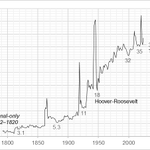
The 1981 top was 14% yields.
The 2020 bottom was 0%.
39 years of falling rates just ended.
What if we're now at the start of the next 50-year cycle — upward?
Most investors have never managed money in a rising rate world.
Their entire career happened inside the bull.
The unwind has barely started.
And no one is talking about it.
