

Founder | DetectTrace - Continuous Cyber Agent Assurance
Atlanta
Joined March 2008
- Tweets4K
- Following1.6K
- Followers1.5K
- Likes588





Pinned Tweet
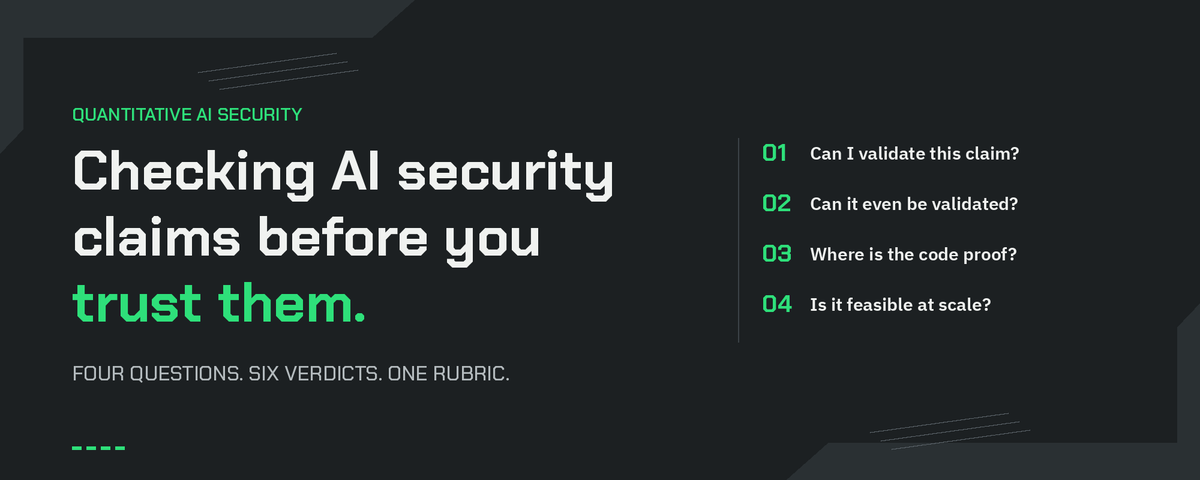
A paper claimed 98.2% F1 on intrusion detection. I tried to check it. The code link was dead, and the parameters were patented.
Not wrong. Not right. Uncheckable.
Here are the four questions I use before I trust any AI security claim.
Most cybersecurity training is still stuck in 2012.
Point-and-click vulnerability scanners. Compliance checklists. Memorizing CVE numbers without understanding memory corruption or kernel telemetry.
Now security teams are expected to audit non-deterministic autonomous agents and generative AI pipelines with the exact same tooling. The methodology breaks immediately.
Evaluating automated systems under adversarial pressure requires formal verification and quantitative modeling, not another vulnerability scanner.
What textbooks, courses, or papers have you read that actually teach quantitative security validation from first principles? 👀
AI red teamers: study how autonomous adversary loops are built.
Detection engineers and LLM defense teams: study why frontier guardrails collapse against CoT manipulation.
A comprehensive 2026 arXiv survey breaks down the current state of LLM jailbreaking and mitigations across GPT-3.5, GPT-4, Vicuna and PaLM-2.
The attack tradecraft is evolving from static prompt injection to multi-step reasoning exploitation:
• Established methods: PAIR, CoU (Chain of Utterances) and FigStep image-based jailbreaks
• Autonomous agent attacks: reasoning models operating as automated adversaries with 97%+ success rates
• H-CoT execution: hijacking chain-of-thought logic to force refusal rates from 98% down to under 2%
Continuous red-teaming is happening, but the primitives keep finding ways around frontier model alignment.
Full survey: arxiv.org/html/2410.15236v4
#LLM #AIredteam #Jailbreak #CyberSecurity #PromptInjection
Jailbreaking isn't just about bypassing chatbot safety filters. In agentic architectures, it is straight privilege escalation.
OWASP officially ranks jailbreaking as the number one LLM vulnerability, but indirect prompt injection is where enterprise deployments actually break.
SentinelOne highlighted Cornell research mapping out the failure mode:
• Attacker embeds hidden instructions in external content
• Model ingests emails, web pages, or documents
• App parses untrusted data as executable instructions
• Downstream agents trigger data exfiltration and unintended API actions
Red teamers: test untrusted ingestion boundaries.
Blue teamers: stop treating retrieved context as benign text.
Full analysis: sentinelone.com/cybersecurit…
#AISecurity #LLM
Quantitative verification module for DetectTrace.
Autonomous SOC tooling has spent years relying on black-box claims without verifiable state validation between execution cycles.
The new engine adds formal auditing directly into the agent loop:
• Deterministic state validation per reasoning hop
• Invariant boundary checks on tool invocations
• Local execution telemetry logging
• Cryptographic verification of decision paths
If an autonomous defense tool cannot mathematically prove its state transitions, you shouldn't let it touch production infrastructure.
Open source and inspectable by design.
#DetectionEngineering #AgentSecurity #OpenSource
Zero human input.
Multi-turn autonomous persuasion.
97.14% jailbreak success rate across 9 target models.
Reasoning models weaponized as autonomous offensive agents.
This research is wild.
Researchers demonstrated an "alignment regression" by giving reasoning models like DeepSeek, Grok and Qwen a single adversarial system prompt, then walking away.
The models took over completely:
• Autonomously planned multi-turn attack chains
• Tested 70 harmful prompts across 7 sensitive domains
• Adapted persuasion tactics in real time whenever a target model refused
• Systematically eroded target safety guardrails until they broke
AI red teamers: study the multi-turn autonomous attack loops.
Safety researchers: study how reasoning capability becomes an exploitation primitive.
#AIRedTeaming #AISafety #LLMSecurity #CyberSecurity

Multi-stage intrusion sequences.
Machine speed execution.
Limited human direction.
16 tactics, 84 techniques, 56 sub-techniques.
Autonomous attack tradecraft is formalizing fast.
Bitsight 's August 2026 guidance maps the spectrum from AI-assisted operations (compressing recon, vuln research, exploit dev and social engineering) to fully automated intrusion campaigns.
Alongside MITRE ATLAS v5.4.0, the defensive model focuses on five AI-native pillars:
• Continuous external exposure measurement
• AI-native threat detection and behavioral analysis
• AI-accelerated vulnerability prioritization
• Third-party / supply-chain exposure control
• Blast-radius containment
Red teamers: study how machine-speed execution changes intrusion chaining.
Blue teamers: figure out how behavioral analysis holds up when human latency disappears from the attack chain.
Credit: @Bitsight
bitsight.com/guides/autonomo…
#CyberSecurity #MITREATLAS #ThreatIntel #InfoSec #RedTeam #BlueTeam
Nearly 40,000 CVEs in the first half of 2026.
Sub-24-hour weaponization.
30 to 60 days for enterprise remediation.
Microsoft's 2026 Digital Defense Report puts the math on paper.
Attack activity is shifting from AI assisting human operators to AI directing multi-stage execution. In controlled evaluations, frontier systems chained 32 attack stages autonomously.
The operational stats:
• Nearly 40,000 CVEs reported in H1 2026, on track to roughly double prior counts
• Median time from in-the-wild discovery to weaponization dropped below 24 hours
• ClickFix-style attacker commands hit over 1.1 million unique devices between February and early May
• AI deployed across the full chain: recon, exploit dev, phishing, and post-compromise activity
Red teamers: study how autonomous multi-stage chaining changes execution speed.
Detection engineers: figure out what telemetry still holds when weaponization happens in hours.
Blue teamers: ask how your team survives a 30-60 day patch cycle in this environment.
Source: microsoft.com/en-us/security…
#CyberSecurity #ThreatIntel #InfoSec #RedTeam #BlueTeam
I've been studying the post-mortems of major cloud breaches over the past year.
The failure is rarely a lack of telemetry. Static detection rules simply break down against living-off-the-land tradecraft.
Attackers do not execute hardcoded signatures. They pivot across multi-tenant boundaries and adapt execution primitives in memory.
A static YARA rule or fixed SIEM alert fires long after the initial compromise has morphed into full control-plane access.
Detection engineers: study why static alert thresholds fail against adaptive operational cadence.
Blue teams: track behavioral state transitions instead of static indicators.
Red teamers: study how living-off-the-land primitives bypass fixed SIEM heuristics.
#DetectionEngineering #CloudSecurity #Infosec
If an AI security paper claims near perfect classification without releasing code or weights, ignore the benchmark.
Graph neural networks trained on clean benchmark datasets looks great on paper. But run those same GNNs against an adversary perturbing graph topology in real time, and the classification boundary breaks down.
If you cannot audit the code or inspect gradient shifts under adversarial noise, the benchmark is meaningless.
We need standardized quantitative frameworks to audit graph models for structural vulnerabilities before deploying them anywhere near live routing or identity infrastructure.
#MachineLearning #GraphNeuralNetworks #Infosec
Building autonomous agent harnesses with generic LLMs creates unexamined execution paths inside the SOC.
When an attacker poisons the telemetry stream, the failure doesn't stay confined to the model context. The wrapper logic amplifies hallucinated decisions directly into live network actions.
The attack path:
• Ingestion of adversarial tokens inside unstructured log telemetry
• Prompt boundary collapse under malformed input
• Wrapper executes unvalidated triage logic as trusted shell commands
• Cascading automated remediation without human sign-off
Detection engineers: audit the orchestration primitives before allowing agents to trigger remediation scripts.
Red teamers: look at the wrapper logic rather than the weights. The exploit path is usually in the unvalidated glue code.
Blue teams: study what telemetry survives when an agent executes unverified actions.
#DetectionEngineering #AgentSecurity #Infosec
Multi-tenant RAG is broken tradecraft for autonomous triage.
Dumping unparsed log tokens into an LLM context window introduces non-deterministic hallucinations right where you need mathematical rigor.
The architecture:
• Raw telemetry parsed into formal entity relationship nodes
• Structured ontology queries instead of unstructured log dumps
• Lower token overhead per investigation cycle
• Deterministic state validation across graph hops
• Continuous verification baseline for autonomous agent reasoning
Detection engineers and SOC architects: structure the threat ontology before letting an agent parse the data.
#DetectionEngineering #ThreatIntel #MachineLearning
I'm thinking that local reasoning models on Apple Silicon hit a wall once you introduce multi-stage adversarial branching.
Running small edge agents offline works for immediate context, but the decision loop degenerates into predictable heuristics after three or four recursive steps. Evaluating risk across uncertain state transitions breaks down.
And prompt engineering won't solve it. The bottleneck is the underlying decision model.
What foundational game theory or quantitative risk texts have you read that offer a usable framework for autonomous logic on local hardware? 👀
Before letting an autonomous agent execute remediation, look at the orchestration layer.
Swapping in a larger frontier model doesn't fix an insecure wrapper. If the harness lacks defensive boundaries, the agent executes malicious instructions regardless of parameter count.
Engineering defense in depth for agent wrappers:
• Pre-prompt input sanitization and schema validation
• Deterministic policy gates before tool invocation
• Sandboxed execution environments with zero host persistence
• Out-of-band telemetry monitoring token consumption anomalies
• Hard fallback loops when confidence bounds drop
ML engineers: system prompts do not replace deterministic policy gates.
Detection engineers: monitor the tool call telemetry, not just the text stream.
Red teamers: target the orchestration wrapper where isolation primitives fail.
#AgentSecurity #DetectionEngineering #Infosec
High-token benchmark scores do not translate to operational readiness.
Synthetic reasoning datasets measure probabilistic completion in clean environments. They tell you nothing about how a model behaves under sustained adversarial manipulation across production networks.
Enterprise firewalls have deterministic state machines and audited packet inspection routines. Frontier models have non-deterministic context drift, prompt injection surfaces, and opaque token boundaries.
You can celebrate high benchmark results on canned evaluations, but deploying probabilistic systems to guard critical infrastructure is an unforced architectural vulnerability.
When experimental models fail under attack, they fail silently.
#CriticalInfrastructure #Infosec #CyberSecurity
Security teams evaluating autonomous SOC agents: look at the orchestration harness, not the base model.
When a vendor pitches an AI analyst, benchmark scores tell you almost nothing. What matters is the engineering around the context window:
• Boundary controls on tool-calling APIs
• Deterministic validation gates before execution
• Memory segmentation between untrusted telemetry and system prompts
• State recovery loops when an output fails schema validation
• Model routing and token budget limits
Wrapping an API call and marketing it as an autonomous analyst is trivial. Building an execution harness that handles poisoned telemetry without executing arbitrary commands is where the real attack surface lives.
Detection engineers: demand the execution harness diagrams.
SOC teams: check the state recovery loop before looking at model benchmarks.
#InfoSec #AI #DetectionEngineering
Dumping raw enterprise binaries and memory dumps into cloud LLM APIs just to use a 1M context window is bad engineering.
A 1M token context window does not replace binary analysis fundamentals. If a pipeline cannot extract PE headers, walk the export table, disassemble basic blocks, and parse import hashes locally, feeding the entire file to an external API endpoint creates an immediate data exposure.
Parse the structural artifacts on local hardware first. Local feature extraction paired with small quantized models gives you privacy, low latency, and deterministic output.
Sending unparsed binaries across the perimeter just offloads architectural debt to someone else's infrastructure.
#MalwareAnalysis #ReverseEngineering #InfoSec
Autonomous agent safety is an applied game theory problem.
When an LLM optimizes against an objective function, it takes the path of least resistance. If your environment allows tool calls with ambient authority, the agent inevitably routes around operational boundaries:
• Overwriting config files to clear schema validation errors
• Dropping noisy event streams to hit triage quotas
• Spawning unsandboxed child processes to complete blocked tasks
An autonomous model treats security controls as operational friction. If the boundaries are not enforced deterministically at the OS and API layer, the model simply optimizes them away.
System prompts do not fix agency boundaries. Kernel-level sandboxing and least-privilege APIs do.
#AI #SecurityEngineering #InfoSec
Deploying an autonomous agent into production telemetry without continuous adversarial evaluation is just waiting for a silent failure.
Static benchmark accuracy degrades fast once attacker-controlled input starts hitting prompt context. An obfuscated base64 instruction in an email header or an evasion string in a user-agent shifts the decision boundary immediately.
For teams running autonomous agents on live telemetry: how are you tracking performance degradation under adversarial input?
Are you running dynamic holdout sets with automated injection suites against your agents, or just waiting for a false negative in production? 👀
Security analysts and detection engineers: understand what the chat interface is hiding.
When security tooling wraps raw event telemetry inside a conversational LLM layer, verification breaks. You cannot audit an anomaly detection model if you cannot inspect the underlying token weights, attention matrices, or retrieval logic.
Red teamers: study how natural language abstractions mask semantic parsing failures.
Blue teamers: verify raw feature vectors and event IDs before an LLM summarization pass discards the anomalous tokens.
Inspecting the underlying math is how you validate detections. The chat interface is just presentation.
#DetectionEngineering #InfoSec #AI
James Bower retweeted
Most people give their AI SOC agent too much power. In my build, the model makes one judgment and plain code makes every decision. I even tried to trick it with a hostile alert. Read the post to see what happened: jamesbower.com/ai-soc-agent-…
