
Full Stack Dev + Husban + Twin Dad
Buenos Aires
Joined April 2011
- Tweets524
- Following3.1K
- Followers357
- Likes1.1K


Chavi retweeted

GOOGLE LANZO EL KUBERNETES PARA AGENTES DE IA
Se llama AX
Y es un orquestador para correr agentes a escala
Un agente trabaja horas, guarda archivos y llama al modelo. Si nadie lo vigila, se queda en bucle y te funde el dinero
AX lo trata como una carga de verdad
Defines todo el entorno del agente en YAML:
Task + Workspace + Gateway + Model
Lo mete en un sandbox
Le pone limites de CPU, memoria y red
→ Monitorea agentes en tiempo real
→ Pausa y reanuda sin perder su estado
→ Entras al sandbox si algo sale mal
No es otro framework para chatear con un agente
Es la capa para gestionar toda una flota entera
REPOO 👇
Chavi retweeted

mattpocock/skills v1.3 is out!
- /pr (new) writes easy-to-read PR bodies, showing hard evidence that the changes work and assessing merge risk
- /implement-spec (new) takes in a spec and tickets, and implements them with subagents
- CONTEXT.md renamed to GLOSSARY.md
- /retro (new) reviews recent coding agent sessions and suggests repo improvements
/retro, especially, feels like a huge upgrade. Enjoy!
Chavi retweeted

OCR is dead 🪦 Long live agentic OCR!
Traditional OCR makes one pass and hands back whatever text it got. Tables get flattened, charts disappear, and multi-column layouts come out scrambled. Nothing checks the output.
Agentic OCR treats parsing as a loop instead:
✅ layout-aware reading order
✅ smart routing of hard elements to the right model
✅ multi-pass verification and self-correction
✅ multimodal parsing of charts, images, and complex tables
Logan Markewich, LlamaIndex's Head of Open Source, wrote about what that shift looks like in practice and where it's still struggling. Link to the breakdown in the comments below.


Chavi retweeted

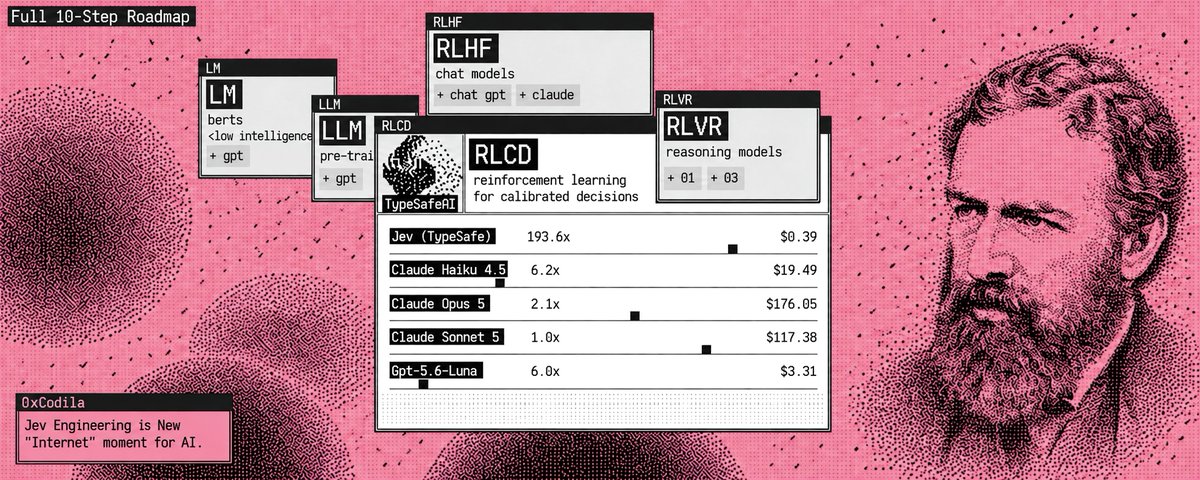
Jev is the "Internet" moment for the AI industry
It tells your agents and LLMs what to do next, in milliseconds and at almost zero cost
If you set it up correctly, you will have the AI engineer’s stack for 2028
In this article, I show you how

Chavi retweeted

Anthropic engineer:
"You can build 5 assistants in one afternoon. Each one handles a task you've been doing manually every single day."
In 45 minutes he shows exactly how to do it from scratch, step by step.
Most people are still doing all of this by hand.
Watch the session, then save the guide below.


Chavi retweeted

This is actually useful.
LangChain just released OpenWiki.
It's an open-source agent that creates a wiki for your codebase, connects it to your coding agent, and keeps it updated as your repo changes.
Your AI coding agent gets long-term repo context without stuffing everything into CLAUDE.md.
Here's how to setup. Save this.
Chavi retweeted

O CEO do Obsidian criou skills oficiais para o Claude Code e quase ninguém viu ainda.
Seu agente aprende a escrever Markdown correto, gerenciar bases, editar canvas e limpar páginas da web para economizar tokens.
Salva antes de perder e comenta se já usa Obsidian com IA.
Chavi retweeted
Claude Code está armado sobre una arquitectura bastante clara.
Tiene 5 capas:
1) CLAUDE.md → memoria persistente (reglas, arquitectura, contexto base)
2) Skills → conocimiento modular que se activa cuando hace falta
3) Hooks → control y calidad a nivel sistema (no depende del prompt)
4) Subagents → delegación con contexto aislado
5) Plugins → distribución de todo eso al equipo
Estas 5 capas forman el core del agente.
Alrededor de eso:
MCP → integraciones (APIs, DBs, SaaS)
Agent Teams → ejecución en paralelo y coordinación
Cómo funciona en la práctica:
definís reglas → agregás conocimiento → asegurás calidad → delegás tareas → lo compartís con el equipo

Claude Code ships with 5 architectural layers most engineers never open.
Not features. Not settings. Layers — each solving a distinct problem that LLMs alone can't solve. And four of them have nothing to do with prompting.
Here's the full Agent Development Kit:
Layer 1 — CLAUDE.md → The Memory Layer
Architecture rules, naming conventions, test expectations, repo map. Always loaded. Always active.
Two scopes:
• ~/.claude/CLAUDE.md → global
• .claude/CLAUDE.md → project
This isn't context you paste in before every session. It's context that never needs repeating. The agent's constitution.
Layer 2 — Skills → The Knowledge Layer
Each SKILL.md carries a description. Claude matches it at runtime and forks the skill into an isolated subagent. On-demand, never always-on.
Task-specific knowledge without inflating your main context window. Modular by design.
Layer 3 — Hooks → The Guardrail Layer
PreToolUse → PostToolUse → SessionStart → Stop → SubagentStop
This is the layer most teams skip. And the one they regret skipping first.
Hooks are NOT AI. They're deterministic event-driven shell commands.
• Auto-lint on every Write
• Hard-block on rm -rf
• Slack notification on Stop
Event fires → Matcher checks → Command runs
Quality enforced at the infrastructure level. Not the prompt level.
Layer 4 — Subagents → The Delegation Layer
Each subagent gets its own context window, model, tools, and permissions.
Main agent delegates down. Receives results up. That's it.
No infinite recursion — subagents can't spawn subagents. Main context stays clean. Hard boundaries by design.
Layer 5 — Plugins → The Distribution Layer
Bundle your skills + agents + hooks + commands into a plugin. One install. Whole team inherits the behavior.
Think npm packages — but for what your agent knows how to do.
Wrapping everything:
→ MCP Servers on the left (GitHub, databases, APIs, custom integrations)
→ Agent Teams on the right (parallel execution, message passing, shared permissions)
The 5-layer stack in one line:
CLAUDE.md sets rules → Skills provide expertise → Hooks enforce quality → Subagents delegate work → Plugins distribute to the team
Most production failures in agentic systems trace back to one missing layer.
Which one is the gap in your current setup?

Chavi retweeted

KUBERNETES ALWAYS LOOKED OVERWHELMING UNTIL I FOUND THIS REPO
I remember staring at my first kubectl command like it was written in a different language
pods, deployments, services, ingress, PVCs everyone kept throwing terms around like they were obvious
they weren't obvious
I spent weeks watching tutorials that explained concepts but never made me actually build anything
then i found Fast-Kubernetes
no fluff...no 10-hour courses... just here's the concept, here's the lab, go run it yourself
you learn pods by creating them
you learn rollouts by breaking them and rolling back
you learn persistent volumes by setting up a real mysql pod with storage that survives restarts
that's how it clicked for me
the repo covers everything
▫️ pods, deployments, services, configmaps, secrets
▫️ daemonsets, stateful sets, persistent volumes
▫️ ingress, RBAC, taint-toleration, node affinity
▫️ prometheus + grafana monitoring setup
▫️ full kubeadm cluster from scratch
▫️ helm with jenkins, kubectl cheatsheet included
every single topic has a hands-on lab attached
if you've been putting off learning kubernetes because it felt too big this is where you start
→ github.com/omerbsezer/Fast-K…


Chavi retweeted
En Claude Code podés construir skills, hooks, subagents y MCP servers.
Pero, ¿cómo compartís todo eso con tu equipo o con la comunidad?
Con plugins.
Un plugin es una forma de empaquetar esas capacidades para que otra persona las instale y las use directamente.
¿Cómo se arma?
Es una carpeta con una estructura definida.
Tiene un archivo obligatorio:
.claude-plugin/plugin.json → define el plugin (nombre, versión y configuración)
A eso le sumás lo que quieras compartir:
- skills/<nombre>/SKILL.md
- agents/ → agentes (.md)
- hooks/hooks.json
- .mcp.json → MCP servers
Lo publicás en un marketplace (un lugar donde se distribuyen plugins). Hay uno oficial de Anthropic.
Otra persona lo instala desde Claude Code:
/plugin install <nombre-del-plugin>
Y Claude Code lee la estructura, registra las skills, activa los agentes y conecta los MCP.
Así, quien instala tu plugin pasa a tener tus skills, agentes y automatizaciones listas para usar.

Chavi retweeted
Escribí un artículo sobre los fundamentos de Claude Code.
Estuve semanas leyendo documentación, probando cosas y entendiendo cómo funciona por dentro.
Desde el Agent Loop hasta SubAgents, pasando por Skills, Hooks y Memory.
Todo eso lo reuní en este artículo.
La idea es que cuando lo termines, tengas un modelo mental claro de cómo funciona Claude Code.
Hay muchísimo contenido.
Ojalá te sirva.


Chavi retweeted

🚨 Most developers are using Claude Code wrong.
They open the terminal...
write a prompt...
and expect magic.
That’s not where the real power is.
Claude Code is actually a 4-layer AI engineering system:
1️⃣ CLAUDE.md → project memory
Architecture, rules, commands, conventions
2️⃣ Skills → reusable knowledge packs
Testing workflows, code review guides, deploy patterns
3️⃣ Hooks → deterministic guardrails
Security checks, enforced rules, automation
4️⃣ Agents → specialized sub-agents
Break complex tasks into parallel workflows
Once you structure these properly, something interesting happens:
Claude stops behaving like a chatbot.
It starts behaving like a real AI dev system.
Most engineers miss this because they jump straight to prompting.
But the difference between average output and production-level results usually comes down to setup.
If you're building with AI agents in 2026, learn the system — not just the prompt.
I made a Claude Code Starter Pack explaining everything.
If you want it:
Follow
Like + RT
Comment CLAUDE
I'll DM it to a few people.
Future AI dev workflows won't be prompt-first.
They’ll be system-first. 🚀
#AI #Claude #AIAgents #LLM #GenAI



Chavi retweeted
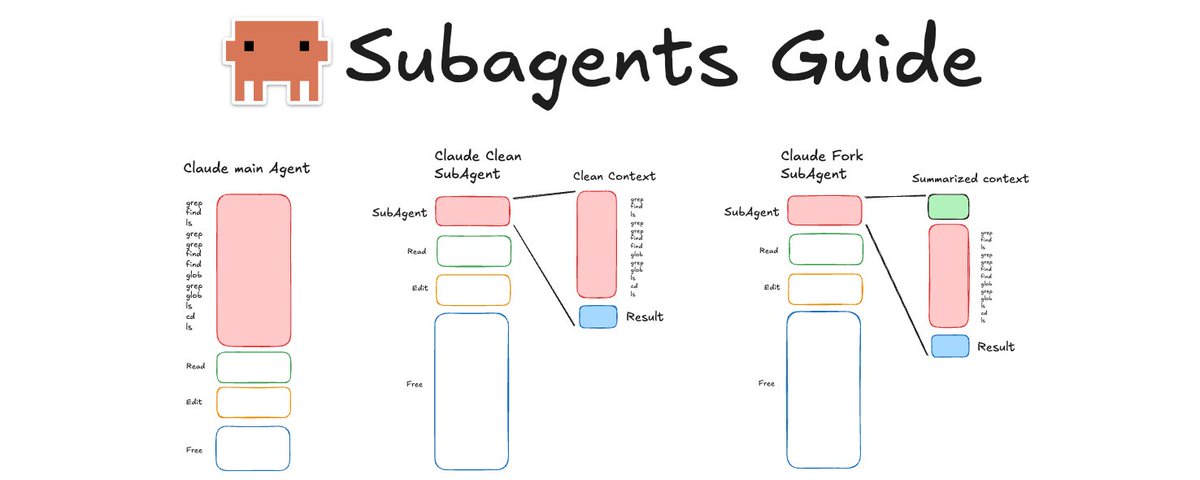
Cuando trabajás con un solo agente, todo pasa por el mismo context window.
Eso genera varios problemas:
1) el contexto se llena rápido (archivos, logs o diffs consumen muchos tokens)
2) las tareas se mezclan (analizar, implementar y revisar al mismo tiempo)
3) el razonamiento empeora (más ruido en el contexto)
Una forma de resolverlo es usar Subagentes.
El agente principal puede invocar a otro agente para resolver una tarea específica.
Cada subagente trabaja con su propio contexto, usa solo la información que necesita y devuelve un resultado o resumen.
Así, el agente principal pasa a actuar como orquestador: divide la tarea, delega partes del trabajo y después junta los resultados para generar la respuesta final.
Ejemplo: code review de un PR grande.
Con un solo agente:
tiene que buscar bugs, revisar calidad y analizar performance dentro del mismo contexto.
Con subagentes:
Subagente 1 → busca bugs y edge cases
Subagente 2 → revisa calidad del código
Subagente 3 → analiza performance
Cada uno trabaja con su propio contexto y devuelve sus conclusiones. Después, el agente principal junta todo y arma el review final.
Tradeoff: más tokens y más complejidad.
Pero en tareas grandes suele funcionar mejor, porque cada agente se enfoca en una sola cosa y el contexto se mantiene limpio.

Chavi retweeted

EL POTRERO Y LOS HUEVOS CONTRA LO MILLONES. LANÚS HIZO HISTORIA DE NUEVO EN EL CONTINENTE 🇱🇻🌎

