

Author of 'Mahabharata 3136 BCE: Validation of the Traditional Date' Write to [email protected] to get my books https://teapawt.net/t.co/0UEcqru0yw
India
Joined April 2011
- Tweets39.4K
- Following542
- Followers11.1K
- Likes15.6K






Pinned Tweet
Did Vālmīki ever say that the Rāma Setu ran north–south?
There are only two relevant references to the southern shore (dakṣiṇaṃ tīram / dakṣiṇaṃ pāram):
Sampāti tells the vānaras to proceed to the southern shore.
On reaching the seacoast, Rāma wonders how they can cross the ocean and reach the southern shore.
That is all.
Yet, interpreting the ancient geography through the lens of modern coastal orientations, researchers have often looked past the Rāma Setu, which runs broadly east–west, and shifted the search for Laṅkā and the Setu to locations far to the south—even towards the equatorial region or Gujarat.
But have they transported themselves to Vālmīki's geographical world? No.
Now, important scientific research is providing another perspective.
Bathymetric research of the Palk Strait by Dubey et al. indicates that the Palk region was not simply an open extension of the Bay of Bengal. It contained a vast freshwater reservoir, about 35 m deep and ~15,000 sq. km in extent, bounded by Rāmeśvaram, Pāmban, intervening shallow stretches of land and Talaimannar.
Those shallow stretches are significant. According to the research, people could have used this region as a causeway until around 7,000 years ago, before a sudden rise in sea level inundated its boundaries.
Now reconsider Vālmīki's words.
When Sampāti speaks of the southern shore, why assume he meant some distant southern coastline? The southern boundary of this Palk reservoir provides a much more immediate geographical meaning.
The vānaras, led by Aṅgada, had already traversed the coastal region. The southern shore offered the shortest practical route towards Rāvaṇa's Laṅkā in southern Sri Lanka.
When they reached Rāmeśvaram, however, the ancient pathway was no longer completely above water. Hence Rāma's question: How are we to cross the ocean and reach the southern shore?
The solution was the Setu.
And setu means a bund, embankment, causeway or structure enabling passage across water.
In this interpretation, Rāma was not constructing an imaginary bridge across the entire sea. He was strengthening or raising the shallow, partially submerged causeway across the Palk reservoir so that the vānaras could cross.
This also gives us a potential chronological marker.
If the scientific evidence indicates that the southern boundary of this ancient freshwater reservoir was inundated around 7,000 years ago, it provides an important environmental clue for dating the Rāma episode.
The point is not to force modern geography upon Vālmīki.
It is precisely the opposite:
Let Vālmīki's words lead us to the ancient geography—and then see whether geology and bathymetry support it.
More such evidence is discussed in my book Ramayana 5114 BCE: Decoding the Date and Myths.
Study the Bharateeya past through its own texts, geography and scientific evidence.
Our history deserves investigation—not dismissal.
#Ramayana_5114BCE


This video was created by my 10 year old granddaughter. Based on Valmiki Ramayana. Just compare this with Namith Malhotra's version.
Rama's Swayamvara: The Trial of the Divine Bow youtu.be/jwWK8whIBto?si=zTk8… via @YouTube
@praarabdh_in @anuradhasabha
Check the channel for other videos.
In the name of our god, they have made money.
Sell the news, then reality. They sold the news and made money. We are seeing the reality (ie the movie). But zero impact on the investors.

Whether we buy a ticket or not, Namit Malhotra’s team and the cast have already made huge gains in the stock market, riding on nothing more than the publicity glitz surrounding the Ramayana movie. The investors who bought into this hype are equally to blame. After all, hype has its beneficiaries, and the share buyers have played right into it.
Check this tweet teapawt.net/CommanMan777589/status…

Honestly, I would have preferred not to spend my money on a ticket for this movie. But seeing the comments and reactions, I was curious to witness the deviations from Valmiki Ramayana firsthand, especially as someone who has researched the epic extensively. Besides, having been invited for interviews about the movie, watching it became a necessity.

Watched Namit Malhotra’s Ramayana. A flop of a film being discussed only because it bears a superficial resemblance to the Ramayana! What is promoted is essentially a Dravidianist, feminist and socialist interpretation of a Ravanayanam.
Rama is reduced to a sorry figure, with a hunchback and an expressionless, stone-like face.
My 10-year-old granddaughter, who makes videos based on Valmiki Ramayana, refused to believe this was supposed to be the Ramayana and fell asleep halfway through!
That is a good sign: our younger generation may not take this movie seriously. But the danger is that unsuspecting foreign audiences, with no prior knowledge of the Ramayana, may mistake this fictionalised portrayal for the real epic.
#RamayanaMovie

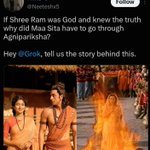
A hue and cry is being raised over the so-called Agni Pravesha being forced upon Sita by Rama. But was it really so? Grok seems to know better than the anti-Rama brigade!
And here’s another question they conveniently overlook: If Sita had actually entered the fire, how did she emerge without even a mention of burns, blisters or injuries in the Ramayana?
For the exact details of what really happened, read my book Ramayana 5114 BCE. Don't judge Valmiki through hearsay. Read the original!
Write to [email protected] to get a copy available at 20% discount.


In a debate on Ramayana and Ravana in Kumudam digital channel.
youtu.be/cvA1bFJoFng?si=16j3…

My heartfelt thanks to Smt. Vijaya Rao @viji22 for her thoughtful and remarkably detailed review of my book, Ramayana 5114 BCE.
Her observations span Rama’s birth chronology, Valmiki’s genealogies, the refutation of Aryan migration theories, Ravana’s ten heads, Pushpaka Vimana, ancient geography, flora and fauna, the Tamil connections and much more.
I am particularly happy that the book has prompted her to revisit Valmiki Ramayana and explore its historical depth. It is great to know that her family has renovated a Ram temple in their home town.
Ramayana is not merely an epic to be admired; it is a civilizational record to be studied.
Smt Vijaya Rao, thank you for reading it so closely and sharing your insights!
Presently the book is available at 20% discount. Please scan the QR code to know the discounted price and place the order.
#Ramayana_5114BCE


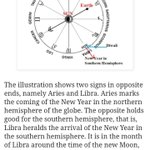
Diwali is not merely a festival of lights; its roots reach deep into the antiquity of Hindu civilization.
What does the astronomical evidence reveal about the long history of this sacred festival? Discover how ancient traditions preserve clues to our civilizational past.
Read my article:
jayasreesaranathan.blogspot.…

There is no Year Zero between 1 BC and 1 CE in the traditional Christian calendar. The BC/AD system was devised without a year zero, consistent with the absence of zero in the Roman numerical system. Astronomers later introduced Year 0 for computational convenience.
Interestingly, in Kali Yuga chronology, the Raudri year serves as the zero year in the corresponding year-counting framework. Kali Yuga counting began 5127 years ago, with an uninterrupted count that does not require a BC–CE break.
Different calendrical systems follow different epoch conventions. Unless these are properly reconciled, chronological calculations can go wrong by a year. Blindly converting Indian dates into BC/CE dates, without accounting for these differences, can therefore produce erroneous historical chronologies.

No 0 A.D either.
Beauty of Gregorian calendar !
How this jump affects other calendar system which counted from 0 like Maya or Indian?
@jayasartn
Soon, Twitter will be flooded with absurd scenes being passed off as the Ramayana, from the upcoming Ramayana film. Better read Valmiki Ramayana—or my book that encapsulates his version—before watching its cinematic reinvention!
👇read the first comment.

Hey @grok, did Jatayu ever visit Ayodhya or attend Lord Shri Ram and Mata Sita’s Swayamvar or wedding ceremony? Is there any mention of this in Valmiki Ramayana or other ancient Ramayana texts? Please fact-check with authentic scriptural references.🤔
The book 'Ramayana 5114 BCE' is available at 20% discount.
Paperback for Rs. 720
Hard- bound for Rs. 920
Scan the QR code to place the order.
Click here for the ebook version: amzn.in/d/05RKuaQT

As far as I know, no researcher has been able to match all the Panchanga details of Adi Shankara 's birth date. Those who attempted to date the events relied on Western astronomical simulators, which operate differently from the traditional calendrical system we follow.
Somehow remember the post and here is an interesting read 👇🏻
Book by @jayasartn addresses the anomalies with solid knowledge of #Panchang.
Beauty is every scholar is unanimous on Panchang details yet provide different "dates".


If Trump has the audacity to rename the Atlantic Ocean after himself as the “Trump Ocean,” why shouldn’t we demand that the Indian Ocean be renamed Indu Sagar and the Bay of Bengal Ganga Sagar? At least, these names have historical and cultural roots, unlike the name of a mortal whose tenure in power is limited to two terms. Civilisations endure; individuals come and go!
This quoted post is unavailable.
I received Ramayana – Part 2, authored by Sri @dushyanthsridar ji and was delighted to find that he has used my Ramayana Timeline. I consider this a significant acknowledgement of my work, coming as it does from a Vedic scholar well-versed in the Śāstras.
His endorsement of Rama Setu and Lanka in Sri Lanka sends a clear message to readers not to be swayed by alternative theories that place Lanka on the equator or in Gujarat. He also endorses Mahendra Giri in the now submerged Kavaatam as the mountain from which Hanuman crossed the ocean to reach Lanka, in accordance with Sugreeva’s description in the Vālmīki Rāmāyaṇa.
For those interested in exploring the minute, lesser-known and still-unexplored details of the Vālmīki Rāmāyaṇa, write to [email protected] to order your copy, or scan the QR code to place an order.
📚 Special Offer: 20% Discount!
My Rāmāyaṇa book (both paperback and hardbound editions), Mahabharata 3136 BCE, and Ramanuja Itihasa are currently available at a 20% discount.
Discover the evidence, chronology and insights that bring our Itihāsa traditions into sharper focus!


Durga Puja: Traces in Ancient Tamil Tradition
Durga worship has deep roots in Tamil literary tradition. The Silappadhikaram describes the worship of the Goddess as Mahishasuramardhini among the hunter communities, offering fascinating glimpses of ancient Tamil religious practices.
🔹 A young girl was adorned as the Goddess, with a third eye painted on her forehead, and worshipped as Kotravai, the warrior Goddess.
🔹 Songs, dances and rituals celebrated the Goddess who vanquished Mahishasura.
🔹 Sangam literature, including the Tolkappiyam and Pathitrupathu, preserves evidence of ancient Tamil traditions involving martial valour, weapons and worship.
🔹 These traditions invite us to explore the historical connections between Goddess worship, Ayudha Puja and the wider festival traditions associated with Durga.
Durga Puja should therefore be studied in the light of India's diverse regional traditions, including the rich literary heritage of ancient Tamilakam. The Tamil sources deserve wider attention in discussions of the antiquity and evolution of Durga worship.
Read the article: jayasreesaranathan.blogspot.…
#DurgaPuja


10 Million Reads — 1 Crore! 🎉
My primary blog, jayasreesaranathan.blogspot.…, has crossed 10 million (1 crore) reads!
A heartfelt thank you to all my readers for making this milestone possible. No promotions, no publicity campaigns—yet readers keep finding their way to my pages.
It’s simply வாவ் (Vaav!) — a moment of sheer wonder and gratitude! 🙏

Walter Russell’s vision of a universe governed by light, consciousness and rhythmic cycles evokes profound parallels with Vedic thought. What Russell claimed to have glimpsed in an altered state of consciousness echoes the cosmic truths revealed by Vedic seers millennia ago. Such insights may arise in deep meditative states, as the Vedic tradition recognises through the concept of Mantra-Drashtas—seers who perceived, rather than composed, the eternal truths embodied in the mantras. Russell’s experience thus invites us to revisit the profound possibilities of human consciousness that the Vedic seers had already explored and demonstrated through their revelations. #Vedic_Wisdom

In May 1921, American polymath Walter Russell entered a 39-day coma-like state, during which he claimed to have accessed “the source of all knowledge.” Upon awakening, he frantically wrote down what he had seen—pages filled with philosophical, scientific, and spiritual revelations that would later form the foundation of his manuscript *The Universal One*. Though he sent his findings to 500 leading minds of the time, nearly all dismissed him as mad—except one. Nikola Tesla, the visionary inventor, was so struck by Russell’s insights that he urged him to seal the work away for a thousand years, insisting that humanity was not yet ready for its truths.
Walter Russell’s revelations reimagined the very structure of reality. He argued that matter was not solid but crystallized light slowed by thought—that everything around us, from rocks to human bodies, was composed of light patterns, shaped by consciousness. He believed the universe was fundamentally mental, not material, and that all things moved in rhythmic cycles—expansion and contraction, like breath. He dismissed opposites like good and evil as illusions, asserting instead that everything sought harmony and balance. To Russell, death wasn’t an end but the release of compressed light returning to its source. Even time, he claimed, wasn’t linear, but a spiral where past, present, and future coexisted.
These ideas were radically ahead of their time, blending metaphysics, wave dynamics, and a deep sense of universal unity. He believed electricity was a living spiral of energy, not merely electrons in motion, and that the vacuum of space was in fact a vibrant sea of untapped potential. Health, in his view, was the natural rhythm of the body, and disease was simply a disruption of that flow. Though ignored or ridiculed during his lifetime, Russell’s work now draws new attention in an era where quantum physics and consciousness studies begin to echo the same questions. To many, he is no longer a forgotten eccentric, but a prophet of a paradigm yet to come.
-Golden Historical Images
