

Entrepreneur & investor across tech, culture, crypto, & AI. CEO @AtomicStrata & Partner Matador VC | Former @DSCVR1, Downey Ventures, @IDEO, @BMW | @Stanford
Venice, CA
Joined March 2008
- Tweets1.1K
- Following790
- Followers13.9K
- Likes1.8K





Juan Bruce retweeted

What does enterprise AI need before it can be trusted with real work?
Our founder @jbruce shares what Atomic Strata is building: governed AI context memory that enterprises can configure, inspect, and correct.
Watch our showcase with Imagination in Action @imaginationxyz @johnkwerner

Juan Bruce retweeted

From August 2021 through 2023, blockchains captured 90%+ of monthly crypto revenue.
By mid-2026, that share dropped to 25%.
The new breakdown:
🔸 Finance apps: exceeded 50% in most months
🔸 Consumer apps: steady meaningful share
🔸 Blockchains: down to ~25%
🔸 Physical and crypto infrastructure: rounding errors
The economic center of crypto moved from the base layer to the apps running on it.
Early cycles were infrastructure-focused because infrastructure was the only place value could accrue.
Users paid L1 gas fees because there was nowhere else for the money to go. Ethereum's high fees, Solana's spikes, Bitcoin's security budget drove revenue.
As blockchains became cheaper, more scalable, and more reliable, apps could finally support real users and capture their own revenue streams.
Finance apps (perp DEXs, lending protocols, stablecoin issuers, trading tools) earn fees from trading volume, not just gas.
Consumer apps (memecoin launchpads, wallets, social tools) turn engagement into sustained revenue as they find market fit.
The internet followed the same arc.
In the 1990s, ISPs and backbone providers made the money. By the 2010s, applications and platforms captured most of the value.
Crypto is following that path, faster and with full transparency because everything settles onchain.
You can't value L1s solely on the claim that they capture all fees anymore.
App-layer protocols have proven that lean teams can generate hundreds of millions in revenue across:
🔸 @HyperliquidX -style derivatives platforms
🔸 @Pumpfun -style consumer platforms
🔸 The wider DeFi stack
These products now capture economic surplus that once flowed almost entirely to validators and miners.
That diversification is healthy. Crypto no longer depends on one revenue source or one narrative.
The infra succeeded, which is why its revenue share fell. Finance and consumer apps now generate the majority.
That's where the next decade of value compounds.
h/t: @Blockworks

Juan Bruce retweeted
Agent memory without grounding just becomes context pollution.
Most memory stacks are append-only. No provenance or way to correct false beliefs, just more text crammed into your context window. Memory needs source tracking and update semantics so you can track each fact's source and edit what your agent believes and why.
Don't build on a black box.
github.com/atomicstrata/atom…

Juan Bruce retweeted

It’s well within Anthropic’s rights to compete in any market they choose.
What’s funny, in this instance, are the number of Pharma companies, who through their unchecked use of Anthropic, are driving revenues into what they think is a model provider but is in fact a competitor lurking in the shadows thereby accelerating their own demise.
I suspect any end market with reasonable ROCE that could be AI accelerated is on the table.
If I were them, I’d probably do the same.


Juan Bruce retweeted

Our thoughts on the importance of AI sovereignty.
1. Your AI sovereignty dictates your institution’s future. Sovereignty is the precondition for choice. Relinquishing sovereignty transfers the future choices of your institution to others, who are likely to exploit it for their gain and your loss.
2. Data retention is your treasure. Transfer it at your own peril. Your ability to win is dictated by your ability to recognize and use your unique edges, and you keep winning by compounding the underlying data to generate new insights. Transferring that data hands over access to your pre-existing winning plays and yields the means of production for new ones.
3. Tokenmaxxing hijacks your value orientation and decreases your institutional fortitude and intelligence. The pursuit of high token usage incentivizes disposable scripts over robust software — with the addictive feeling of false progress. There is a reason why those selling tokens refuse to charge based on value.
4. Controlling your weights is controlling your fate. Weights are the distilled form of hard-won, accumulated institutional knowledge. If you let others control your weights, you are allowing them to migrate the alpha of your business to theirs.
5. There is no contradiction between sovereignty and alpha. The architecture that maximally preserves sovereignty is one that enables institutions to own their tribal knowledge, and to compound it as alpha.
6. Politicizing the technical issues involving sovereignty is what your adversary wants. Techno-politicization is the wellspring of false sovereignty. Techno-politicization drives decisions that seem to reduce dependency, but ultimately limit agency — especially on the battlefield in the West.
7. Real expertise is existential. Allowing politics or favoritism to determine your technical decisions rewards whoever is best at politics, not whoever is right. Listen to those closest to the problems, not those speaking most compellingly about them.
8. Learn from institutions that are winning or that have consistently delivered. Institutions facing existential threats do not have the luxury of making technical decisions based on political preferences.
9. Only listen to institutions, countries, and people who have a proven record of being right. A track record of correctness is the best and only signal for future correctness. Judging something as right or wrong based on who you like is exceedingly misguided.
Juan Bruce retweeted

Legacy Media types are calling this Alex Karp interview a “crash-out” so that’s your first clue that he is actually saying something extremely insightful. He is articulating what real “AI safety” looks like in the enterprise.
Not abstract alignment research or certification by a government-run DMV for AI. Real AI safety for businesses is the ability to control their own data, model weights, and compute — so a frontier lab can’t hoover up their proprietary knowledge and turn it into their next product.
As Karp explains, technical customers want “control over their compute, their models, their data stack, and their alpha. They want to know they own the means of production, and it’s not being transferred to someone else.”
Don’t think that can happen? Just look at Figma. According to The Information, Anthropic “blindsided” its then-business partner with the launch of Claude Design. Figma’s founder said Anthropic had not been “consistently honest” with them. Anthropic’s chief product officer had even served on Figma’s board until three days before the launch of Claude Design. Figma’s stock has fallen sharply this year while Anthropic’s valuation has surged.
This isn’t an isolated example. Anthropic has launched Claude Science, Claude Security, Claude Legal, and of course Claude Code — each expanding into categories previously served by companies building on top of their models. The pattern is consistent: watch where value is being created, then move in directly. Dominate the model layer, then use that position to capture the most lucrative verticals.
Dario has argued that open source models powerful enough to compete with Anthropic are “dangerous.” But dangerous to whom? Not to enterprises that want to retain control over their data and workflows. Dangerous to a business model that benefits from customers having few real alternatives at the model layer.
As Karp exposes, true enterprise safety isn’t trusting that a lab’s future roadmap won’t include your business. It’s retaining the ability to choose — at the model layer — who gets to see and use your alpha.

Palantir CEO Alex Karp on what customers actually want, the real business of frontier labs, and the importance of open source models:
“What the technical customers want is control over their compute, their models, their data stack, and their alpha. They want to know they own the means of production, and it's not being transferred to someone else.”
"Who owns the data? Are the prompts secure? Is this being transferred to you?"
"If it was so valuable, and I can make you a billion dollars, wouldn't I say I'll make you a billion dollars and I want 30%? Why are they charging for tokens if it's so valuable?"
Juan Bruce retweeted
There's an underlying problem in AI memory growing stale over time and a bigger context window can't fix this.
Agents are designed to be intelligent but it keeps getting dumber about the same queries you make. Last week, it found the right sources and wrote a correct answer. This week, almost the same query but it ignored your previous correction and update, and repeated the same retrieval as last time.
AI's knowledge doesn't compound by default when you talk to it. We built LLM-wiki so that your agent isn't limited to a simple search & summarize.

Juan Bruce retweeted

Increasingly, I believe companies may need to be rebuilt from the ground up, where you have a single timeline of all observability + product metrics + file changes laid out in a retrievable system, like Datadog + Posthog + Google Drive + Slack (really unified filesystem of Claude Code chats + Codex chats). This might be the new data foundation for any and all companies to maximize AI. Needs to be rebuilt because keeping track of diffs on existing system basically impossible to produce longitudinal information on decisions and rollbacks, something coding agent storage companies are actively trying to figure out, but this should extend to businesses as a whole.
Highly skeptical existing businesses will adopt this though because it means overhauling everything about their instrumentation and business data, but I think businesses built on this foundation probably can execute 100x better and faster
Juan Bruce retweeted
This memory engine is built to be swapped. Not lock you in.
Memory providers will have you rewriting parts of your code tied to them to switch them out. This is what we built to avoid with Atomic Memory. The SDK is designed so that if you ever want to swap out the memory backend, you only touch the configuration. Your application code stays exactly as you wrote it.
Start building without the lock-in. ⬇️
github.com/atomicstrata/atom…

Juan Bruce retweeted

AI agents forget everything between sessions. @AtomicStrata built the open-source memory layer that fixes it. 1,300 GitHub stars since launch. @jbruce got inbound from JPMorgan's head of agentic within days.
Watch their pitch:
youtu.be/nVOKw_Z0-Yo?t=3193
Juan Bruce retweeted
Run a Smarter Memory Layer at
a Lower Cost for your AI Agents
Your agents inject their entire memory file into every prompt, whether it is relevant or not. Hermes native memory includes the full MEMORY.md every turn. OpenClaw carries full cross-channel context on every query. That is a fixed token cost you pay regardless of whether any of what it retrieves is useful.
Atomic Memory sits underneath both Hermes and OpenClaw and changes how memory gets injected. Retrieving only the facts the current query actually needs. Benchmarks show it does this at a lower cost per query than tools with comparable retrieval accuracy, which enables precise context injection without the token overhead.

Juan Bruce retweeted
Our benchmark is out for v66!
Atomic Memory delivers top-tier memory performance in each reported category while costing significantly less to run in real applications.
The case for switching makes itself 😉
github.com/atomicstrata/atom…

Juan Bruce retweeted
This is @_HermesAgent backed by Atomic Memory in a real work setup.
Every decision, update, and correction your team makes gets organized and stays inspectable across sessions.
Atomic Memory improves your Hermes agent by replacing the 2.2KB native memory cap with unbounded, per-turn memory that resolves contradictions before anything hits storage.
The memory layer your team actually needs.
github.com/atomicstrata/atom…
Juan Bruce retweeted

Watch LLM Wiki Compiler in action 👁️
An open-source tool inspired by @karpathy's pattern.
At SuperNet, we are constantly experimenting with the state of the art in AI context, including alternatives to conventional RAG memory.
Test it out and let us know your feedback!
github.com/atomicmemory/llm-…
Juan Bruce retweeted
At SuperNet’s Atomic Memory Lab, we spend a lot of time thinking about AI context — how context is created, structured, persisted, and reused across workflows.
We’re especially interested in alternatives to conventional RAG memory.
Today we open sourced LLM Wiki Compiler:
github.com/atomicmemory/llm-…

Juan Bruce retweeted

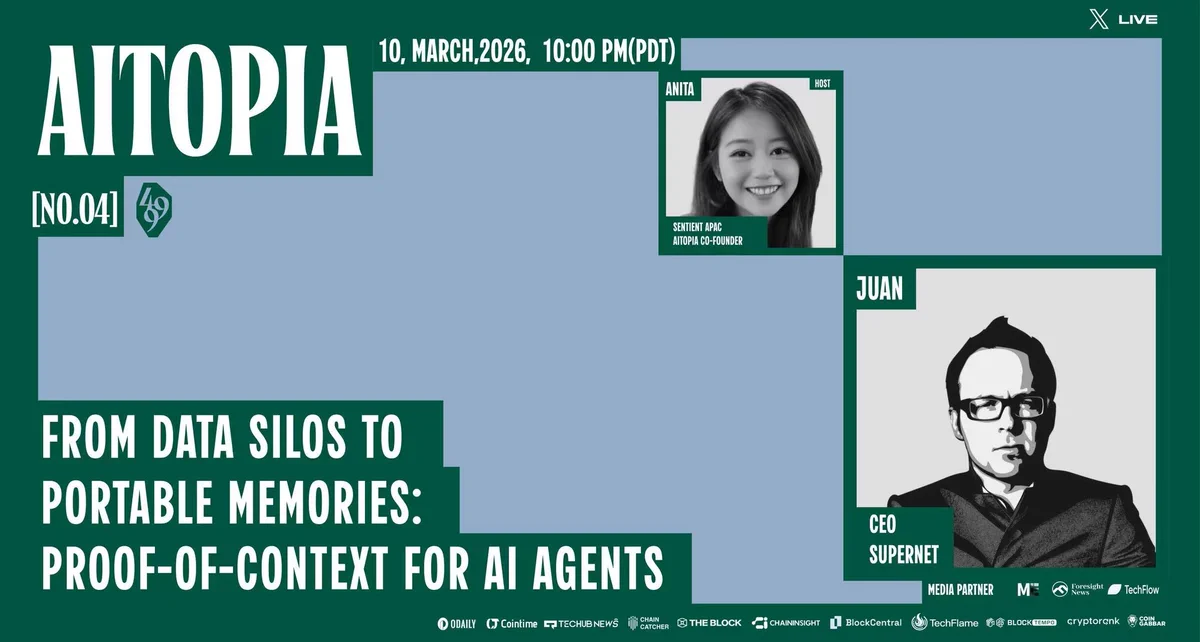
We’re very honored to welcome Juan Bruce (@jbruce), CEO of Supernet AI(@Supernet_AI), as the guest of this episode of AITopia, where we explore cutting-edge AI technologies and how Supernet is being applied in real-world building scenarios.
One of the hardest challenges in AI and agent interaction is memory. As conversations get longer, LLMs often become more prone to hallucinations, memory drift, or context confusion. This becomes even more complex when different models or agents are responsible for very different domains, such as one handling daily life and another managing financial tasks. In this context, the memory layer becomes the key to creating more unified, reliable, and optimized interactions.
That is exactly the problem Supernet AI is built to solve. During the conversation, Juan shared a number of fascinating real-world examples, including the recent OpenClaw trend. Supernet has also been internally testing SuperClaw, a new solution designed to seamlessly and securely integrate multiple agents into autonomous multi-tasking agents that better align with human needs.
The full podcast episode will be released soon.

If you’re curious about what happens when AI can actually remember.
Save the date. xitter.cf/i/broadcasts/1PKqrEaLN…
Juan Bruce retweeted

Jensen Huang, at Morgan Stanley's TMT Conference:
"OpenClaw is probably the single most important release of software, probably ever.
If you look at... the adoption of it, Linux took some 30 years to reach this level. OpenClaw has now surpassed Linux. It is now the single most downloaded open source software in history, and it took 3 weeks."

Juan Bruce retweeted
Hong Kong proved something: Context sovereignty isn't a niche concern. This is the next infrastructure primitive.
Thank you to our speakers:
@jbruce
@googlecloud
@elkun_peng - @theBBFund
@Anitahityou - @SentientAGI
@Leoninweb3 - @MeetHubble
See you next at ETH Denver // SuperNet Builder House 🏠


Juan Bruce retweeted

storytellers might be the most important asset in a company.
they’re the face, the translators, the ones who understand the business and the market.
protect your storytellers at all costs.
if you lose them, you lose the story and you lose belief- and that’s the most expensive thing to rebuild.