
Computational biologist. Policy & biosecurity at @TwistBioscience. Chair of the International Gene Synthesis Consortium
South San Francisco
Joined July 2026
- Tweets29
- Following481
- Followers29
- Likes2K

James Diggans retweeted

Today, we’re announcing an open call for guest investigators in life sciences. Over 8–12 weeks, guest investigators will work directly with my team and other Anthropic researchers to produce analyses and tools for their work. We’ll run our models and harnesses, at no cost to them. We’ll work together to open-source the resulting data, artifacts, and code, and write preprints about what we find.
We want humans to remain at the center of scientific discovery, deciding what questions to pursue, and how to pursue them. Those decisions are not ours to make alone. This open call is part of our ongoing efforts at Anthropic to support researchers and accelerate scientific discovery.
I’m looking for principal investigators and their research groups at academic institutions, nonprofits, or government labs, working in causal human biology, structural and computational molecular biology, medicinal chemistry, drug discovery, and clinical science.
Applications are open for about 14 days: anthropic.com/news/open-call…

James Diggans retweeted

Introducing Carbon-X: The best open DNA model.
We midtrained a 14B model on DNA and text, and it beats every open language model and matches GPT-6.1 Sol at 1,000x lower cost.
Ask it about a sequence, what a mutation does, or to generate new DNA.
huggingface.co/HuggingFaceBi…
James Diggans retweeted

Avengers assemble: 1 year BakerLab + NVIDIA GenAIR = 🔥 rfd4-proteina.org
Presenting RFD4-Proteina, our latest protein design model, significantly better and faster than everything we compared against, both in silico and in the lab! 1/30
James Diggans retweeted

Excited to share what we’ve been building with Chaperone!
In our benchmark, Chaperone reduced token usage by 86%. We also went from hypothesis to sequences ready for wet-lab testing in just two weeks—yielding a 1.32 nM cortisol binder in the first experimental round!

James Diggans retweeted

Five major databases of human surface proteins agree on only 188 of them. So we had Claude read the literature instead. Today @deliverome is releasing an open atlas of the accessible human surfaceome, with claims traced directly to quotes from their source 🎯
James Diggans retweeted

What if SI could help us better understand & design biology?
Two new Genesis Mission Phase II projects explore that potential: @UW Seattle will develop SI tools to design functional enzymes, and @UCSanDiego will expand RNA data to help engineer resilient crops and microbes.


James Diggans retweeted

Introducing Omnii-1, our most powerful genome language model, and a major step toward general biological intelligence
In a world first, Omnii-1 designed the first AI-generated bacteriophages to be administered to a human patient with an antibiotic-resistant infection under compassionate use
James Diggans retweeted

Public preview of BioEmu2! @MSFTResearch AI for Science’s new foundation model for biomolecular structure, dynamics and function. Open weights, MIT license.
github.com/microsoft/bioemu2
Movie: BioEmu2-simulated binding of intrinsically disordered peptide PUMA to MCL-1 receptor. 🧵⬇️


James Diggans retweeted
America didn't stop building physical things because we forgot how. We stopped because SaaS has 80% margins
If you want talented people to build physical things again, you must, at some level, root against the software industry

BREAKING: A developer used AI to build free, open-source alternatives to Microsoft Word, Excel and PowerPoint.
Brandon Thomas, creator of ArtCraft, a suite of free tools meant to replace Adobe’s apps, built GridCraft, DeckCraft and WordCraft with Anthropic’s Claude, per Tom’s Hardware.
All three are free to download on GitHub.
James Diggans retweeted

Today we're sharing an update on our diffusion method from last year, RFdiffusion3, in @ScienceMagazine. Notably, we show significant improvement in design of sequence specific proteases for amyloid sequences and metallohydrolases for pesticide degradation.
James Diggans retweeted

@FilippaLentzos and I just published a @BulletinAtomic (thanks, @MatthewField2!) article about @AnnieJacobsen’s recent book: “Biological War: a Scenario”.
You can read the article here:
thebulletin.org/2026/10/anni…

James Diggans retweeted

🧵 Biohub, @ENERGY, @NIH, and new funding partners today announced a major expansion of an international effort to generate and make accessible the data enabling predictive AI models of biology. Together, the organizations are investing $1.8 billion in funding, data, computation and new measurement technology - largest coordinated commitment to map the biology of the cell to power development of digital models of biology. bit.ly/3UhjoxD

James Diggans retweeted

A universal predictive model of the cell would dramatically accelerate science, allowing biologists to perform experiments digitally. Today we’re announcing a major partnership with the DOE and NIH. The goal of this partnership is to generate the data that will be needed to build an accurate model of the cell with artificial intelligence.
Isomorphic, Google DeepMind, and Meta are joining us as founding partners in the Virtual Biology Initiative. This is the beginning of a large scale coordinated effort to map cellular biology to power the development of digital models of life. Other leading scientific institutions and consortia including the Allen Institute, Broad Institute, Gladstone Institutes, the Human Cell Atlas, the Human Protein Atlas, the Wellcome Sanger Institute, as well as NVIDIA, are working together as part of this international scientific project.
Creating a predictive model of the cell is one of the most important challenges for the next decade of science. The insights that come from this could unlock a far greater understanding of disease, and open new paths for cures.
We invite the worldwide scientific community and other funders to join us in this effort.
James Diggans retweeted

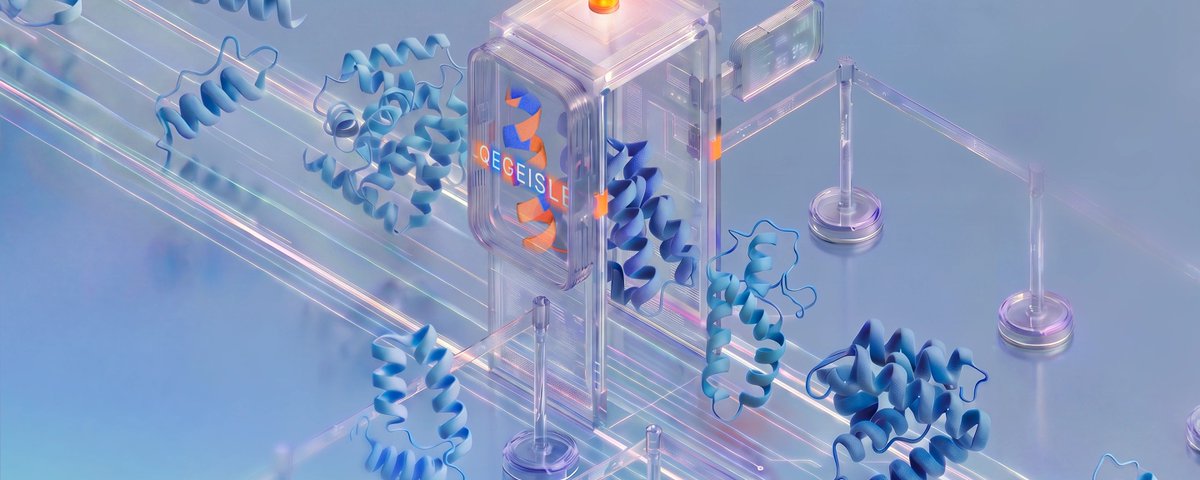
SynthID Bio is our new family of watermarking methods made for AI-generated biological designs.
In a world first, we can now embed an imperceptible signature directly into protein sequences without affecting their biological function. 🧵
James Diggans retweeted

Very happy to announce that our team @GoogleDeepmind has pushed the boundaries of generative biology, achieving the successful synthesis of AI-designed proteins that are both functional and watermarked.
This proof-of-concept watermarking of the building blocks of life is enabled by SynthID Bio, our new protein watermarking method. It is designed to safeguard the new era of AI-powered generative biology and strengthen global biosecurity.
You can read my thoughts here on why watermarking AI-designed proteins is an important research breakthrough: teapawt.net/pushmeet/status/210531…

James Diggans retweeted

Genomes are full of dark matter of unknown functions.
We present Minerva, a new method for discovery guided by genome language models. Minerva reveals the interactions hidden in non-coding DNA, pointing to hundreds of new putative RNAs and repetitive elements per bacterial genome. Minerva allows us to find and study elements invisible to traditional methods at orders of magnitude greater scale than before.
James Diggans retweeted
1/5 🧬 Today, our team @GoogleDeepMind is taking another step on our mission of deciphering the genome. We are releasing AlphaGenome Atlas, a massive (petabyte-scale) resource containing AlphaGenome predictions for every possible single-letter DNA change in the human genome — 9 billion in total.
deepmind.google/blog/alphage…

